

In the “Psychology Talks from Existence to the Search for Meaning” program, where Ramadan was discussed, Prof. Dr. Nevzat Tarhan emphasized that Ramadan is an important period for people to remember their servitude to God. Tarhan stated that the ego desires endlessly, is greedy, insatiable, boundless, irresponsible, and like a wild horse, adding that Ramadan is a crucial period for disciplining the ego. Tarhan said, “If we give command to the heart, we will be on the good side; if we give command to the ego, we will be on the side of evil.”
Content
Prof. Dr. Nevzat Tarhan: “If we give command to the ego, we are heading in a bad direction!”
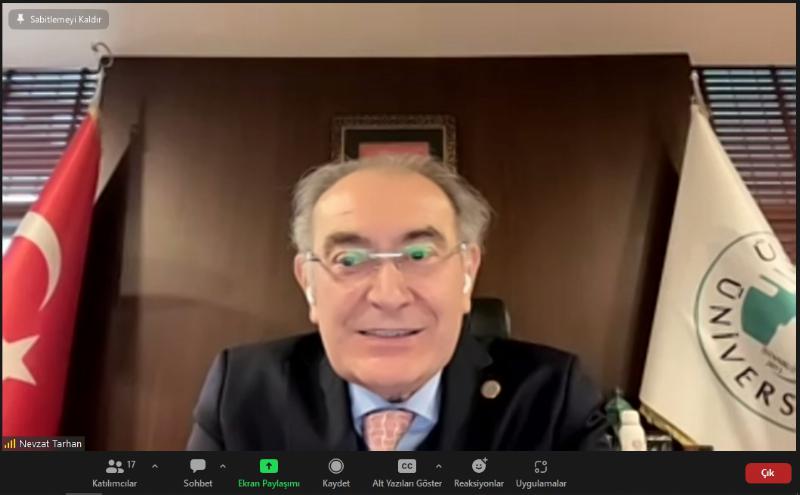
This week, the holy month of Ramadan was discussed in the Psychology Talks from Existence to the Search for Meaning with Uskudar University Founding Rector Prof. Dr. Nevzat Tarhan, organized by the Conscience of the Age Club with the support of the Uskudar University Health, Culture and Sports Department.
“If there were no fasting, it would not be understood how dire hunger and poverty are”
Making striking evaluations regarding the month of Ramadan, Tarhan emphasized that this important period is a time of social awareness. He stated that if there were no fasting, it would be impossible to understand how dire hunger and poverty are. Tarhan said; “God invites the rich to help the poor, meaning the rich are tested by helping the needy. The poor, in turn, are tested by not rebelling against their situation, by being patient, and by working. The rich can fully comprehend the pitiful conditions and hunger of the poor through the hunger experienced during fasting. If there is no fasting, how dire hunger and poverty are, and how much those in such situations need compassion, cannot be understood. In fact, that compassion is also a form of gratitude; when we say 'gratitude', we always understand the word 'alhamdulillah', whereas showing compassion, helping someone who has fallen, and assisting someone in need are also forms of gratitude. A beautiful example in our culture during Ramadan is going to the neighborhood grocer, taking the credit ledger, tearing out its pages, and paying the debts. Zakat is actually given once a year, but people time it to coincide with Ramadan for greater reward, as it is a blessed month. Zakat is a debt owed by the rich to the poor; zakat is not the property of the rich. When a year passes, one-fortieth of that money is the right of the poor. Unpaid zakat will be given to that person as a piece of fire; it is the right of a human. No one can go to God's presence with this. People mistake fleeting, temporary things for eternal ones.” he said.
“The Quran mandates virtue and zakat against global inequality”
Tarhan stated that compassion and mercy strengthen social bonds, and highlighted some rules implemented by Islam, such as the prohibition of interest, to prevent global inequality. Tarhan said; “With Ramadan, compassion-enhancing practices lead to the rich noticing the poor, and the poor not harboring resentment, anger, or hatred towards the rich. The mentality of 'What do I care if someone else dies of hunger!' is the biggest cause of social chaos, conflict, and rebellions. Today, global inequality is at an extreme level. At the World Economic Forum 2019 meeting in Davos, three dangers awaiting the world were identified: loneliness, climate change, and global inequality. The Holy Quran mandates virtue (mürüvvet) and zakat against global inequality. This means you either put your money to work or pay zakat. In such situations, people are forced to make their money work, fearing it will dwindle if idle, thereby forcing themselves into economic activity. The 'you work, I'll eat' logic, however, leads to interest. With the interest money earned, one travels the world, enjoys, and does not work at all, while in another sector, many companies work day and night to pay off the interest they owe, and go bankrupt for this reason. Economies collapse due to interest, people go bankrupt, and states go bankrupt due to their debts. Islam also brings the prohibition of interest against this danger, which is a rule regulating social life. Especially during Ramadan, it creates a ground to draw attention to this.” he stated.
“If we give command to the heart, we go in a good direction; if we give command to the ego, we go in a bad direction”
Tarhan stated that awareness should be created regarding controlling the ego during Ramadan, emphasizing that if we give command to the heart, we will go in a good direction, but if we give command to the ego, we will be on the side of evil. Tarhan said; “The ego desires endlessly; it is greedy, insatiable, boundless, and irresponsible. The ego ceaselessly desires like a wild horse. The ego desires, but the soul, connected to conscience, tells the ego to stop, to brake. The heart and soul are on one side; the ego and Satan are on the other, creating a balance. Reason tells us not to obey the ego; reason synthesizes here, we use our partial free will with reason. The inclinations of Satan and the ego are malevolent inclinations, while the inclinations of the soul and heart are benevolent inclinations. With our reason, we choose one of these inclinations. If we give command to the heart, we go in a good direction; if we give command to the ego, we go in a bad direction. Reason merely allows us to choose; if it gives command to the heart, you stay away from error by connecting with God. If you give command to your ego, it is self-serving, greedy, and never satisfied. It has recently been understood that positive and negative emotions are divided into two in our brain; if a person says something that comes up is from good feelings, it goes to the brain's positive files; if they say it is bad, it goes to memory files related to bad behaviors, and accordingly, chemicals in the brain become active. If one thinks of it as malevolent, avoidance and fear arise. If one thinks of it as benevolent, compassion and cooperation occur, and the brain begins to secrete hormones related to it. We actually receive the upfront payment for thinking good or bad in this world.” he said.
“In Ramadan, everyone from the rich to the poor understands that they are not masters!”
Tarhan conveyed that in Holy Ramadan, everyone from the richest to the poorest remembers that they are not masters but rather servants (abid). He said; “Modern humans eat insatiably, live in luxury, and throw half of it in the trash. They usurp the rights of the poor. If your neighbor is hungry and you throw half your food away, the one who bestowed these blessings will hold you accountable. The Messenger of Allah says, 'He is not one of us who eats his fill while his neighbor is hungry.' In Holy Ramadan, the ego of everyone, from the richest to the poorest, understands that they are not masters, but servants (memluk)! It tells the ego, 'You are not a master, you are a servant; you are not free, you are a worshipper.' Emotional intelligence training, under the name of Positive Psychology, has begun. The most important thing it teaches us is that a person does not become spontaneously helpful unless expected, nor does a person become spontaneously good unless expected. The universe, family, society, the system, the education system, and the state must expect them to be good people; if not, when a person is not educated and is left to their natural course, they become malevolent. Positive psychology tells us this. A person needs to be commanded to do good. That is, their parents and the education system must approve of them being good. Only then will the person know their own limits and the limits of others, not usurp the rights of others, and curb greed, insatiability, and boundlessness. Ramadan provides this. In Ramadan, the month reminds people of the thought: 'There are hungry and poor people, I must know my limits. I am not the master, this property is not mine. I am a guest here.' Adopting one's servitude and worship, remembering that they are a servant rather than playing the role of an earthly god, leads to true gratitude. If one adopts their servitude and embraces their worship, and can prostrate their head, then prostrating one's head means feeling one's helplessness and weakness before Allah.” he stated.
“Our desire for immortality is proof that there is life after death”
Tarhan emphasized that there is a causal link between our mind, heart, emotional world, and eternity, and pointed out that desires for perfection and immortality prove that there is life after death. Tarhan said; “Evil was created for the understanding of good. Therefore, if there is no justice in this world right now, then there must be a Great Supreme Court after this world; if not, this world has no meaning. In this world, evil often goes unpunished for many people, and many good people die as victims. If there is no life after death, there is no justice in this world. It is against reason and conscience for the creator of this world to make such an unjust thing. Therefore, since He gave us the desire to ask, He must have wanted to give us eternal life. Our faculty of reason, our faculty of heart, our faculty of emotion, our desire for eternity, perfection, and immortality are proof that there is life after death. Just as the existence of hunger in our stomach is proof of food, if there is a causal link between them, there is a causal link between these faculties in us and the eternal realm. Therefore, with methods of reasoning, we can find God, understand the afterlife, understand why we worship, the necessity of worship, and strongly believe, almost certainly, in the existence of eternal life. We see this with the eye of reason. God does not show it with the physical eye as a secret of test. But He gave reason, saying, 'Seek and you shall find'; a hint is enough for the discerning... God has given that much of a hint. Destiny says, 'You have to put in some effort; it's not like pears will just fall into your mouth.' He gives respite, but does not neglect. They asked Hz. Ali; 'You worship so much, what if God doesn't exist?', and he replied; 'If He doesn't exist, I lose nothing from my worship and servitude. I am happier, more at peace.' What God asks for are not things we cannot do. He says you will be moral, honest, conscientious, fair, mindful of others' rights, and not eat forbidden things. He says, 'I gave you 24 pieces of gold; spend 1 of these 24 in worship for Me.' There are 24 hours in a day, 'spend 1 hour in worship, this is what I want; outside of this general framework, you are free'.” he said.
Share
Update Date: March 01, 2026
Creation Date: April 11, 2023
Request a Call
Other News
- The book that read today's digital threats in 2014: Being a Conscious Family
- Experts warn: 'Instead of memorizing letters, teach pencil grip, scissor use, and coloring'
- School fear and school love both start in the family!
- Family is not merely transforming, it is being battered under a serious assault
- Artificial intelligence opens the door to early diagnosis in autism!