

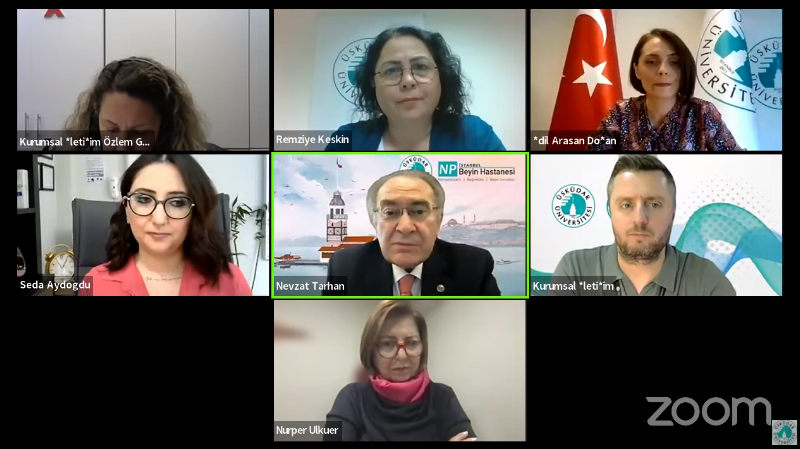
At the April 23 World Baby, Child and Adolescent Mental Health Day Panel, organized online by Üsküdar Üniversitesi, attention was drawn to the importance of baby, child, and adolescent mental health. Üsküdar Üniversitesi Founding Rector, Psychiatrist Prof. Dr. Nevzat Tarhan, stated that contrary to expectations, the pandemic process affected children and adolescents, not the elderly age group. Tarhan warned, “It was observed that children and adolescents were the most damaged group by the pandemic. Adolescent cases significantly increased in child psychiatry clinics.” Tarhan underlined that if family ties were strong, this situation could turn into a gain for children, but in families with unhealthy ties, parents rejected their roles, viewing approaches such as spending time with and loving their child as a burden. Prof. Dr. Tarhan also noted that children tend to become products of popular culture and that measures should be taken.
Content
Prof. Dr. Nevzat Tarhan: “Children and adolescents were most damaged by the pandemic”
“Spending time with children is seen as a burden”
International non-governmental organizations formed by scientists working in the field of child mental health worldwide came together and designated April 23 as World Baby, Child, and Adolescent Mental Health Day. At the April 23 World Baby, Child and Adolescent Mental Health Day Panel, organized online by the Üsküdar Üniversitesi Mother and Baby Mental Health Application and Research Center, attention was drawn to the importance of baby, child, and adolescent mental health.
Prof. Dr. Nevzat Tarhan: “It was very meaningful and beautiful that this decision coincided with our national holiday”
Üsküdar Üniversitesi Founding Rector, Psychiatrist Prof. Dr. Nevzat Tarhan, stated in his speech at the panel that the Mother-Child Mental Health Center has been carrying out various activities within the university for several years. Tarhan said, “We identified global trends in the world. We identified the psychological needs of young people and children. While planning to inform the public with scientific studies and noting the need for parent education, a positive development occurred. By the joint decision of organizations working on mental health worldwide, April 23 was declared World Baby, Child and Adolescent Mental Health Day. It was also very meaningful and beautiful that this decision coincided with our national holiday.”
Tarhan: “If we lose our local distinctiveness, our children become children of colonization”
Emphasizing that national holidays are days when a society's national values are experienced and transmitted, Prof. Dr. Nevzat Tarhan continued: “Our cultural identity is organic, meaning living structures. We will take from the past, synthesize with today, and pass it on to our children. In this way, it is important to transmit our values to our children, that is, to be 'us' while remaining 'me' globally, and to exist in the world by preserving our own identity. We cannot be universal without being local. This is a rule. If we abandon our local distinctiveness, we become objects of global imperialism, and our children will not be truly ours. They become children of colonization, manipulated by global capital groups. However, only children with national values, national ideals, and national aspirations can protect their own cultures in such situations.”
Prof. Dr. Nevzat Tarhan: “Our children tend to become products of popular culture”
Pointing out that many cultures will disappear in 50 years if the world continues this way, Prof. Dr. Nevzat Tarhan said, “Popular culture tends to manage economic, social, and cultural mobility worldwide through a consent-based system. Accordingly, our children tend to cease being ours and become products of popular culture. As a result, we face a situation where we lose many of our values, and effectively, our own identity. This situation is valid not only for us but for the world as well. The declaration of April 23 in this manner could be an opening for the solution of this problem.”
Prof. Dr. Nevzat Tarhan: “Children and adolescents were most affected by the pandemic”
Prof. Dr. Nevzat Tarhan emphasized that the world experienced a serious crisis after the pandemic and continued: “Children and adolescents were most affected by the pandemic. It was expected that individuals aged 65 and older would be most affected by the pandemic. However, it was observed that children and adolescents were the most damaged group. We are observing this significantly in child psychiatry clinics. Adolescent cases have increased considerably. Hospitalizations have also risen. If family ties were strong, this situation could turn into a gain for children, but in families with unhealthy ties, we frequently encountered cases where mothers and fathers rejected their roles. The mother has every means, fulfilling all physical needs, but rejects the mother's role. She views approaches such as spending time with her child, loving, smelling, and feeding them as a burden. We observe this becoming widespread globally.”
Prof. Dr. Nevzat Tarhan: “There must be continuity of love between mother and child”
Stating that no one can replace a mother for a child aged 0-3, Prof. Dr. Nevzat Tarhan said, “The relationship with the mother or the mother substitute must be permanent, consistent, and continuous. In psychology, we call this object constancy. If love is not continuous, if it changes frequently, in such cases, child mental health does not develop healthily. If we want healthy child mental health development, we need to ensure object constancy. When a child stays with their mother one day, at daycare another day, and with a caregiver on another day, even if their physical needs are met, their spiritual needs cannot be met. Therefore, there is a need for social awareness and parent education. As a university, we produce knowledge and present it to the scientific flow with its evidence to inform society, but we also expect those who determine health policies and child mental health policies to properly utilize this information.”
Prof. Dr. Nevzat Tarhan: “Let our children be subjects, not objects, of global culture”
Stating, ‘Let our children be subjects, not objects, of global culture,’ Prof. Dr. Nevzat Tarhan said, “Let our children not be victims of narcissism that works only for themselves and spreads globally. It is very important that we raise children who say, ‘I must contribute something’ to the society we live in, to our country, to our homeland, and even to the planet. This is possible when a child aged 0-3 is with their mother and family. We must have a mission to strengthen the family. Therefore, these issues are a priority for us.”
Prof. Dr. Nevzat Tarhan: “A child subjected to emotional neglect does not grow”
Touching upon the concept of learned autism, Prof. Dr. Nevzat Tarhan continued: “It’s as if there’s learned autism. Social media causes non-verbal learning difficulties in our children. When we say non-verbal learning difficulties, we mean a generation that is good at mathematical learning and acquiring technical skills, but cannot learn social and emotional skills. What does it mean to have a generation that cannot learn social and emotional skills? We are talking about a generation with non-verbal learning difficulties. Our youth are facing a situation that somewhat falls into the autism spectrum. The spread of autism, becoming an epidemic, is not a coincidence. There is a global autism epidemic. Cases are increasing. Those with a genetic dimension are in a higher risk group. The main problem is an environment that cannot teach children fine motor, gross motor, social, sensory, and emotional skills. There is emotional neglect in children. They are physically fed, given drinks, and clothed, but if there is emotional neglect, growth in the child stops.”
Prof. Dr. Nurper Ülküer: “Atatürk continues to inspire the world even after 100 years”
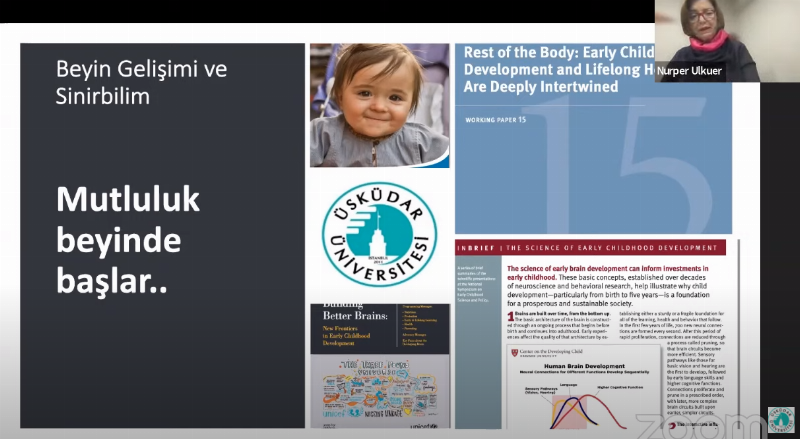
Üsküdar Üniversitesi Faculty of Health Sciences, Head of Child Development Department, Prof. Dr. Nurper Ülküer, also stated in her presentation titled “Developing Parents-Happy Children” that it was very meaningful and proud that World Baby, Child, and Adolescent Mental Health Day was declared on the same day as April 23 National Sovereignty and Children's Day. Prof. Dr. Nurper Ülküer said, “Atatürk set an example for all nations of the world as a leader who gifted a holiday to children and continues to inspire, even after 100 years. This is a great honor.”
Prof. Dr. Nurper Ülküer: “The brain changes with experiences”
Stating that scientific studies in the field of brain and neuroscience reveal that happiness begins in the brain, Prof. Dr. Nurper Ülküer said, “The brain is not yet mature at birth. The brain changes with experiences. The quality of a young child's relationship with their caregiver is paramount. Negatives affect brain development. The brain is built over time. The formation of brain architecture follows a hierarchical order. The foundation is important. Skill brings skill. The development of a high-level skill becomes difficult if the previous lower-level connections have not fully established.”
Prof. Dr. Nurper Ülküer: “Interaction between baby and parents is very important between 0-3 years old”
Pointing to sensitive periods in brain development, Prof. Dr. Nurper Ülküer said, “The period from 0-3 years is when language learning, habits, and emotional control are fastest, and one is most open to environmental stimuli. Emotional control is one of the most important issues for a child's mental health. Harvard University research and other neuroscientific studies emphasize that early childhood experiences and stimuli a child receives from their environment affect the child's brain structure, and this lasts a lifetime. Therefore, mother-baby, father-baby, family, and caregiver-baby interactions are very important. Negative childhood experiences during this period pave the way for mental and physical problems that will emerge in later years of life.” Ülküer underlined that negative childhood experiences also include neglect, abuse, domestic violence, social mobility such as war and migration, pandemics, and poverty.
Prof. Dr. Nurper Ülküer: “Nurturing care forms the foundation of brain development”
Touching upon the concept of “nurturing care,” Prof. Dr. Nurper Ülküer emphasized the importance of a responsive and reciprocal nurturing parent-child relationship. Prof. Dr. Nurper Ülküer said, “The capacity of the primary caregiver for infants and young children in infancy and early childhood is directly linked to a safe home environment. A child's first learning environment is shaped by the home environment. Therefore, relationships within the home and the quality of the home environment directly affect development. The most formative experiences of young children come through nurturing care. Nurturing care forms the foundation of a baby's brain development. Nurturing care is the totality of basic conditions consisting of children's healthy growth, nutrition, being in a safe environment, receiving responsive and sensitive care, and opportunities for early learning.”
The panel, which was attended by Expert Clinical Psychologist Seda Aydoğdu from Üsküdar Üniversitesi NP Feneryolu Tıp Merkezi with her presentation titled “The Place of Child Mental Health in Our Future,” was broadcast live on ÜÜ TV and Üsküdar Üniversitesi's official YouTube account.
Share
Request a Call
Other News
- The book that read today's digital threats in 2014: Being a Conscious Family
- Experts warn: 'Instead of memorizing letters, teach pencil grip, scissor use, and coloring'
- School fear and school love both start in the family!
- Family is not merely transforming, it is being battered under a serious assault
- Artificial intelligence opens the door to early diagnosis in autism!