

Founder Rector of Üsküdar Üniversitesi, Psychiatrist Prof. Dr. Nevzat Tarhan, made evaluations regarding the earthquake and its traumatic effects on Kanal 7 Main News live broadcast. Tarhan stated that the feeling of hope under the rubble is very important for a person to hold onto life, saying, “If a person loses the feeling of hope, the brain resents it; when the brain resents, it starts not to produce defense-related chemicals, and the body rapidly collapses. Because the basic human instinct is the survival instinct; without this feeling, one would want to die.”
Content
Prof. Dr. Nevzat Tarhan: “The brain resents those who lose hope!”
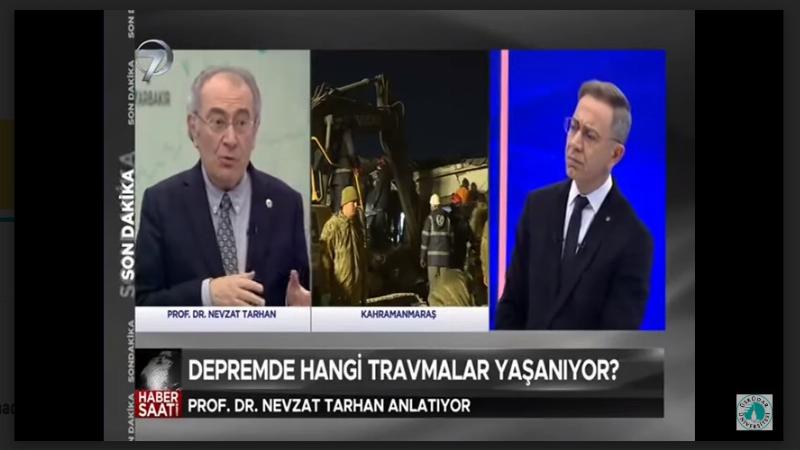
Answering Tümer Doğru's questions on Kanal 7 Main News, Üsküdar Üniversitesi Founder Rector Prof. Dr. Nevzat Tarhan made important remarks regarding the shock period of earthquake trauma…
Those currently experiencing the most intense shock are those who never saw such an earthquake as an option…
Prof. Dr. Nevzat Tarhan; “The characteristic of the shock period is that a person usually experiences that shock emotion gradually; the brain secretes excessive cortisol-stimulating hormones, and the person becomes blocked as soon as possible… For example, when a person's arm breaks, it hurts, they can't move it; similarly, you can't operate your brain, you wander around looking blankly and meaninglessly. The same applies to a person whose relatives are under the rubble; they wander around doing nothing because their brain is blocked. So much so that even deaths can occur due to sudden panic and fear. Some people overcome the short-term shock and immediately take control. These people are generally those who are prepared for crises in advance…” he said, sharing insights about the post-earthquake trauma.
Evaluating the earthquakes experienced in Japan and that region, Tarhan said, “Japanese people receive crisis management training, they give earthquake alarms at certain intervals, they conduct reminders and training related to earthquakes, and in such situations, a person knows what to do when an earthquake or a shocking event occurs. Those currently experiencing the most intense shock are those who never expected it, those who never saw such a thing as an option, and those who experienced an earthquake before and still haven't overcome that trauma. People who have resolved their trauma, however, immediately turn it into an experience in such situations. For example, during the Yalova earthquake, I know everyone ran downstairs in a panic when the earthquake happened, but guests from Japan did the opposite; as the building collapsed, they went to upper floors to survive, which is related to their training or previous experiences.”
If a person loses the feeling of hope, the brain resents it…
Prof. Dr. Nevzat Tarhan answered the question, ‘What do people who remain under the rubble for hours experience psychologically?’ as follows: “Here, personality structure is very important; for example, people who are prepared, trained, and have stress management skills differ from others. Stress management is something unconscious; these are people who have experienced some difficulties in life before and received resilience training… They don't give up easily in the face of difficulties. For instance, commando training is like that; you are left on a mountain for days, told to meet your needs on your own, and then picked up after 3-5 days. There is a big difference between such a person being under the rubble and us being there.”
Stating that if a person loses the feeling of hope, the brain resents it, Tarhan, “When the brain resents, it starts not to produce defense-related chemicals and rapidly collapses; there are people who age overnight in such situations… Because the basic human instinct is the survival instinct; without this feeling, one would want to die. The survival instinct comes from creation. There is an example of two frogs that we use in therapy… Two frogs fall into a large cauldron of milk; one says, ‘I can't get out of this big cauldron,’ loses hope, and gives up… And dies. The other does not give up, does not lose hope, and struggles; something unexpected happens, a thick layer of fat forms, and then by stepping on it, it gets out of the cauldron and is saved.”
The world is not a ship drifting aimlessly in the cosmos; it has a captain, a power and will to which it belongs.
Prof. Dr. Nevzat Tarhan, stating that this world is not a ship drifting aimlessly in the cosmos, but that this ship has a captain, a high power and a high will to which it belongs, said that the belief in monotheism has an hope-increasing effect on an individual.
Tarhan pointed out that when the human brain normally doesn't sleep for 2 days, it produces a tremendous fatigue substance, and stated that there is a hidden potential in the brain; if a person does not fall into despair, their brain has a hidden potential to keep the person alive and give them energy for a much longer time.
Share
Update Date: March 01, 2026
Creation Date: February 16, 2023
Request a Call
Other News
- The book that read today's digital threats in 2014: Being a Conscious Family
- Experts warn: 'Instead of memorizing letters, teach pencil grip, scissor use, and coloring'
- School fear and school love both start in the family!
- Family is not merely transforming, it is being battered under a serious assault
- Artificial intelligence opens the door to early diagnosis in autism!