

Founding Rector of Üsküdar Üniversitesi, Psychiatrist Prof. Dr. Nevzat Tarhan, was the guest of an online interview organized by Çankaya Mufti's Office under the leadership of the Presidency of Religious Affairs. In the online program held for religious officials, Prof. Dr. Nevzat Tarhan made evaluations on the topic of 'Contemporary Superstitions and Various Religious Beliefs', emphasizing that it is not a bad thing for young people to be inquisitive in life. Stating that today's youth are not the same as the youth of 20-30 years ago, possessing much more information and approaching things inquisitively, Tarhan added that people sacralize causes. Tarhan said, “Before, idols and statues were worshipped; in this era, causes are worshipped. People attribute a divine power to causes.”
Content
Prof. Dr. Nevzat Tarhan; “Before, idols and statues were worshipped; now, causes are worshipped”
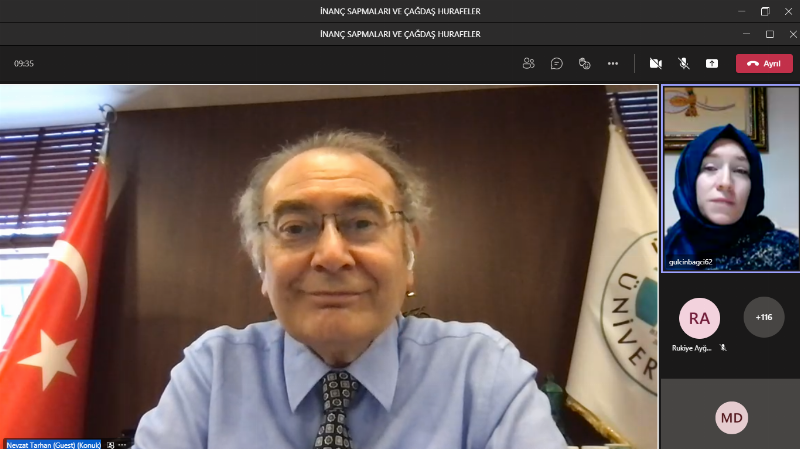
“In human psychology, there is a mind above the brain, and a soul above the mind”
Emphasizing the need to find new answers by adding different perspectives to the same topics in the program moderated by Gülçin Akan, preacher at Çankaya Mufti's Office, Prof. Dr. Nevzat Tarhan said; “In human psychology, there is a mind above the brain, and a soul above the mind. When we approach the subject this way, we realize that the questions of this era have changed. Old topics continue, but because the questions have changed, or rather, the ways in which they are asked have changed, new perspectives have emerged within the framework of some new information. The essence of the questions is the same, the topic continues in the same way, but the scenarios and actors have changed. In such situations, we need to write new and correct scenarios for old problems. We constantly have to change the life scenarios we learned in childhood in adulthood. As we age and new actors join our lives, the scenarios also change. For example, when we get married, the actors change; when we go to a workplace, new people change, and we rewrite new truths accordingly. That is why our Prophet Muhammad (PBUH) emphasized the coming of a mujaddid in every era. He said, 'Scholars are the inheritors of prophets.' What does this mean? We need to find, give, and expect new answers to questions posed according to the new situation from them. We need to find this answer together with them.”
“Before, idols and statues were worshipped; in this era, causes are worshipped”
Stating that Muslims in our age sacralize causes, Prof. Dr. Nevzat Tarhan said; “I observe that throughout Turkey, Muslims are Muslim only by name. Because their minds are full of shirk. For example, a Muslim person comes to us and says, 'Please, heal my son.' They ask, 'If you heal him, I will do this for you,' or 'Are you giving me a guarantee that he will recover?' It is my duty to look at all the causes for the patient to recover here, but whether they recover or not is up to divine healing. My duty is to resort to all causes within my power, this is my responsibility, my burden. But I say I cannot make promises about anything I cannot control. I cannot say 'I will heal' anyone, I cannot guarantee it, but I can do my best to heal, I say. However, they are not aware of this. That is why even a person who says 'I am religious' sacralizes causes. Before, idols and statues were worshipped; in this era, causes are worshipped. People attribute a divine power to causes. Laws are a cause. Archimedes' principle is a cause. But these are laws, they are written. These are written texts. They do not have enforcement powers. They are just written texts like a book. It is like a constitution book; it is useless without a legislature to apply it, without an executive to apply it.”
“A child takes three things as an example: the mother, the father, and the mother-father relationship”
Speaking about the importance of parents in a child's identity formation process, Prof. Dr. Nevzat Tarhan said; “Currently, the family has three open doors that it needs to protect itself from. Before there was one, now there are three: television, phone, and tablet. All kinds of information enter through these open doors in the insecure home environment. We call media social media, but it is actually virtual media. There are false relationships, false roles. Now, a false reality is also created here. Within this, young people entertain themselves by thinking about their current pleasures. However, what will a person's current pleasure be in five, ten, or twenty years? These also need to be considered; those who create these projects do not think about these. They only think about their own interests, but parents also have to think about their own interests. It is the period of the child's sexual identity. Identity can be ethnic identity, sexual identity. It can be social, religious identity. All these identities are formed and adopted during adolescence. During this period, a child takes three things as an example: the mother, the father, and the mother-father relationship. If the parent-child relationship is good, children do not easily turn to these things.”
“If parents act harshly, the child adopts a reverse identity”
Emphasizing that it is not a bad thing for young people to be inquisitive in life, Prof. Dr. Nevzat Tarhan said; “Today's youth are not the same as the youth of 20-30 years ago. They have much more information and approach things inquisitively. In fact, young people are not Generation Z as we fear. In other words, they are not a 'wrong' generation. Young people question. They just ask 'why' and 'for what reason'. For example, they ask why they should pray, not how to pray. We need to find an answer to this. When we provide an answer, even if children do not know Islam well, they can cite sources and try to persuade. When we dedicate time to our child, they are often convinced. When the child is not convinced, they see that the parents do not approve. When they see disapproval, they do not accept that information as approved information. If parents act harshly, the child adopts a reverse identity. They act in the exact opposite way to anger their parents. Clinically, families come to us saying 'the child became like this in terms of sexual identity, became an atheist,' and we see that the child has taken on a role contrary to the parents' inquisitive side. They are not acting out of belief, but enjoy irritating their mother and father. In such situations, parents should act like companions. They should say, 'I know enough about this topic, but let's read it together.' If they know, they will explain and not expect the child to accept it this way, nor disapprove.”
Reporter: Meryem Türk
Share
Request a Call
Other News
- Prof. Nevzat Tarhan: “Those with a mental filter are not afraid of the digital”
- Artificial intelligence doesn't eliminate the translator, it transforms their expertise!
- Social responsibility courses moved to the field
- Erasmus+ Orientation Week completed at Üsküdar
- Prof. Nevzat Tarhan: “Brain secretes ‘dark glue’ in social media lynchers!”