

Founding Rector of Üsküdar Üniversitesi Prof. Dr. Nevzat Tarhan was a live broadcast guest on Esra Erol's Earthquake Special program, aired on ATV. Tarhan made evaluations regarding 'The Traumatic Impact of the Earthquake' during the program. Tarhan stated that the shock effect period of the experienced earthquake is divided into two: before and after the earthquake, and said, “As Turkey, not only the earthquake victims but all of Turkey experienced secondary trauma. Many people started to question life as before and after the earthquake. This is the shock effect of the earthquake on people. We call the changes in individuals during the recovery period after this shock effect 'post-traumatic growth'. If we handle this process correctly, we will manage this trauma correctly.”
Content
Prof. Dr. Nevzat Tarhan: “All of Turkey experienced secondary trauma due to the earthquake”
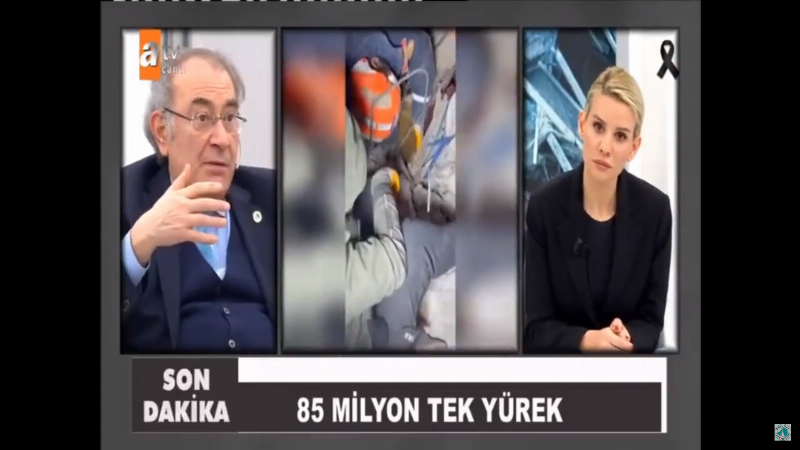
Psychiatrist Prof. Dr. Nevzat Tarhan, Founding Rector of Üsküdar Üniversitesi, answered Esra Erol's questions on the Earthquake Special program during the ATV Live Broadcast, sharing important insights regarding earthquake trauma and the appropriate behavior towards individuals exposed to the shock effect of the earthquake…
Mankind is very skilled at deceiving itself…
Prof. Dr. Nevzat Tarhan, addressing the psychological reasons behind not inspecting the buildings where life is sustained, said: “There are two reasons for this. The first reason is that we, as a society and culture, do not attach much importance to this issue. There is a weak aspect of our local culture, such as not learning from the past. As a second reason, we can say it's because of fear of the outcome. Mankind is very skilled at deceiving itself. Our indifference and avoidance here also stem somewhat from the weak culture of self-criticism in our society. We see self-criticism almost as a threat. In this situation, self-criticism is a sign of strength. Criticism is a gift. If a person criticizes someone and says 'there's a scorpion in your bag,' that person is helping the one they criticize. For this reason, we need to see criticism as a gift. Both from the perspective of administrators and society. We must hear the criticisms made by scientists. Let's not shy away from this. Let's face it, but let's not fall into despair. Because we are an emotion-based society, we say 'either all or nothing'. We either praise to the skies or condemn to hell. Due to this cultural characteristic, we attribute no fault at all. We have a kind of sanctification disease.”

People with a mental refuge do not lose hope…
Tarhan, stating that having a mental refuge is linked to the feeling of hope: “There are studies. If a person is confined to a room for fifteen days without mental stimulation, a schizophrenic breakdown occurs. And there's also the threat of death here. That is, the threat of staying there and dying. For a human, remaining without stimuli is a stress factor in itself. A person walking, talking to someone, entering, exiting a place are all signs of vitality and things that keep that person going. If that person's sense of hope is high, if they have a mental refuge, people with a mental refuge do not lose hope in such situations. There's even a famous story about Mandela. He stayed in prison for about 18 years. In the cell next to him, there was a young South African Muslim of Indian origin, but they talked through the bars. Mandela said he was losing hope, that he wouldn't be able to get out. The Indian Muslim in the next room said that one should not lose hope in Allah's mercy. Upon this, Mandela said, 'Allah is one, I believe in this,' and revived. He later became the founding president of South Africa. For example, if mankind doesn't fall into despair, a door opens from an unexpected, unforeseen, unawaited place. There is such a hidden law of psychology.”
One needs to be realistic with children
Tarhan, stating that emotions related to the post-earthquake period should be expressed to school-aged children in the initial stage: “At first, emotional sharing is important. It is necessary to share the trauma and pain experienced by the people there. This is a good opportunity to learn emotional sharing. Secondly, there is social sharing. In such times, one should not fall into despair or pessimism, and regarding this, by maintaining order here, we should focus on how we will emerge from this event, and our test is to be able to help them. To make children ask questions like 'What will we do if such a situation happens to us in the future?' and 'What did this teach us?' would be a great gain for children in that early adolescence period. Such an introduction should be made in class. After that, this topic should not be processed by talking about it again and again. Because when it becomes mummified, it becomes chronic trauma. One needs to be realistic with children while their perceptions are open. However, we will not scare them. It needs to be conveyed calmly, along with a sense of control. Because if a child lives as if this event does not exist, that is also dangerous.”
The acute mourning period has officially ended
Prof. Dr. Tarhan, stating that the acute mourning period has officially ended, emphasized that “the emotion experienced is very human, but this crisis should be managed with reason, not emotions, that the felt emotion should not be forgotten, and that having a routine in the first place is healthier, stating that transitioning to normalization 7-14 days after natural disasters and continuing with routine life is the most correct decision.”
Share
Request a Call
Other News
- The book that read today's digital threats in 2014: Being a Conscious Family
- Experts warn: 'Instead of memorizing letters, teach pencil grip, scissor use, and coloring'
- School fear and school love both start in the family!
- Family is not merely transforming, it is being battered under a serious assault
- Artificial intelligence opens the door to early diagnosis in autism!