

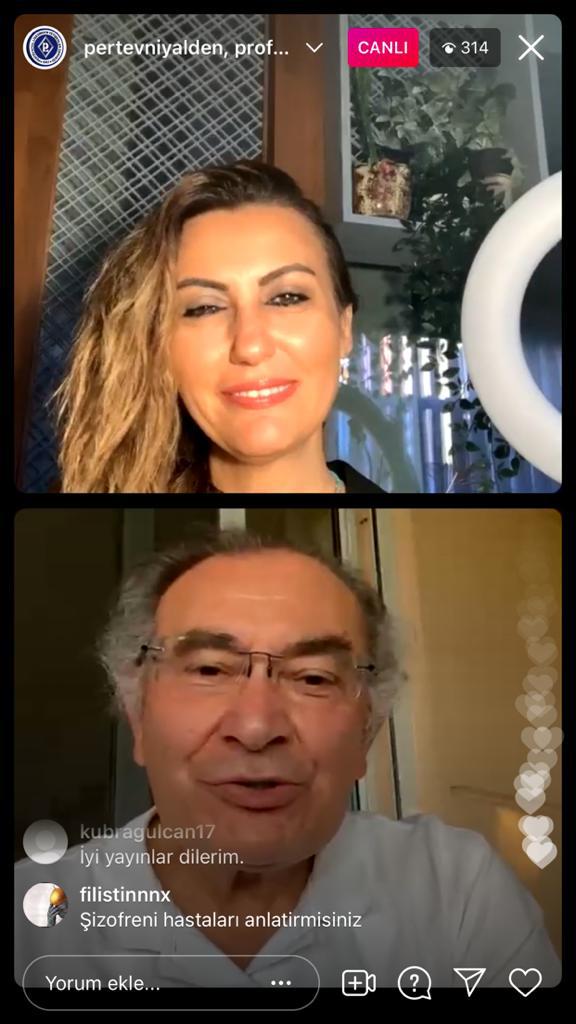
Üsküdar University Founding Rector, Psychiatrist Prof. Dr. Nevzat Tarhan, was a guest on the ‘Pertevniyal Talks’ Instagram live broadcast, organized by the Pertevniyal High School Alumni Association. In the broadcast moderated by TV program presenter Ayşenur Asuman Uğur, Prof. Dr. Nevzat Tarhan made evaluations under the title ‘How to Be a Conscious Young Person?’, stating; “The biggest risk for young people is not having a purpose to work for, sweat for, tire for, and suffer for. Popular culture and the capitalist system encourage hedonism and shopping to increase consumption. Currently, there is a global trend that views sexuality, wealth, and fame as life goals. This trend affects everyone, but especially young people.”
Content
Prof. Dr. Nevzat Tarhan: “Aimlessness is the Biggest Risk for Youth in Life”
“The Book ‘How to Be a Conscious Young Person’ Guides Youth”
Prof. Dr. Tarhan stated that he decided to write the book ‘How to Be a Conscious Young Person’ after seeing the needs of young people on this subject; “They should think of the values related to being a conscious young person explained in the book as road signs for a young person in traffic. If young people say they want to be successful, happy, and a good person; this book contains guiding information like traffic signs for them. There are three different ways to learn these in life. The first way is the path an average person takes. A person makes a mistake and does not repeat the same mistake again. This is an expensive way. Because human life is too short to learn by constantly making the same mistake through trial and error. The second learning method is to constantly repeat the mistake made. People who do this are still in the same place after 30 years. They cannot make progress. The third learning method is to learn from the experiences of others. This method is the ideal one. Because they take books as their guide. This book is written for them in this direction. They can find the information they would obtain by reading 10 books, all in one place,” he said.
“Aimlessness is the Biggest Risk for Youth in Life”
Tarhan stated that the young generation are digital natives, emphasizing the problems of youth and explaining that due to their upbringing conditions, they are prone to easy gains and are aimless. Prof. Dr. Nevzat Tarhan; “Young people are natives of the digital world, while we are migrants, even refugees, of the digital world. The biggest problem for young people is that past generations matured through hardship, whereas these generations mostly mature in affluence. For this reason, they tend towards easy gratification and egocentrism. However, these generations have a characteristic: they are very amiable, and with good guidance and direction, they quickly recover and are very open to novelty. This generation is not one to be managed by fear, but by persuasion. Adults need to understand this. It is important for young people to be as diligent as a bee when embarking on their life journey. A bee reportedly visits 400 flowers in a day. Think about how much effort goes into a single drop of honey. Humankind is similar; whoever works hard and has a goal shines. The biggest risk for young people right now is aimlessness. Not having a purpose to work for, sweat for, tire for, and suffer for. Young people with a purpose will make a difference on their life path,” he said.
“The Capitalist System Encourages Hedonism and Shopping”
Prof. Dr. Tarhan stated that aimlessness is a global problem and that a worldly perspective eliminates many values, saying, “Aimlessness is a global problem that dominates youth not only in Turkey but all over the world. Popular culture and the capitalist system encourage hedonism and shopping to increase consumption. They use young people’s fascination with brands and technology to the fullest, drawing them away from their true ideals. Why would a young person who chooses pleasure as an ego ideal endure difficulties and strive? An individual who has become an object of popular culture or social media cannot say no to all these advertisements. You see something released in Hollywood, and the next day our youth have imitated it. This is voluntary imperialism. Generations of 1990 and earlier had ideals of doing something for society, regardless of their worldview. In the 20th century, humanistic, existentialist philosophy emerged, changing truths and values. This view sanctified humans and made them egocentric. Currently, there is a global trend that views sexuality, wealth, and fame as life goals. This trend affects everyone, but especially young people. Some of those who fall into this trend will say ‘I made a mistake’ when they reach 30-40 years old,” he said.
“Young People Should Not Choose Departments They Don’t Want”
Tarhan also offered advice to candidates regarding university preferences, emphasizing that individuals should choose fields they are talented in and research the academic staff of the universities they plan to choose. Prof. Dr. Tarhan; “When choosing a university, young people should not write down departments they don't want on their preference lists. As Üsküdar University, we have published a test called Holland related to social, academic, aesthetic, and engineering skills. Young people can visit our website and take the test to measure their tendencies. When a person does this, it reveals which area they are strong in. When making a choice, a person will make a selection based on their chosen fields, depending on whether they are equally weighted, verbal, or quantitative. While doing this, they should definitely consult with preference advisors. There are 24 choices, and they need to select 4 of them above and 4 below their success rank. When making choices, there are two important decisions in a person's life: the first is spouse selection, and the second is career selection. In fact, we attribute too much meaning to a profession; a profession is like clothing, not like skin. Skin doesn’t change, but clothing does. You might enter profession A, but over time, opportunities arise, and you can use profession A as a bridge to profession B and advance from there. There are some newly established universities where we ask, ‘Let's see who is on their academic staff,’ and they haven't even announced their academic staff; they should definitely pay attention to this when choosing a university. Also, whether a university is cumbersome or dynamic is very important. For example, whether it quickly adapted to the pandemic period provides important clues. Even when buying a tomato, people inspect it to make sure it’s not rotten, so won’t you inspect a university when enrolling? In this matter, you can't say, ‘whatever comes my way, randomly.’ Because it’s an important decision in your life. A person should be able to proudly say that they graduated from that university. To be able to say that, one needs to be sensitive in choosing a university that values quality and can sustain that perception,” he stated.
“The Most Important Thing for Young People is Mental Health”
Prof. Dr. Tarhan pointed out that mental health is no less valuable than physical health; “The most important thing for young people today is an individual's mental health. The pandemic has helped us understand its value even more. Mental health was previously understood as ‘the absence of a mental illness.’ The World Health Organization defines this as well-being, a state of wellness, with the new perspective brought by positive psychology. In our culture, there are equivalents for this usage, for instance, people pray ‘May Allah grant health and afiyet.’ Here, the word ‘afiyet’ perfectly corresponds to well-being. While health refers to being physically well, ‘afiyet’ can be defined as a person who enjoys what they eat, can genuinely smile, and be happy. Its equivalent in Ottoman Turkish, the word ‘afiyet,’ reflects this very well. We only say ‘afiyet olsun’ during meals, but wishing for health and ‘afiyet’ is a very important thing. To learn this, one must also invest in it. I am talking about being at peace with oneself. Young people should first be at peace with themselves. A person at war with themselves cannot be at peace with others. There are certain adjustments a person needs to make in life. One of these is internal harmony, meaning a healthy relationship with oneself. The second is social harmony; having healthy relationships with family and social life. The third is professional harmony. The fourth is what I can call universal harmony, which is being able to live without forgetting one's country, nation, creator, and reason for existence. Only by living this way can a person add meaning to their life,” he said.
“One Must Be Their Own Leader Before Leading Others”
Prof. Dr. Tarhan stated that to be a conscious young person, one must first lead oneself; “To be a conscious young person, one needs to see themselves as a project. They should strive to improve and develop themselves. One must be their own leader before others. Neuroleadership is a new concept in leadership. Neuroleadership means being able to manage a person's brain chemistry. There’s an emotion called the ‘5 horsemen of darkness’: resentment, anger, hatred, jealousy, and hostility. If these are secreted for a few hours, the body can immediately compensate; the parasympathetic system kicks in, saying 'relax, the danger has passed, the problem is solved,' and it calms the body. But in some people, these emotions—resentment, anger, hatred—are continuously secreted in the body, which can lead to early heart attacks and cancer. For this reason, leadership actually begins with self-management. Someone who can manage themselves, who can be their own leader, becomes a leader of a family, a class leader among students, and can provide effective leadership in friendships. Therefore, I recommend being a conscious young person who is our own leader,” he concluded.
Share
Update Date: February 28, 2026
Creation Date: August 18, 2021
Request a Call
Other News
- Social responsibility courses moved to the field
- Erasmus+ Orientation Week completed at Üsküdar
- Prof. Nevzat Tarhan: “Brain secretes ‘dark glue’ in social media lynchers!”
- Prof. Nevzat Tarhan: “Every segment of society should be able to say, ‘This constitution is my constitution!’”
- OHS releases guide for safe operation of industrial robots