

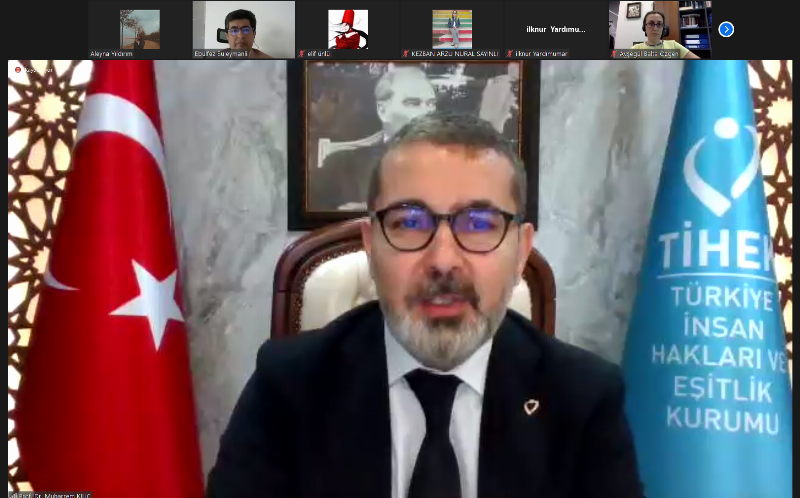
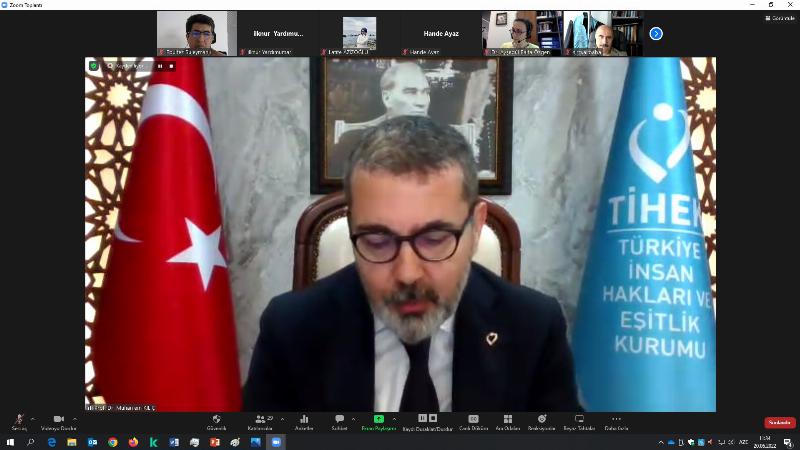
Üsküdar University Human Rights Studies Application and Research Center and the Turkish Human Rights and Equality Institution (TİHEK) held a conference titled 'Refugee Status and Discrimination from a Human Rights Perspective'. The guest of the program was Prof. Dr. Muharrem Kılıç, President of the Turkish Human Rights and Equality Institution. Kılıç, drawing attention to the inadequacy of human rights, stated; “We see that the scales set by human rights are not sufficient. Humanity's report card is getting more failing grades.”
Content
Prof. Dr. Muharrem Kılıç: “Humanity's report card is getting more failing grades”
“One of our main missions is the observance of human rights”
In the program moderated by Prof. Dr. Ebulfez Süleymanlı, Director of Üsküdar University Human Rights Studies Application and Research Center and Head of the Sociology Department, Kılıç spoke about their missions as the Turkish Human Rights and Equality Institution (TİHEK); “As TİHEK, this is an issue we follow through observation and surveys. One of our main missions is the observance of human rights. Human rights law, along with its commitments, refers to international rights. Refugee rights fall within our core mission areas. Turkey has set an example for the whole world with its humanitarian policy. We carry a mission to prevent the severity and abuse of human rights violations that asylum seekers may be subjected to. We have addressed violations against asylum seekers and irregular migrants.” he said.
“All nations of the world must take human rights into account”
Kılıç, drawing attention to the importance of human rights, said: “How do people dare to go out on rubber boats, risking their lives, when they wouldn't even dare to swim near the shore? We see people, regardless of whether they are children or adults, or disabled women, throwing themselves into such risky areas out of desperation. The background of this needs to be addressed. In this century, we witness people dying of starvation on television screens. We are faced with events that wound people's consciences, which we dare not see, and do not want to see. All nations of the world must take human rights into account. The entire global collective conscience must feel the responsibility for this.”
“Refugees, migrants are vulnerable groups”
Kılıç, referring to discrimination against refugees and migrants, said; “Especially during the pandemic, we saw race-based and ethnic discrimination come to the forefront even more. No nation or country in the world is immune to the issue of migration. It is not certain that no one will face such a situation. Social mobility is a reality. Refugees, migrants are vulnerable groups. We see that they are subjected to discriminatory treatment. This leads to discrimination based on a person's gender or language.” he stated.
“Humanity's report card is getting more failing grades”
Kılıç, drawing attention to the inadequacy of human rights, said; “We see that the scales set by human rights are not sufficient. Humanity's report card is getting more failing grades. To be a subject of rights, it is sufficient to be born human. It must be considered that the fundamental problem is deprivation. This truth must be recognized, and everyone's homeland must be made livable. The viewpoint and perspective of this policy need to be developed.” he said.
Prof. Dr. Ebulfez Süleymanlı, "Turkey accepted 3.5 million refugees without any discrimination"
Prof. Dr. Ebulfez Süleymanlı, Director of Üsküdar University Human Rights Studies Application and Research Center and Head of the Sociology Department, who moderated the conference, stated that Üsküdar University continuously organizes scientific conferences on refugee issues. Süleymanlı stated that no Syrian entering Turkey was sent back and they were granted “temporary protection status,” and added, “At a time when many European countries closed their borders with barbed wire and did not accept refugees due to concerns that their security would be jeopardized, Turkey, within the framework of its 'open door' policy, accepted 3.5 million refugees without any discrimination.”
Prof. Dr. Süleymanlı emphasized that, in general, issues related to refugees should be treated as a supra-political matter, and it is important to adopt an approach based on universal human rights, and said, “in this context, a civilian understanding must prevail in society”.
Share
Update Date: March 01, 2026
Creation Date: June 20, 2022