

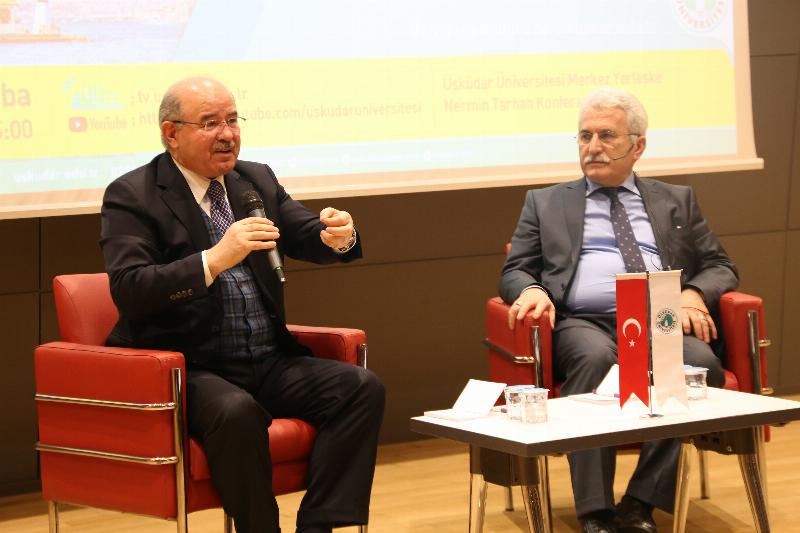
Prof. Dr. Hüseyin Çelik, former Minister of National Education, participated as a speaker in the conference “Freedom of Expression in the Ottoman Empire During the Westernization Period,” organized by the Üsküdar Üniversitesi Faculty of Humanities and Social Sciences as part of the ‘University Culture’ course. At the event, held in the Üsküdar Üniversitesi Central Campus Nermin Tarhan Conference Hall and broadcast live on ÜÜTV and YouTube, Çelik spoke about how individuals can make fewer mistakes by knowing their history and learning from past events: “One who does not know their history, does not know their own past. This is one hundred percent true. Why do we read or teach history? So that we do not repeat the mistakes we made in the past, and to take the good things from the past as examples by bringing them to the present. To learn lessons and take warning from them. Otherwise, dwelling on the past is not right.”
Content
Prof. Dr. Hüseyin Çelik: “One who does not know their history, does not know their own past”
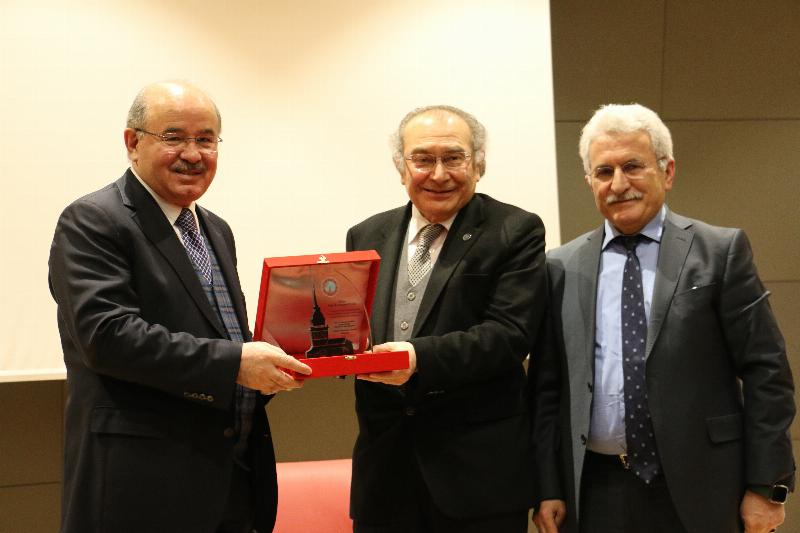
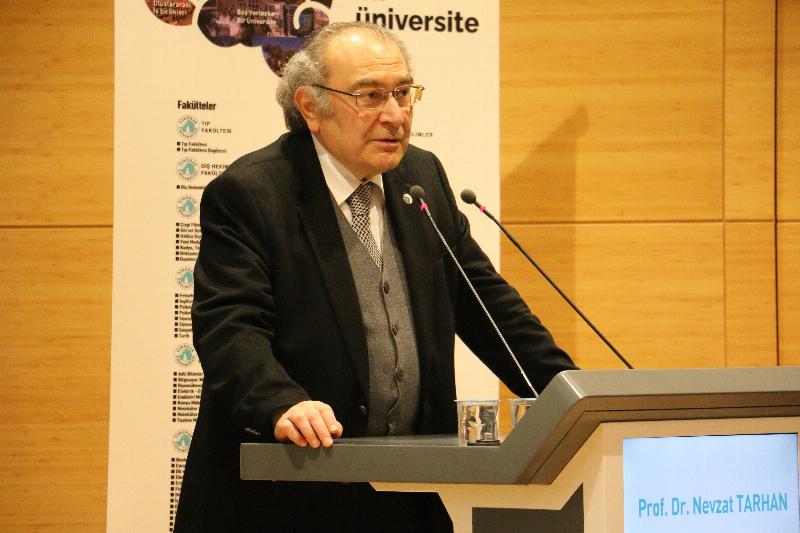
Prof. Dr. Nevzat Tarhan: “The most important sources proving history are documents”
Üsküdar Üniversitesi Founding Rector Prof. Dr. Nevzat Tarhan, who delivered a welcoming speech at the conference, spoke about the great importance of accessing information from correct sources and added: “Perhaps today we will hear things that are not written in books. Our memorized facts will be somewhat disrupted. I believe we will restructure recent history in our minds. It is very important to approach it objectively, outside of official history or ideological polarization. Accessing information from correct sources is crucial here. Since history is always written by the victors, the true history only later comes to light. Not knowing historical facts is like having a map; if you don't know where you're going on this map, you cannot find your way. From this perspective, as Üsküdar Üniversitesi, we also have a history department. This year, hopefully, we will have our first graduates. We proceed with a perspective that explains events and information with evidence and advances with this realism. In this context, the most important sources proving history are documents.”
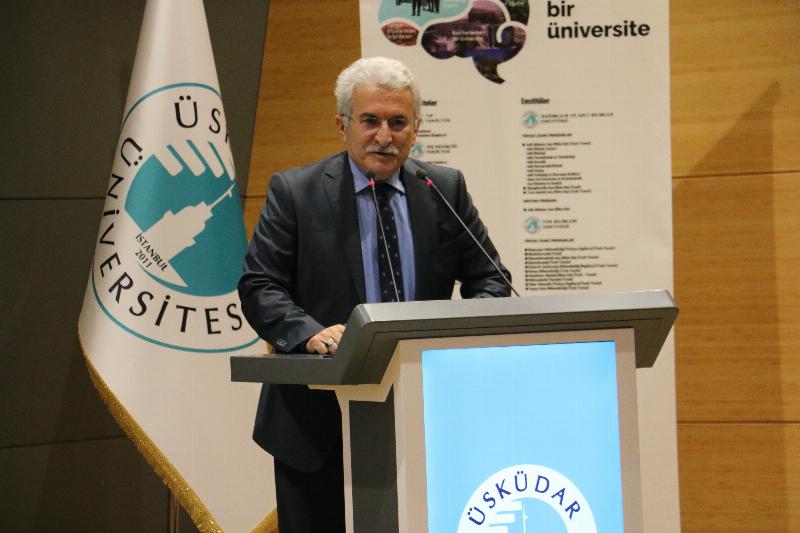
Prof. Dr. İbrahim Özdemir: “He personally donated over 6,000 books for the benefit of young people”
The program was moderated by Prof. Dr. İbrahim Özdemir, Dean of Üsküdar Üniversitesi Faculty of Humanities and Social Sciences. Özdemir, speaking about the periods he worked with Prof. Dr. Hüseyin Çelik, said: “I started working with our esteemed Minister during his tenure at the Ministry of Culture in the 58th Republic government, and he served as the Minister of National Education for approximately 6.5 years. Afterwards, including his time at the Ministry of Culture, I had the honor of working with him for over 7 years. I traveled with him to China, to America, and to many countries. No matter where we went, or how busy it was, what I enjoyed most was always finding 3-4 books in his bag, or documentaries or recent films he needed to watch. Since we used VIP services a lot, we saw many politicians up close. You open their bags, and unfortunately, most of our politicians don't have a good relationship with books, but I want to talk about this aspect of our esteemed minister, as you will see for yourselves. When the books he read no longer fit in his home or office, as Üsküdar Üniversitesi did not exist back then, he personally donated over 6,000 books to a foundation university in Ankara for the benefit of young people. Another aspect is his passion for poetry. I want to mention this too. He knows hundreds of lines of poetry, song lyrics, and folk song lyrics by heart, and uses them when appropriate, just as he reads ancient and new poets. His passion always reminds me of John F. Kennedy, a politician who was also passionate about poetry.”
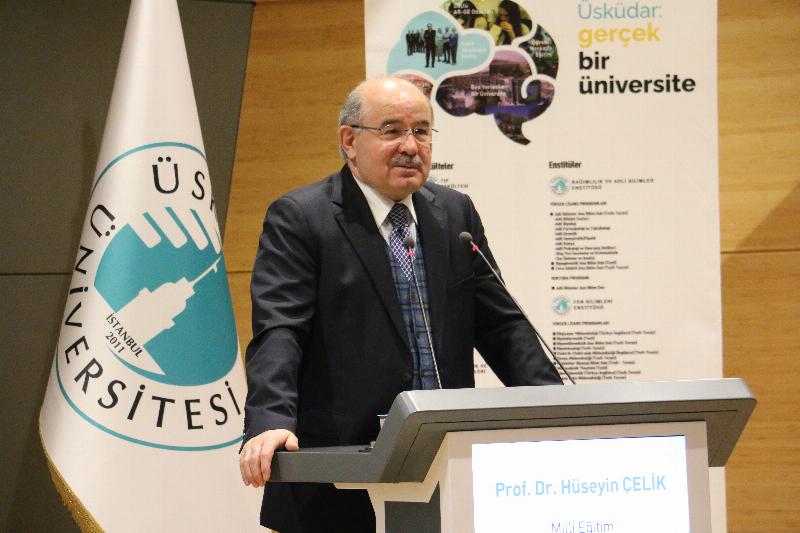
Prof. Dr. Hüseyin Çelik: “Some leave a trace behind when they depart, while others leave a stain”
Prof. Dr. Hüseyin Çelik, explaining his work philosophy acquired during his tenure as Minister of National Education, said: “Our times were very different, friends. The period when I was the Minister of National Education and Mr. İbrahim was the Director General of Foreign Relations, truly, Turkey's environment and conjuncture were very different, but I will not delve into those here. We came, as it were, in the dead of winter, and thankfully, many things were accomplished. That is, if I had even a needle's worth of contribution to the establishment of Üsküdar Üniversitesi today, I would be honored by it. Because you know the scholar Mahir İz. He says: 'We are mortal, we will pass from this world. And we will undoubtedly leave the positions and offices we hold. Some leave a trace behind when they depart, while others leave a stain.' Yes, that is why for every seat I occupied, I prayed, 'My God, make me one of those who leave a trace.' Thankfully, of course, everyone has admirers, but no one has shown any stain left behind us to this day. Thank God we did not leave such a stain.”
“We must put our dreams before our memories”
Prof. Dr. Hüseyin Çelik, expressing the impact of one's past on their future, emphasized the importance of drawing conclusions from both personal and societal perspectives. Çelik said: “One who does not know their history, does not know their own past. This is one hundred percent true. Why do we read or teach history? So that we do not repeat the mistakes we made in the past, and to take the good things from the past as examples by bringing them to the present, to learn lessons and take warning from them. Otherwise, dwelling on the past is not right. A famous thinker has a beautiful saying: 'Societies that cannot place their dreams before their memories cannot truly achieve success and development.' Those who cannot place their dreams before their memories cannot truly achieve success. We must put our dreams before our memories.”
“Intelligent people do not claim to stop the flow of water”
Prof. Dr. Hüseyin Çelik explained the fundamental differences between the concepts of 'opposition' (muhalefet) and 'adversary' (muarız) with contemporary examples: “We confuse opposition with adversary. An adversary is someone who causes trouble, but an opponent is someone who has an idea and expresses it. They don't have to agree with you. If you obstruct them, if you suppress them, what happens? They will find their own way. In the past, the Ottomans called what we now call intellectual currents 'fikir cereyanları' (currents of thought). A current or flow. It has a characteristic of penetrating and spreading to the mind. If you claim 'I will cut off the flow of water,' you are mocking your own intelligence. Intelligent people do not claim to stop the flow of water. Intelligent people build dams in front of the water, canalize channels and use them for irrigation. They send it to turbines to generate electricity, use it in fishing, transportation, and ultimately as an element of beauty. There is such a thing as regulating water. Instead of evaluating the accumulation of writers, artists, young people, and intellectuals in a potential country this way and transforming that potential in favor of the country, if you go down the path of prohibiting it, this is what will happen. One will go and say, 'I will find a country where telling the truth is not forbidden, and I will express myself there again.'”
“The victors write history according to themselves”
Prof. Dr. Hüseyin Çelik emphasized that universities, instead of imposing certain thought patterns on people and having them memorize them, should create awareness on subjects and offer individuals a space for thinking and discussion: “Universities are not places where information is imposed, where we copy knowledge as if to computer diskettes; they are institutions where universal values are discussed, debated, and shared. We should not see people in that way either. As Professor Nevzat also mentioned a moment ago, it is necessary to break the memorized facts. It is truly so. Because history is written by the victors. Now, let's say a military coup happens. Imagine going back to 1980. If Kenan Evren Pasha's military coup had failed, could Kenan Evren have become president? No. He would have gone down in history as an adventurer, a dreamer. Just like in the July 15 coup attempt or with Talat Aydemir. But if it succeeds, the situation changes. For example, if the British had sunk Atatürk's ship as he passed through the Bosphorus on the Bandırma ferry to go to Samsun, how would that situation have gone down in history? It would have been said, 'The British had turned their cannons towards the palace, they held the Bosphorus, and you are going with the Bandırma ferry.' But after he became victorious, after the reins were in his hands, the situation becomes different. This is one hundred percent true. The victors write history according to themselves.”
“Sunni Islam has abolished the right of Muslims to object and rebel”
Prof. Dr. Hüseyin Çelik, elaborating on the disputes experienced during the Umayyad period and the intellectual structures these disputes created, explained: “What we call consultation is collective wisdom, and it is the minds supporting each other. Just as biceps and wrists can jointly lift a heavy object, so too can minds come together to solve problems that seem inextricable and very difficult. But unfortunately, with the Umayyads, this situation changed, and something more terrible happened. As you know, immediately after the Age of Happiness (Asr-ı Saadet), disputes emerged in Islamic societies. There were political disputes. In this way, the Islamic community was divided into three: Shia-i Ali, Shia-i Umayyad – what we call Sunnism today – and the Kharijites emerged. Then, disputes began on jurisprudential matters, and four schools of thought emerged. Later, disputes arose concerning kalam (Islamic scholastic theology). We know of Mutazila, Ash'ariyyah, Qadariyyah, Jabriyyah, etc., and many other branches like these. At that time, the Umayyads imposed a Jabriyyah (fatalistic) understanding on society, saying, 'Allah has appointed us as kings and sultans over you, and you are our servants; your opposition to us is opposition to Allah's command,' and Sunni Islam abolished the right of Muslims to object and rebel. Allegiance and obedience are essential. Loyalty, allegiance, and obedience to the 'ulū al-amr' (those in authority) are essential. When Hz. Abu Bakr and Hz. Omar asked the Companions, 'If we do wrong, what will you do?' the Companions replied, 'O Commander of the Faithful, we will warn you with 'kavl-i leyyin,' meaning soft words. But if you persist in wrongdoing, by God, we will correct you with our swords.' But after that, let alone correcting him with a sword, even objecting to him with words was out of the question.”
Share
Request a Call
Other News
- The book that read today's digital threats in 2014: Being a Conscious Family
- Experts warn: 'Instead of memorizing letters, teach pencil grip, scissor use, and coloring'
- School fear and school love both start in the family!
- Family is not merely transforming, it is being battered under a serious assault
- Artificial intelligence opens the door to early diagnosis in autism!