

Prof. Dr. Deniz Ülke Arıboğan, who made a presentation titled “The Political Psychology of Loneliness” at the International Loneliness Symposium, held for the second time this year at Üsküdar Üniversitesi, stated that the 21st century first experienced a crisis of trust, then an economic crisis worldwide, adding that the third crisis is the pandemic crisis. Prof. Dr. Deniz Ülke Arıboğan noted that with the pandemic crisis, we have entered a completely different world where everyone, from China to Brazil, has come under some form of digital control, stating, “One of the things that completes this crisis is the state of loneliness we are thrown into.” Prof. Dr. Deniz Ülke Arıboğan stated that the world has currently become an isolated global village, emphasizing that this order, where everyone produces and lives without mutual aid in their own world, is a very important social problem for human communities. Prof. Dr. Arıboğan also stated that the main front of the war between globalists and nationalists will be the digital environment, saying, “Today, on one hand, there is a worldwide digital attack, and on the other hand, there is a national digital restriction. Both can come to the forefront here.”
Content
Prof. Dr. Deniz Ülke Arıboğan: “The Third Crisis of the 21st Century is the Pandemic Crisis”
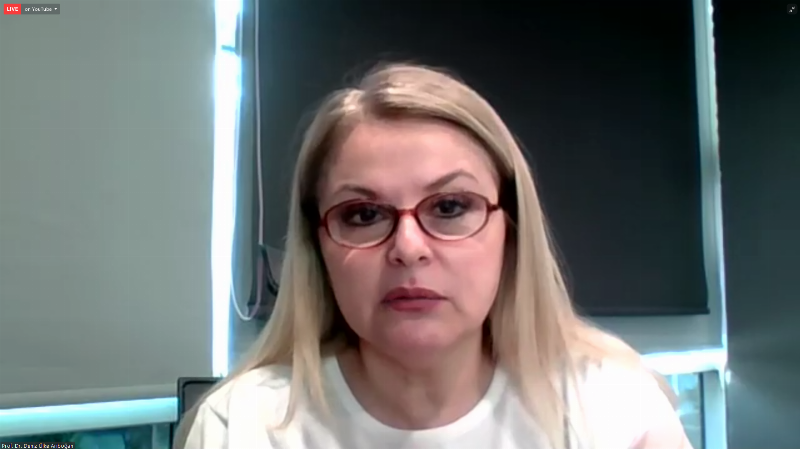
Üsküdar Üniversitesi hosted the International Loneliness Symposium for the second time this year, held under the title “Pandemic.”
Prof. Dr. Deniz Ülke Arıboğan: “We are feeling loneliness in a different climate this year”
Prof. Dr. Deniz Ülke Arıboğan, Dean of the Faculty of Humanities and Social Sciences at Üsküdar Üniversitesi, stated in her presentation titled “The Political Psychology of Loneliness” that the theme of loneliness has become a very special subject for the university and the sociology department, with intensive research being conducted on it, and added:
“We are talking about a period where we design regular symposiums every year, and interestingly, we find ourselves in a different kind of loneliness each time. Because while we discussed completely different topics at the loneliness symposium we held a year ago, and the loneliness of that period was entirely different, we now see that we need to perceive and analyze the loneliness of this period with very different parameters. As Leo Tolstoy says in his novel ‘Anna Karenina,’ ‘All happy families are alike; each unhappy family is unhappy in its own way.’ In fact, all crowds are alike, but all lonelinesses also have their unique circumstances. These lonelinesses are nourished by the spirit of the times and the environment we are in. We are currently in an interesting climate that we face once in a century. That is, approximately one hundred years after the Spanish flu of 1918, we are analyzing loneliness for the first time in a pandemic environment. We are talking about loneliness for the first time in a period where the technological and digital environment has entered our lives to such an extent. And perhaps for the first time after liberalism, we are talking about loneliness at a time when such totalitarian structures have started to take over our lives,” she said.
Prof. Dr. Deniz Ülke Arıboğan: “Loneliness is a political concept”
Prof. Dr. Arıboğan stated that the feeling of loneliness is not a matter to be examined solely psychologically or sociologically, adding, “Olivia Laing has an expression: Loneliness is a political concept. It is a concept that we must evaluate both personally and politically. It will not be very possible to examine it independently of politics.”
Prof. Dr. Deniz Ülke Arıboğan: “In the 21st century, there was first a crisis of trust, then an economic crisis”
Arıboğan stated that there was an expectation of a different world when entering the 21st century, saying, “When the 20th century ended, we all had only one concern; that is, when we entered the first day of 2001, we only feared that computers might crash. What we defined as a doomsday scenario involved computers crashing and everything falling into chaos. Such an event did not happen. But with the September 11 attacks in 2001, we actually took the first step towards the world going off its hinges. That is, while talking about a liberal world, a rosy world, a global village where everyone mingled and merged, where all people would live in happiness and peace around common norms, suddenly with the September 11 attacks, we entered a major crisis of terror and trust. Economic resources worldwide began to flow towards the military-industrial complex. Securitization issues came to the agenda, and liberalism actually took its first wave, its first blow there. Then we entered the 2008-2009 crisis. That is, the second global crisis was actually an economic crisis. And entirely different environments of insecurity had emerged. The state, as an actor, intervened in the system again. This time, it entered as an economic actor.”
Prof. Dr. Deniz Ülke Arıboğan: “In the pandemic crisis, the world came under digital control”
Arıboğan stated that the third crisis is the pandemic crisis, adding, “For the first time, these things we call mass tracking systems – in August, 25 million people in Turkey had their HES codes entered. We have entered a completely different world where everyone, from China to Brazil, has come under some form of digital control, tracking what each of us does. So, we are actually experiencing a major crisis. This is the third global crisis, and it is a major one, and one of the things that completes this crisis and strengthens totalitarianism is the state of loneliness we are thrown into, into which we are driven.”
Prof. Dr. Deniz Ülke Arıboğan: “We are experiencing a complete security concern”
Arıboğan stated that in the new process we are in, we are putting distance between ourselves and our loved ones, saying, “We are talking about individual isolation; this is not just the inability to walk around in the market or go to work properly. This is something that, first and foremost, removes us from 'zoon politikon.' We are now starting to put a distance between ourselves, our loved ones, and our emotions. Grandmothers and grandfathers cannot hug their grandchildren. Mothers cannot hug their children. We cannot be with our friends in our offices. We cannot exchange ideas together. In fact, what we have entered, what flows upon us as psychological pressure, is entirely a security concern. It says, ‘You can die.’ It says, ‘You are living face to face with death.’ Where does death come from? Death comes from the place we trust most; it can enter our home. Death can come from our spouse, our friend, our grandchild, our child. We are talking about a state of insecurity that strikes us in our safest place, our refuge.”
Prof. Dr. Deniz Ülke Arıboğan: “Digital environments have created a totalitarian pressure on us”
Arıboğan stated that digital totalitarianism is effective in today's world, saying: “Social media channels, these digital environments, which have permeated all aspects of our lives, control all our information systems, and actually soothe us with a different kind of socialization within loneliness, have created a tremendous totalitarian pressure on us. Because in an environment where we cannot learn by touching, where we cannot touch the outside world, we begin to perceive the world only through certain information that comes to us and adopt political stances accordingly. We are actually just watching the world from this screen. And the act of watching is something that passivates people. Hugo Münsterberg said this for the first time in 1911 after watching a silent film; 'A watching society, a society tethered to the screen, one that perceives only from the screen and watches through the screen, is actually a lonely society.'”
Prof. Dr. Deniz Ülke Arıboğan: “A significant social problem is being experienced in the isolated global village”
Prof. Dr. Deniz Ülke Arıboğan stated that one could speak of an isolated global village, saying, “The characteristic of a village is actually the prevalence of mutual aid. One is not alone in a village. You are together during its Mevlid, together at birth, you go to school together. So, when this is a global village, it happens in conjunction with production. Even today's understanding of production is transforming into an environment where a person can sit at home alone, without anyone else, producing certain software, producing alone, without any connection to anyone else at home. You eat your meals by yourself, you have your weddings by yourself, you can't even have celebrations anymore; this life has no carnival. Therefore, we can say that a very significant social problem is being experienced by human communities swept into such an order.”
Prof. Dr. Deniz Ülke Arıboğan: “The digital world has negative effects on all of us”
Prof. Dr. Deniz Ülke Arıboğan underlined that it is not possible for humans to live in isolation in a sociological context, stating, “We will certainly try to provide ourselves with new social pursuits. That is, the extraordinary power of certain social communities like Facebook and Twitter also has negative effects on all of us. We are talking about a totalitarian structure via Facebook and Twitter. We are talking about its power to elect an American President. This can only be possible by isolating people and confining them to their homes. That is, we are talking about people who do not have any information acquisition channel other than social media. And we are talking about people determining their political behavior based on the information they receive. Trump may be a very bad person, or a very good person, but that cannot make us forget the fact that he was elected by Twitter. That is, an attitude that freely allows the speech of any political leader it wants in the world, freely allows any criticism it wants, and despotically blocks the side it doesn't want, is the attitude of a totalitarian dictatorship. It is the attitude of digital dictatorship,” she said.
“A person is open to all manipulations only when they are lonely,” said Prof. Dr. Arıboğan, adding, “One of the most important political consequences of loneliness is being open to disinformation. Because there is no longer any medium where you can test it. Especially if the social media platform, while appearing to be a very colorful, very democratic, very free medium where everyone can say what they want, has actually turned into a prison, and if we have all lost awareness of our captivity there, if we are no longer even aware, if we think it is free, if we believe we are expressing ourselves in a free environment, then the real problem lies here. When a person loses awareness of their captivity, they do not make an escape plan for themselves. They cannot have the freedom to make an escape plan or such an emotional state. Therefore, totalitarian structures encourage loneliness and know that it is a subject open to manipulation.”
Prof. Dr. Deniz Ülke Arıboğan: “Turkey is trying to establish its national digital infrastructure”
Arıboğan stated that when the Berlin Wall fell, there were about a dozen, 12-13, states with border walls, whereas today 77 countries have surrounded their borders with walls. “Turkey is one of them. Do not perceive this wall only as a concrete wall made of bricks, meant to block migrants or terrorists. A digital wall is also in question. Turkey is also trying to establish its national digital complex, its infrastructure. It is trying to centralize it as much as possible. America, on the one hand, has launched a major technology war. But apart from this, in fact, there is a difference between the values symbolized by Trump and those symbolized by Facebook and Twitter. These are elements of two colliding wings worldwide. The main front of the war between globalists and nationalists will also be the digital environment. Today, on one hand, there is a worldwide digital attack, and on the other hand, there is a national digital restriction. Both can come to the forefront here. Either totalitarian centers will emerge in the national arena, and we will come under the control of national political actors, or we will come under the digital groups at a global level. Therefore, I think it is more accurate to perceive this as two separate processes clashing with each other but using the same tool and fighting on the same front,” she said.
Share
Request a Call
Other News
- Social responsibility courses moved to the field
- Erasmus+ Orientation Week completed at Üsküdar
- Prof. Nevzat Tarhan: “Brain secretes ‘dark glue’ in social media lynchers!”
- Prof. Nevzat Tarhan: “Every segment of society should be able to say, ‘This constitution is my constitution!’”
- OHS releases guide for safe operation of industrial robots