

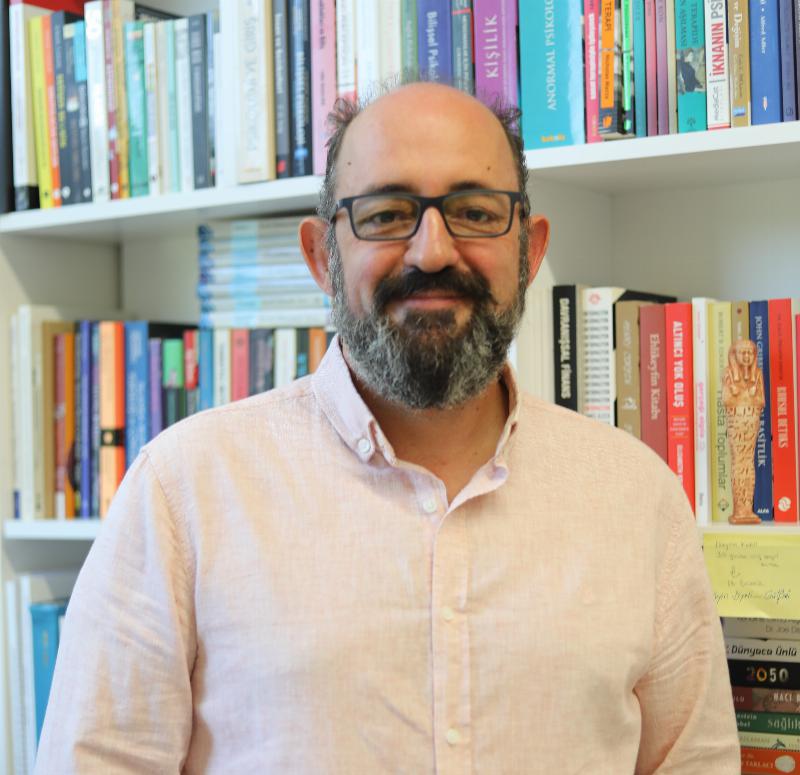
Üsküdar Üniversitesi Head of Neuromarketing Department, Prof. Dr. Sinan Canan, made striking assessments regarding nutrition today. Canan, stating that new terms such as gluten allergy have emerged regarding nutrition; 'By reducing our food abundance to these types of terms, it feels like we are eating selectively and healthily. But we don't know what the body needs. Maybe what you choose isn't good for you, maybe it causes problems in the long run. Today, the biggest problem of urban people is being biologically unemployed.' he said.
Content
Prof. Dr. Canan: “The biggest problem of urban people is biological unemployment”
“We can grow up in a culture that distorts eating settings”
Canan, expressing his views on eating culture; 'I was once someone who found it hard to get full. Years later, due to my profession, I had the chance to learn the reason for this and realized that the fault was not entirely mine. Unfortunately, we can grow up in a culture that significantly distorts eating settings. The issue we call stress eating is very common in society. We have been given the sense of taste for our nutrition. Taste and smell together create flavor. This is such an attractive sense that in times when food was scarce in nature, our ancestors were able to dig everywhere and find food. Now, sometimes we have enough food in our fridge for two or three months. This is a very serious problem because the brain still functions like a hunter-gatherer from ancient times. We are in a constant state of appetite. We constantly have food to eat, but the primitive part of our brain is not convinced that the food will still be there tomorrow and wants to eat everything at hand.' he said.
“Many people have come to live to eat”
Canan stated that taste has a calming effect on our brain; 'It's like we're trying to vent our frustration somewhere. We can think of it like a battery and a quota. Humans have a need for a certain satisfaction. For example, let's think about well-known leaders, scientists, philosophers. One common point among them is their lack of preoccupation with eating and drinking. They snack on something and return to their work. Because satisfaction begins. In Turkey, neuro-related fields are not very well known, but currently, there is a field with 'neuro' at the beginning of almost everything. All of these emerged out of necessity because brain sciences have so much to say about these areas. No one sits down and thinks, 'I'll do neurogastronomy.' It just emerges. Today, a large majority of people, especially in developed countries, are not eating, they are not nourishing themselves. Food addicts spend their lives chasing what they are addicted to. Many people have come to live to eat. However, we should eat to live.' he stated.
“If the sense of taste is not sufficiently encountered, the resolution of the sense decreases”
Canan emphasized the need to understand the addiction mechanism in the brain; 'Of course, merely understanding the addiction mechanism doesn't tell us why we have such a strong craving for sugar and sauces. We must also add the historical and evolutionary aspect to it. You eat packs and can't get full. It's very normal. Aesthetic perception, taste perception, and even the resolution of the sense of touch are shaped by what you encounter in the early period. If a person is not exposed to aesthetic experience, their aesthetic sense does not develop. If the sense of taste is not sufficiently encountered, the resolution of the sense of taste becomes low. Therefore, we now call what humans do 'eating food' and what animals do 'feeding'. This situation is today's reflection of human indulgence in every era.' he said.
“The biggest problem of urban people is being biologically unemployed”
Canan also stated that new terms related to nutrition have emerged; 'We heard of gluten, we noticed something called gluten allergy. These are very fragmented pieces of information. However, the organism we call human has been here for 300,000 years, and life has continued for 3.5 billion years. Now, by reducing our food abundance to these types of terms, it feels like we are eating selectively and healthily. But we don't know what the body needs. Maybe what you choose isn't good for you, maybe it causes problems in the long run. Today, the biggest problem of urban people is being biologically unemployed. Since we were born, we haven't chased lions, we haven't risked starving to death, we haven't feared dying if weather conditions changed. These were the daily concerns of our ancestors. Now, when these are absent, we say, 'Let's obsess over gluten, starch, yogurt, something.' We turn such things into concerns. When you look at the human diet, we see that in pre-Stone Age periods, they even ate tree roots for long periods. We manage it somehow. Distinguishing and eating minor things like this is not about health, but about obsession. Our present day is actually very rich in terms of variety, new productions, and compounds. But instead of artistic creations we could form with the accompaniment of nature and our own feelings and impulses, we rely on combinations of our paltry knowledge.' he continued.
“The phrase 'I can't get full without eating bread' is an expression of addiction…”
Canan said, 'The phrase "I can't get full without eating bread" is an expression of addiction'; 'This is carbohydrate addiction. For example, no one says, "I can't get full without eating Brussels sprouts." Because that's not addictive, but the other one is. When we see this, let's step out of the addiction cycle and bring the situation to a more human dimension. By the way, I'm saying this to myself first. I used to eat very poorly; now I'm slowly learning from friends. There's a book about these issues called 'Yaratıcı Tür' (Creative Species). I had an epiphany while reading it. There's also a documentary on TV. In the very first section of the book, in the introduction, it says, 'All living things eat. They eat what falls on the ground, they fill something and eat it, but humans prepare a table. They make a presentation.' At that moment, I realized I was filling my plate with something like a mess, spooning it, and looking at the book. I looked up and saw the man was talking about me. From that day on, I said, 'Care will be taken with this food.' Because it's not just about swallowing the food, but also about its preparation. Otherwise, we're just swallowing it.' he said.
Share
Update Date: February 27, 2026
Creation Date: April 15, 2021
Request a Call
Other News
- Social responsibility courses moved to the field
- Erasmus+ Orientation Week completed at Üsküdar
- Prof. Nevzat Tarhan: “Brain secretes ‘dark glue’ in social media lynchers!”
- Prof. Nevzat Tarhan: “Every segment of society should be able to say, ‘This constitution is my constitution!’”
- OHS releases guide for safe operation of industrial robots