

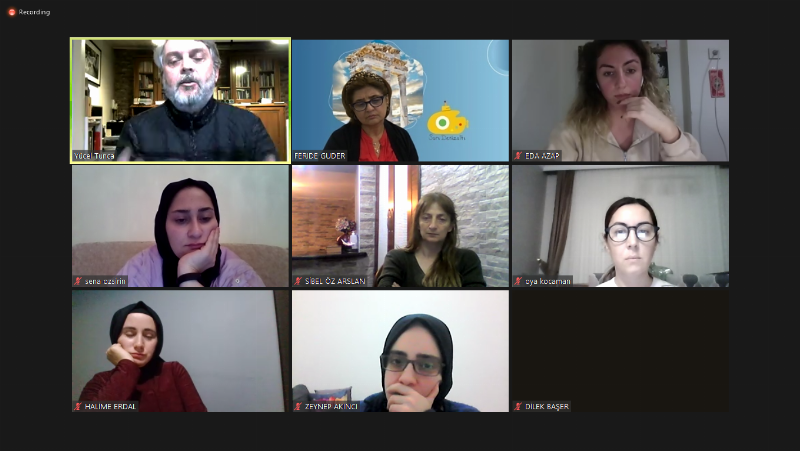
The guest of the 'Photography, Memory, and Truth' event, organized by the New Media and Communication Department of Üsküdar Üniversitesi Faculty of Communication, was Documentary Photographer Yücel Tunca, founder of the Sarı Denizaltı Art Initiative. The event, moderated by Head of the New Media and Communication Department Assoc. Prof. Dr. Feride Zeynep Güder, was held online via the Zoom application. Yücel Tunca, emphasizing the importance of photographs in media, said; “What we call media, whether we consider it in a negative sense or as a neutral concept, is a tool of manipulation. In other words, media has a structure that educates society. As a part of it, photography emerges as a very important structure in terms of informing and guiding this society.”
Content
The Relationship Between Photography, Memory, and Truth Discussed
“If we don’t think, we become a herd”
Yücel Tunca, drawing attention to the effect of thinking while taking photographs on the resulting image, said; “There was an advertisement for an international technology brand that produced cameras and also mobile phones. The advertisement was built on a slogan: ‘Don’t think, just shoot’. As photographers, for years we have specifically argued the exact opposite, saying ‘think a lot, shoot little’. This slogan, however, was the product of an advertisement designed to break this idea and encourage consumption. It reflected the spirit of our age very well. As in many areas of life, it was leading us to live without thinking, consume without thinking, and even produce without thinking. It was an extremely disturbing slogan that even risked the future. Looking at it from that perspective, we see that forming a social future imagination can actually lead to chaotic results. But many people like me reject this slogan. On the contrary, we need to think. If we stop asking questions about what we do and why, we probably stop being ourselves. We cease to be individuals and start to turn into a herd. If we don’t think, we become a herd. Only if we continue to think can we remain individuals and a society made up of those individuals.”
“Photographs are structures that translate the essence of news visually”
Yücel Tunca, speaking about the positive effects of his journalism education on his photography, said; “Actually, my profession is being a journalist; I am a photographer who came from journalism. I received journalism education. I graduated from the Department of Press and Public Relations. I started my profession while studying and worked as a press photographer for many years in newspapers and magazines. Thus, I developed a background directly woven around the relationship between media and photography. At that point, when you say ‘producing photographs in media,’ you start to grasp the importance of the idea behind the image from the very beginning. Because you know that photographs used in media are, in their idealized sense, a summary of the news content. Photographs are structures that visually translate the essence of the news. That's why, from the first years we started taking photographs, we began to think, ‘Why are we taking these photographs, what purpose do we serve, and what do we aim to show in these photographs?’”
“Media has a structure that educates society”
Yücel Tunca, speaking about the perception created by photographs used in the media on society, said; “What we call media, whether we consider it in a negative sense or as a neutral concept, is a tool of manipulation. In other words, media has a structure that educates society. As a part of it, photography emerges as a very important structure in terms of informing and guiding this society. Therefore, having been an active press photographer for nearly 20 years, I acted with the awareness that every photograph I took was a tool of responsibility. After ending my journalism career, I continued with documentary photography in an amateur sense, maintaining the same principles throughout the process up to today. At this point, where we are trying to create a visual memory, we strive not to lose our way by thinking and discussing what this memory serves, why we are after the truth, and how we can form the truth within us if we cannot fully reflect reality. That’s why the title we used today is important. There is a significant area of responsibility here, and each individual, while carrying this responsibility, needs to keep their mind clear in the pursuit of truth.”
Assoc. Prof. Dr. Feride Zeynep Güder; “The inability to achieve peace on earth is a human truth”
Assoc. Prof. Dr. Feride Zeynep Güder, speaking about the differences between the concepts of truth and reality, said; “We can explain the difference between reality and truth as follows. There is a claim to grasp reality with rationality; reality is associated with rationality. This was the fundamental problem of modernity; from the 17th century until the 1960s, we grasped reality with rationality, positivist sentiments, and Kant’s perspective. But when we come to the present day, we see that irrationalities, rather than logic, dominate the decision-making mechanism. That’s why the condemnation of historical follies is like an eternal cycle. When we look at the representation aspect of truth, it is necessary to investigate whether many things, such as photographs or any work of art claiming to represent reality, do so correctly. Humans are unpredictable beings. Although we may think we are rational, we act irrationally in many ways. For example, our inclination towards violence is an example of this. There is nothing more irrational than one human killing another. The inability to achieve peace on earth is a human truth.”
Share
Request a Call
Other News
- Prof. Nevzat Tarhan: “Those with a mental filter are not afraid of the digital”
- Artificial intelligence doesn't eliminate the translator, it transforms their expertise!
- Social responsibility courses moved to the field
- Erasmus+ Orientation Week completed at Üsküdar
- Prof. Nevzat Tarhan: “Brain secretes ‘dark glue’ in social media lynchers!”