

An informative conference on ‘Women's Rights in the Context of Combating Discrimination’ was held via Zoom on December 10, International Human Rights Day, by Üsküdar Üniversitesi Human Rights Studies Application and Research Center and the Human Rights and Equality Institution of Türkiye (TİHEK). Pınar Kaçan, Assistant Human Rights and Equality Expert at TİHEK, participated as a speaker in the conference, which was moderated by Prof. Dr. Ebulfez Süleymanlı, Director of Üsküdar Üniversitesi Human Rights Studies Application and Research Center (İHAMER). Kaçan stated that violence against women increased during the pandemic.
Content
Did the Pandemic Increase Violence Against Women?
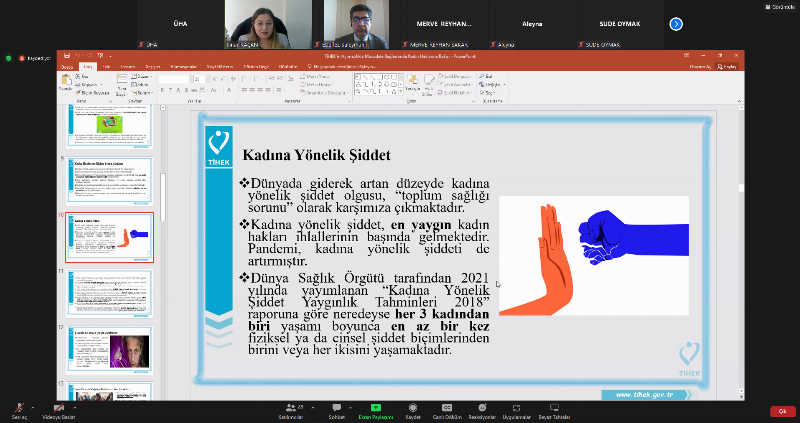
Pınar Kaçan: “The issue of women's rights is one of the most important questions occupying the civilized world”
Pınar Kaçan, Assistant Human Rights and Equality Expert at TİHEK, provided information on women's rights; “Women's human rights are regarded as fundamental human rights that aim for women to benefit from all basic rights and freedoms equally with men, to participate equally in social life, and to eliminate gender-based discrimination. The issue of women's rights is one of the most important questions related to human rights, following its development and occupying the civilized world. Many rights demanded by women are not privileged rights specific to women; they are rights that every human being, male or female, should have by birth. Women's human rights encompass personal and political rights, known as first-generation rights; along with economic, social, and cultural rights, known as second-generation rights, which are also related to the private sphere and hold an important place in women's lives. The persistent and evident continuation of gender-based inequality and discrimination in every area of life has given rise to the concept of women's rights.” she said.

Provided Information on Constitutional Article 10
Pınar Kaçan drew attention to Constitutional Article 10. Kaçan said; “Everyone is equal before the law without discrimination based on language, religion, race, color, gender, political opinion, philosophical belief, religion, sect, and similar reasons. Women and men have equal rights. The state is obliged to ensure that this equality is put into practice. Measures taken for this purpose cannot be interpreted as contrary to the principle of equality. Measures taken for children, the elderly, the disabled, the widows and orphans of war and duty martyrs, and the disabled and veterans are not considered contrary to the principle of equality. No privilege can be granted to any person, family, group, or class. State organs and administrative authorities are obliged to act in accordance with the principle of equality before the law in all their proceedings.”
“Discrimination and women's rights emerge as a human rights issue”
Pınar Kaçan, mentioning March 8, International Women's Day, attributed to women by the United Nations (UN); “March 8, International Women's Day, takes its historical reference from March 8, 1857, but this important day was only designated as a day attributed to women by the United Nations (UN) about 120 years after the date it referenced, with a great historical delay. Every year, the UN determines a new area related to human rights through a specific theme, including women's rights. The UN has designated this year's International Women's Day theme as 'Gender equality today for a sustainable tomorrow.' According to the United Nations Entity for Gender Equality and the Empowerment of Women (UN Women), gender equality means that women and men, and girls and boys, have equal rights, responsibilities, and opportunities. Discrimination and women's rights emerge as a human rights issue.” she stated.
“The pandemic increased violence against women”
Pınar Kaçan drew attention to the increasing number of violence against women cases during the pandemic due to the psychological impact of social isolation at home and the difficulty of accessing help. Kaçan stated; “The phenomenon of violence against women, which is increasing globally, emerges as a ‘public health problem.’ Violence against women is among the most common violations of women's rights. The pandemic also increased violence against women. According to the ‘Global and Regional Prevalence of Violence Against Women and Girls 2018’ report published by the World Health Organization in 2021, nearly one in three women experiences at least one form of physical or sexual violence, or both, in their lifetime. Studies also show that during the pandemic, cases of violence against women increased worldwide due to the psychological effect of social isolation at home and the difficulty of accessing help. According to the data from the Ministry of Interior, 268 women died due to violence against women in 2020, and 307 women in 2021.” she said.
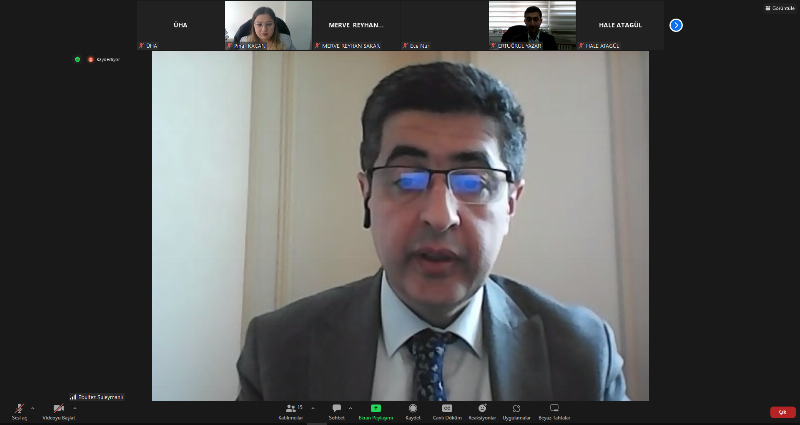
Prof. Dr. Ebulfez Süleymanlı: “We see a higher rate of violence against women”
Prof. Dr. Ebulfez Süleymanlı, Director of Üsküdar Üniversitesi İHAMER; “In recent times, we observe a discrimination against women in terms of rights and their exercise in our world. Unfortunately, this discrimination continues in various fields. When we look at regional and global statistics, we unfortunately see a higher rate of violence against women, which exists in political and social life and concerns everyone, both men and women.” he said.
Share
Update Date: February 26, 2026
Creation Date: December 12, 2022
Request a Call
Other News
- The book that read today's digital threats in 2014: Being a Conscious Family
- Experts warn: 'Instead of memorizing letters, teach pencil grip, scissor use, and coloring'
- School fear and school love both start in the family!
- Family is not merely transforming, it is being battered under a serious assault
- Artificial intelligence opens the door to early diagnosis in autism!