

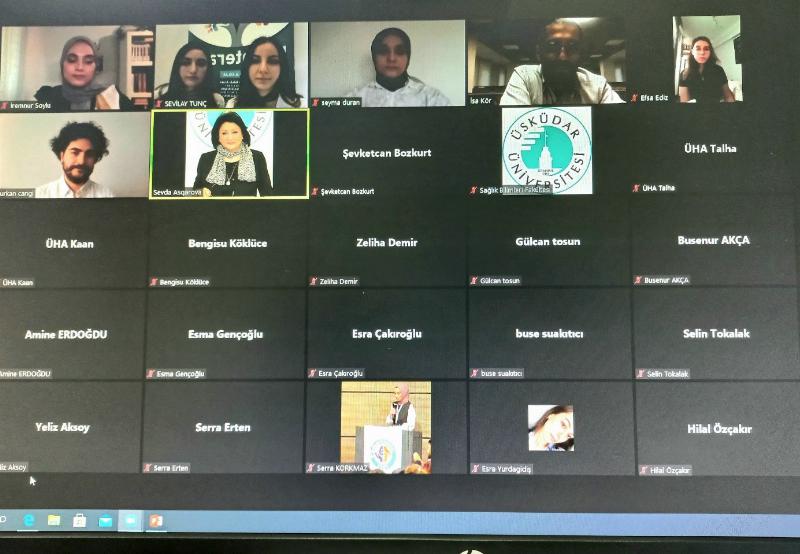
Üsküdar University Department of Occupational Therapy students organized the “October 6 World Cerebral Palsy Day Seminar” under the leadership of Prof. Dr. Sevda Asqarova. Cerebral Palsy awareness was emphasized at the event. In the program moderated by Sevilay Tunç, a 3rd-year student in Üsküdar University's Department of Occupational Therapy and President of the Cerebral Palsy and Occupational Therapy Club, the club president and vice president, Occupational Therapist Furkan Cangi, Erg. İremnur Soylu, and Erg. İsa Kör, all graduates of Üsküdar University, delivered informative presentations as speakers.
Content
October 6 World Cerebral Palsy Day Seminar
“We are aware of individuals with Cerebral Palsy and we stand with them”
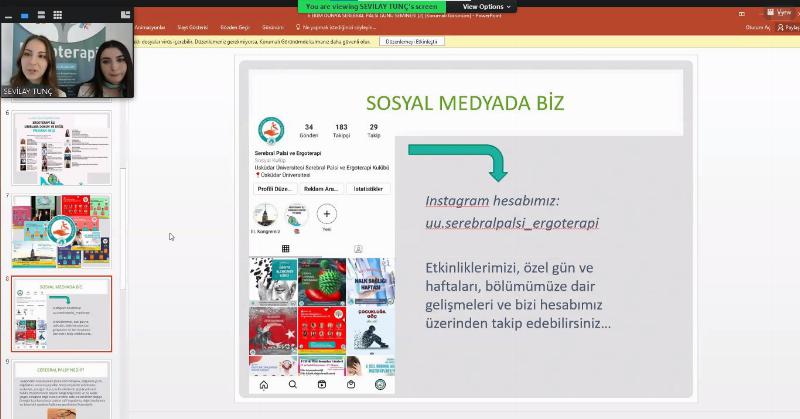
Club president Sevilay TUNÇ, who made a presentation introducing the Cerebral Palsy and Occupational Therapy Club, said: “I am Sevilay Tunç, a 3rd-year student at Üsküdar University and president of the Cerebral Palsy and Occupational Therapy Club. Our club joined the Üsküdar University Faculty of Health Sciences Occupational Therapy family in 2020-2021. We organize activities to bring a very special perspective to our actively operating department in the field of Cerebral Palsy and to raise awareness among our university's prospective Occupational Therapists, families of individuals with Cerebral Palsy, and our society through our activities in this field. We focus on raising awareness among specialists involved in treatment in the field of Cerebral Palsy, the families of these individuals, and the community in which individuals with CP live. Our vision is to work towards increasing the participation in life of individuals with various disabilities and diseases, especially cerebral palsy, to the highest possible level of their capacities, and to raise awareness in society about this issue. Since its establishment, our club has organized many events together with other clubs in our department. You can follow all these events and special days on our club's social media account.” After the club's vice president, Yağmur Erol, took the floor, she said: “Cerebral Palsy is a condition where a child experiences difficulties in posture and movement due to an injury in the developing brain (while in the womb, at birth, or before the age of two after birth). The symptoms of cerebral palsy vary depending on which part of the brain the injury is located and how widespread it is. For example, some patients may only have a slight limp, while others may require the use of a wheelchair. It is not possible to reverse the brain damage that has occurred, but children with cerebral palsy can improve many of their skills with modern medical and supportive therapies. The most important element of treatment is the family's and child's interest and compliance. World Cerebral Palsy Day is a social movement for the CP community. The vision of this awareness day is to ensure that every individual with CP has the same rights and opportunities as everyone else.”
“Babies' first task is to learn to regulate themselves.”
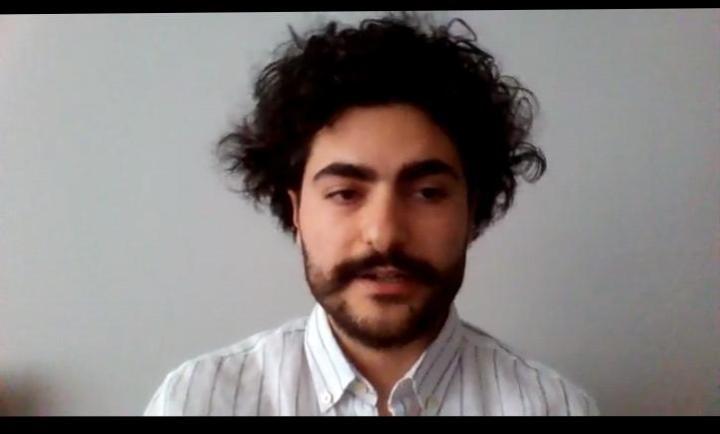
Erg. Furkan CANGİ, who participated in our seminar with his presentation on “Regulation in Children with Cerebral Palsy” and included various literature research and valuable information in his speech, stated: “Regulation can be described as 'the ability to adjust in response to change. Therefore, self-regulation is an internal (individual/self) response to change.' Regulation can be examined by dividing it into 5 categories: physiological, sensory, emotional, cognitive, and behavioral. Children with Cerebral Palsy are at risk for physiological regulation. Sensory regulation also holds great importance. Babies' first task is to learn to regulate themselves and be interested in the world. Babies develop by regulating themselves through the environment they explore. Sudden transitions from crying to laughing in babies can be given as an example of a regulation problem. Behavioral regulation encompasses other types of regulation in parts.”
“The use of assistive equipment is appropriate for individuals with Cerebral Palsy, but one should avoid becoming overly dependent on them.”
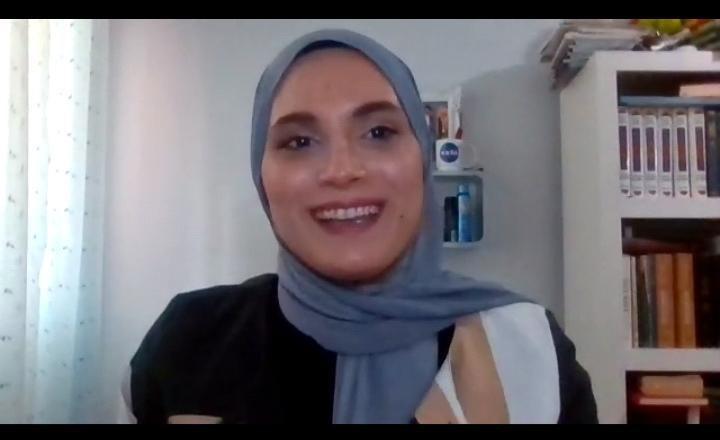
Speaking under the title “How Should Daily Living Participation Activities Be in Children Diagnosed with Cerebral Palsy, with Case Examples?”, Erg. İremnur SOYLU said: “Cerebral Palsy is a group of physical disabilities that affect muscle movement, tone, or posture in the human body. The aims of occupational therapy can be listed as strengthening and increasing performance, facilitating the learning of skills and functions necessary for adaptation and productivity, reducing or correcting pathology, and managing an individual's participation in selected activities to promote and maintain well-being. Activity examples that can be applied to individuals with Cerebral Palsy can be created and implemented in a wide variety of ways. Eating activities with a fork designed for use by individuals with Cerebral Palsy are one such example. The impact of these activities on children and their families is very significant. While ensuring children's development and participation in daily life, it also offers families the opportunity to interact with their children. The importance of assistive equipment is, of course, great and has been diversified for different uses. At this point, we occupational therapists must be careful to recommend the correct equipment. The use of assistive equipment is appropriate for individuals with Cerebral Palsy, but one should avoid becoming overly dependent on them. Individuals with Cerebral Palsy can also have serious respiratory problems. The types of interventions that can be applied in cases of oral sensitivity are very important. There are 18 billion individuals with Cerebral Palsy worldwide, and the awareness we need to show for Cerebral Palsy is crucial.”

“Families of individuals with Cerebral Palsy should be informed about the process and included in the planning stages.”
Addressing the topic of “Interaction of Cerebral Palsy with the Family and the Contribution of the Occupational Therapist,” Erg. İsa KÖR stated: “Occupational therapists should interact with the families of children with Cerebral Palsy. Families of individuals with Cerebral Palsy should be informed about the process and included in the planning stages. Studies conducted with families are of great importance in increasing both intra-family motivation, the satisfaction of the child with Cerebral Palsy, and the interaction between the child and the family. Individuals with Cerebral Palsy should take part in daily living activities. By including individuals with Cerebral Palsy in life through activities determined according to their capacities, they can improve their existing capacities and psychology over time with these various daily living activities. Providing necessary training to families is also a key point. Because the effect of motivation that will follow the training can be more permanent and stronger. While giving hope to families is not wrong, it is important that these hopes are realistic to prevent exhausting processes. Activity selections should also be appropriate for capacity. The approach of occupational therapists is very important. The solution to the fatigue of families of individuals with Cerebral Palsy must be provided by a division of labor (between mother and father). I generally see fathers staying more in the background compared to mothers. A balance must be established in this situation, and occupational therapists should both conduct research and develop applications for this balance. A division of labor must be ensured. Our awareness is very important and valuable. I also believe it needs to be developed.”
Share
Update Date: February 28, 2026
Creation Date: October 07, 2021