

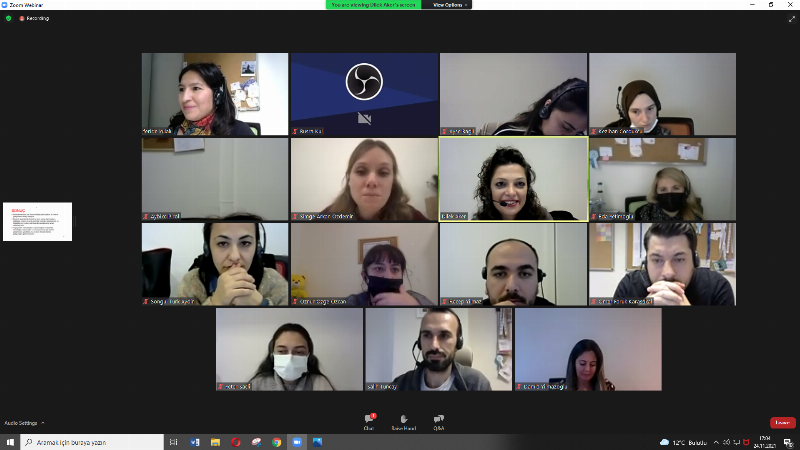
The ‘Nanotechnology and Its Place in Medicine’ event, organized online under the leadership of Lecturer Dilek Aker from Üsküdar University Vocational School of Health Services (SHMYO) Nuclear Technology and Radiation Safety Program, was held online. Aker, who shared information about nanotechnology at the event, pointed out that nanotechnology simplifies human life.
Content
Nanotechnology and Its Place in Medicine event held
“Nanotechnology also takes examples from living creatures around us”
Aker pointed out that substances exhibit different and extraordinary behaviors at nano scale; “Substances that do not conduct light and electricity under normal conditions show exactly the opposite properties at nano scale. The first scientist to talk about doing things at the nano scale was Richard Philip Feynman, born in America in 1918. Algae in the sea reproduce by clinging to flat surfaces, but thanks to the nano surfaces on a shark's skin, algae cannot cling. The nano surfaces on the skin also allow the shark to move faster by cutting through the water. Nanotechnology also takes examples from living creatures around us. The spider, its web, and its mucus still retain their mystery in today's technology. With this inspiration from nature, things that were said to be impossible are being designed one by one, making human life easier and more perfect.” she said.
“The purpose of nanomedicine is to benefit the living organism”
Lecturer Dilek Aker stated that one of the most widely used fields of nanotechnology is medicine; “It is very widely used in all areas, from the diagnosis to the treatment of diseases. A living cell is a biological system that continues its function at the nano scale. From another perspective; a cell is like a natural motor with nano-sized parts inside. This natural motor produces proteins based on the information it receives from the DNA in the cell nucleus. Proteins work like nanorobots, ensuring the continuity of the cellular system. The purpose of nanomedicine is to control the functioning of this system in a way that benefits the living organism. In recent years, nanomedicine has been used in the development of carriers that can facilitate the uptake of drugs and vaccines into the body. Thanks to new molecules obtained using this technology, very durable and lightweight artificial bone can be created. Nano-HA crystals are obtained by restructuring the hydroxyapatite (HA) crystals that form the bone.” she said.
“Thanks to nanotechnology, behaviors in animal brains can be monitored”
Lecturer Dilek Aker; “Artificial DNA, Japanese scientists created artificial DNA for the first time in 2007 with the help of nanotechnology. First, they formed the sugar-structured skeleton. On this skeleton, they placed 4 different bases, also artificially obtained. The artificial bases were joined to the deoxyribose skeleton with acetylene bonds. When the DNA strand obtained in this way was joined with another similarly created strand, the typical double helix structure of DNA was formed. Nanorobots need to be protected from cells and antibodies that attack all foreign molecules entering the body. Their smooth and round surfaces, small volumes, and ability to perform their tasks in a very short time will largely protect nanorobots from cell attacks. The aim is to deliver necessary chemical substances to every desired region of the body, and even to every single cell. One of the biggest limitations in cancer treatment is that drugs damage healthy cells while affecting cancer cells. In short, thanks to this technology, the drug reaches exactly the right address. Thanks to nanotechnology, it is possible to monitor cells in the brain. Through certain molecules placed in cell cultures obtained from animal brains, the behavior of these cells in the brain can be tracked.” she stated.
Share
Update Date: February 28, 2026
Creation Date: November 25, 2021
Request a Call
Other News
- The book that read today's digital threats in 2014: Being a Conscious Family
- Experts warn: 'Instead of memorizing letters, teach pencil grip, scissor use, and coloring'
- School fear and school love both start in the family!
- Family is not merely transforming, it is being battered under a serious assault
- Artificial intelligence opens the door to early diagnosis in autism!