

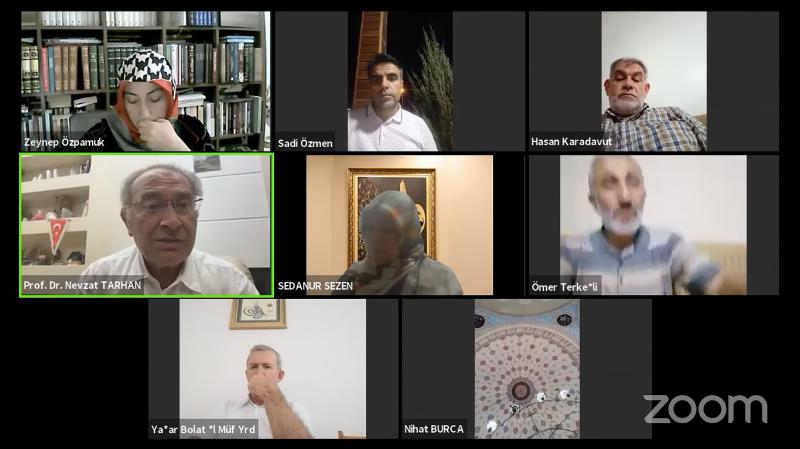
Üsküdar Üniversitesi Founding Rector, Psychiatrist Prof. Dr. Nevzat Tarhan was a live broadcast guest at the event titled ‘Family Trainings During the Pandemic Process,’ organized by the Kayseri Provincial Mufti's Office. In the program, moderated by Education Specialist Sadi Özmen, Prof. Dr. Nevzat Tarhan made evaluations on ‘Bride-Mother-in-Law Relationships,’ stating: “In families where there is conflict between the bride and mother-in-law, we usually suggest a practical solution. We tell brides, ‘Include your mother-in-law in the team.’ Because if you keep your mother-in-law out of the team, she will probe, interfere, and problems will arise. What does a smart bride do? She includes her mother-in-law in the team, prevents problems by making her happy with words of appreciation and praise, and focuses on her mother-in-law’s positive aspects.”
Content
A Mother-in-Law Excluded from the 'Team' Stirs Trouble, Probes, and Causes Problems…

“When this cannot be done, role sharing within the family is not properly managed”
Prof. Dr. Nevzat Tarhan emphasized that after marriage, men and women should approach roles like mother-in-law and father-in-law with a new, unbiased perspective, stating: “One of the questions we ask in the relationship status scale is role sharing within the family. If role sharing is good, and married individuals know how to share roles, many problems can be resolved very easily. Because role sharing is not done during marriage, parties continue their old roles. I can give a concrete example for this: Two young people get married. Both have an environment in which they grew up. They all have life scenarios they learned. They have a mother, an older brother, siblings; with the person they marry, this time a mother-in-law comes. In our culture, 'kayınvalide' (mother-in-law) is used in the sense of a substitute for a mother. 'Kayınpeder' (father-in-law) is used in the sense of a substitute for a father. Here, the roles a person has learned since childhood, such as mother, father, and spouse roles, need to change after marriage. They need to rewrite the life scenarios they learned in childhood because the actors have changed; new actors have entered their lives. The mother-in-law has entered along with the mother, the father-in-law along with the father, or other actors may have entered. When other actors enter, the old scenarios need to be rewritten. The issue is not to completely abandon or discard them, but to rewrite them according to the new situation. When this cannot be done, role sharing within the family is not properly managed.”
“The magic word in marriage is not love, but cooperation”
Prof. Dr. Nevzat Tarhan stated that the magic concept in marriage is 'cooperation', saying: “The disease of suspicion is the biggest enemy of marriage. Marriage means a close relationship, a shared life. In a close relationship, home should be a safe space, a harbor. A male figure who frightens his spouse into obeying him is not valid today. That is, the type of woman who shrinks, fears, and does not seek her rights, as in the past, no longer exists. If a man says, 'The person I marry must be my slave, she must do whatever I say, she must be a doormat,' this person is a narcissist. Narcissism means selfishness becoming a personality trait. In relationship therapies, there is the 'golden mean rule.' According to this rule, parties meet in the middle by taking steps towards each other in turn. For this reason, the magic word in marriage is not love, but cooperation. Relationships where love and cooperation are achieved turn into lifelong love. Marriages where there is love but no cooperation do not work. For this reason, the magic word is cooperation; in couples therapy, we teach this as relationship management.”
“If there is conversation and sharing in the family, conflict arises less”
Prof. Dr. Nevzat Tarhan drew attention to the importance of quality togetherness in marriage, stating: “20-30 years ago, if a husband and wife could spare half an hour for each other for the marriage to work, today this period should be one hour. Because the magic word here is spending time together. The person should strive for this. The man can work intensely, both the woman and man can work; in such situations, we say there should be quality togetherness, even if for a short time. By quality togetherness, we mean many things like ten minutes of eye contact, a loving gaze, a sweet word, a warm touch, a smile. Believe me, these are magical concepts. They immediately cause a change in the other party. There is a study conducted by the University of Nebraska in America. They identified two common features in happy families. First, spending time together. If there is conversation and sharing in the family, conflict arises less here. The second identified feature is the use of words of appreciation, praise, and approval; when I heard this, I later learned a Hadith-i Sharif. The Prophet says: ‘Be gracious to one another, husband and wife.’ In other words, using words of appreciation within the family is actually the Prophet’s morality.”
“Behind most bride-mother-in-law issues is negative communication”
Prof. Dr. Nevzat Tarhan addressed the causes of mother-in-law and bride conflicts occurring within the family, stating: “In families where there is conflict between the bride and mother-in-law, we usually suggest a practical solution. We tell brides, ‘Include your mother-in-law in the team.’ Because if you keep your mother-in-law out of the team, she will probe, interfere, and problems will arise. What does a smart bride do? She includes her mother-in-law in the team, prevents problems by making her happy with words of appreciation and praise, and focuses on her mother-in-law’s positive aspects. Currently, behind most of the bride-mother-in-law issues within the family is negative communication. She sees her fault, and she sees her fault. Your mother, my mother; your money, my money; your word, my word; whereas in such situations, if the positive aspects of the parties could be seen, and a relationship could be established based on that, the problem could be resolved more easily.”
“To ensure peace at home, horizontal relationships need to be established”
Prof. Dr. Nevzat Tarhan emphasized the importance of correct communication within the family, stating: “One of the most common erroneous behaviors we encounter in families is the formation of coalitions within the family. For example, if a mother forms a coalition with a child, or a father forms a coalition with a child, there is polarization in that home. When a problem arises, teams immediately form, and there will be no peace in this home. To ensure peace at home, horizontal relationships need to be established. The parents will establish a relationship among themselves, and the children will establish a relationship among themselves. When there is a problem, parents will use a common language. For example, when children fight, parents should approach them by establishing a horizontal relationship, saying, ‘Try to solve the problem among yourselves; if you can’t, consult us.’ In this way, children will learn problem-solving styles. In tensions between mother-in-law and bride, a woman who establishes a horizontal relationship with her spouse can solve the problem by talking if she explains to her spouse that her mother-in-law is being unfair, even if well-intentioned.”
Share
Request a Call
Other News
- Social responsibility courses moved to the field
- Erasmus+ Orientation Week completed at Üsküdar
- Prof. Nevzat Tarhan: “Brain secretes ‘dark glue’ in social media lynchers!”
- Prof. Nevzat Tarhan: “Every segment of society should be able to say, ‘This constitution is my constitution!’”
- OHS releases guide for safe operation of industrial robots