

Üsküdar Üniversitesi Molecular Biology and Genetics Club organized the “Molecular Biology and Genetics Days” event, which was held online due to pandemic conditions. The event brought together young people studying in this field with expert names in their domain.
Content
Molecular Biology and Genetics Days Held
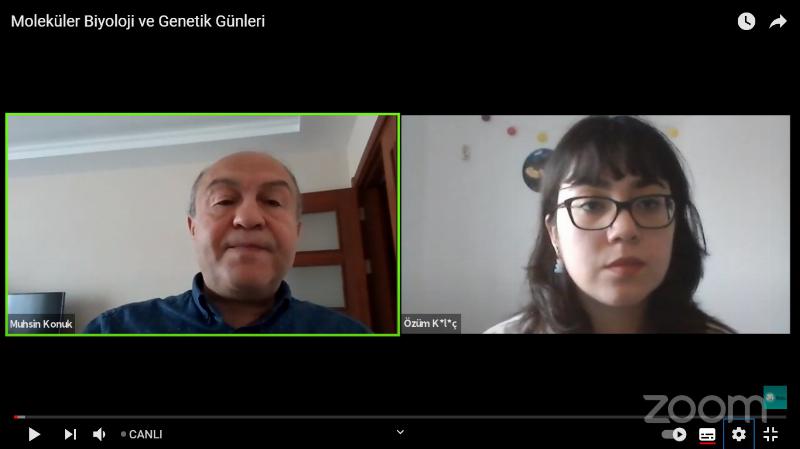
Speakers at the program included Cihan Kaplan, Üsküdar Üniversitesi Corporate and Entrepreneurship Specialist; Assoc. Prof. Dr. Türker Tekin Ergüzel, Head of Üsküdar Üniversitesi Software Engineering Department; Dr. Cihan Taştan, Lecturer in Molecular Biology and Genetics; Assoc. Prof. Dr. Kaan Yılancıoğlu, Head of Biosafety Department; Assoc. Prof. Dr. Mehmet Gönen from Koç Üniversitesi Faculty of Engineering; Arif Engin Çetin, Research Group Leader; and Dr. Cihan Aydın, Lecturer in Molecular Biology and Genetics Department at Medeniyet Üniversitesi.
Prof. Dr. Muhsin Konuk, Vice-Rector of Üsküdar Üniversitesi and Head of the Molecular Biology and Genetics Department, delivered the opening speech of the program, stating that students put great effort into organizing the event; “They have been thinking and working hard on this for about five or six months. I would like to thank all our participating colleagues and professors from academia, who are involved in this work, for kindly accepting our students' invitations and sharing their experiences with our young people.”
Kaplan: “Bio-entrepreneurship is a field that requires collaboration”
Cihan Kaplan, Corporate and Entrepreneurship Specialist, made evaluations under the title “Bio-entrepreneurship” at the event; “When we look at business and product development processes in biotechnology, bio-entrepreneurship is actually a field that requires collaboration and an ecosystem, rather than the work of a single team or individual. Because it absolutely requires collaboration between academia and industry. The knowledge, research, and experiments of academia necessitate collaboration with industry to commercialize and market these products. While research and laboratory environments are very important and necessary in the academic part, it is crucial in the industrial part to transform the academic research into a market need. Therefore, the place of academia and industry collaboration in biotechnological products is generally valuable.
When you think of an idea and say ‘I will bring this to life, this is incredible, I will change the world,’ you usually start with great enthusiasm. Then, due to the lack of a roadmap and difficulties in the work, a feeling of getting lost emerges. Those who build their team or create that roadmap see the challenges of business development when things don't go smoothly. In other words, even if your product is very excellent in Turkey, you cannot be motivated if you cannot market or sell it, or if people don't use it. That's why you have to constantly develop your business. Entrepreneurs generally get lost in the difficulties of business development. Then there is a period of stagnation and recovery. There is such a complex phase where, at the moment they say ‘I have to do this,’ they emerge from this stagnant period and generally succeed.”
Assoc. Prof. Dr. Ergüzel: “It turned out that the collected big data is valuable”
Assoc. Prof. Dr. Türker Tekin Ergüzel, who gave a speech titled “Artificial Intelligence Applications in Health” at the event, said, “As the software engineering department, while we thought we were closer to our professors in fields such as computer engineering, mechanical engineering, and industrial engineering, after listening to the work here and the contributions of our professors, we actually see that we have quite a lot in common. This is very valuable for us. Because our main need is actually based on the analysis of data collected in the field of health sciences, it uses data provided by you. Knowing this is very valuable for us. Therefore, interdisciplinary evaluation studies are much more important. With Industry 4.0, interactions between systems in factories and communication among them were planned to create faster and more accurate production systems. However, we have reached such an unforeseen point that now, along with production lines, big data generated by rapid production has emerged. Now it has become clear that this collected big data actually needs to be processed over time and is very valuable.”
Lecturer Taştan: “The world will give approval, even financial support, for this”
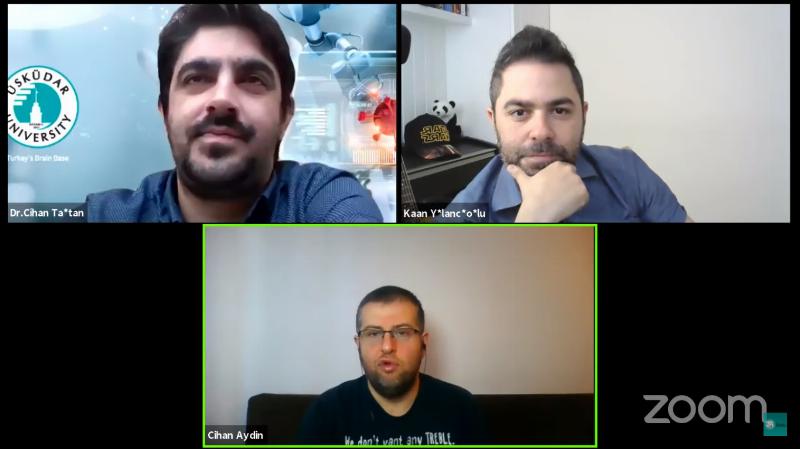
Dr. Cihan Taştan, Lecturer, spoke about current developments in molecular biology and genetics, stating; “It was certainly not expected that a new generation technology like MRNA would be so easily accepted by the world under normal circumstances, enter a market, and emerge as an economic product. There were many different side effects or possibilities and situations that frightened people. However, the Covid-19 pandemic enabled the immediate acceptance of new-generation products in the field of biotechnology. Because people, in a desperate struggle for life, became able to accept all products whose effectiveness they saw. Although these products are currently produced specifically for the Covid-19 pandemic, they showed that they can be used in other areas of biotechnology and that people, both at the state and societal levels, can support this. We will administer MRNA to the body because ears are now familiar with it. When we say ‘we will change human genetics and cure diseases,’ it is highly likely that the world will provide support, approval, and even financial backing for this.”
Assoc. Prof. Dr. Yılancıoğlu: “Things that didn't exist yesterday are in use today”
Assoc. Prof. Dr. Kaan Yılancıoğlu, in his speech, touched upon the acceleration of disease diagnosis due to the acceleration of technology; “None of us are talking about a change from today to tomorrow. This is not something that can happen. Not from today to tomorrow, but it is clear that many things will change in the next ten, twenty years, this is a fact. Because things that didn't exist yesterday are in use today. We are talking about something made like the technology that uses it, and this is not at very high costs. I honestly cannot imagine the technologies 10-15 years from now. Everything will accelerate much more, and consequently, the diagnostic part of the disease will also accelerate greatly. We will increase our sequencing as easily as buying cheese and bread from the grocery store. Today there are technologies that have advanced so much in phenotype, and I'm talking about very complex reasons. Our phenotype; our appearance, our face. Systems have emerged where we can even model our face from DNA. These are tremendous systems, and cancer is something much less complex compared to this. I'm talking about a more chaotic process, but still simpler if you compare it to this. If we can even do these systems, doing it for cancer will be simpler. At least that's how it looks right now.”
Lecturer Aydın: “People will kill themselves before they modify themselves”
Dr. Cihan Aydın, Lecturer in Molecular Biology and Genetics at Medeniyet Üniversitesi, spoke about current developments in molecular biology and genetics, stating; “People will kill themselves before they modify themselves. Because this is not something that can be done ignorantly or unconsciously. Due to the uncontrolled and unregulated nature of the work, I think it will initially get worse. For example, how many years does a doctor work before performing an operation? They study medicine for five or six years, then get their specialization, and only then become capable of holding a scalpel. When this work is undertaken without foundational knowledge, it can lead to dangerous consequences. Especially within the ethical aspects, I believe that such gene modification studies need to be strictly regulated. As humanity, we are genetically coded to try to do everything the short way, to make a profit from everything. Especially in community projects, there are many people and many jobs that explode.”
Assoc. Prof. Dr. Gönen: “If cancer is detected at an early stage, it can be treated with nearly one hundred percent success”
In his speech titled “Understanding Cancer Biology with Artificial Learning Models” at the event, Assoc. Prof. Dr. Mehmet Gönen said, “When cancer begins to form, it first appears in one cell, then in a few cells. When the tumor is caught at what we call the early stage – meaning it hasn't spread, remains in its own organ, and its size is below a certain amount – it can be treated with surgical intervention, with nearly one hundred percent success. Because it has not spread to the lymph nodes or distant organs, it is relatively easy to treat.”
Çetin: “Transducers can convert the binding event into different signals”
Research Group Leader Arif Engin Çetin, in his speech titled “Optical Biosensors and Applications,” said; “Biosensors are devices that can convert biological responses, analytical signals, into meaningful signals. These signals can be electronic, optical, mechanical, or chemical signals. The names of the methods we use vary depending on these signals. Optical biosensors can be called electrochemical. Transducers can convert the binding event into different signals. This means converting a biological response into an electrical, optical, or temperature response.”
Share
Update Date: February 27, 2026
Creation Date: March 16, 2021
Request a Call
Other News
- The book that read today's digital threats in 2014: Being a Conscious Family
- Experts warn: 'Instead of memorizing letters, teach pencil grip, scissor use, and coloring'
- School fear and school love both start in the family!
- Family is not merely transforming, it is being battered under a serious assault
- Artificial intelligence opens the door to early diagnosis in autism!