

'Methodology of Tafsir in Muhâkemât' was discussed in the "RİNAP Monthly Talk" program organized by Üsküdar University Risale-i Nur Research Platform (RİNAP). The guest of the program, regularly held every month by RİNAP, was Hasan Emre Ulutop from Sabahattin Zaim University.
Content
Methodology of Tafsir Discussed in Muhâkemât
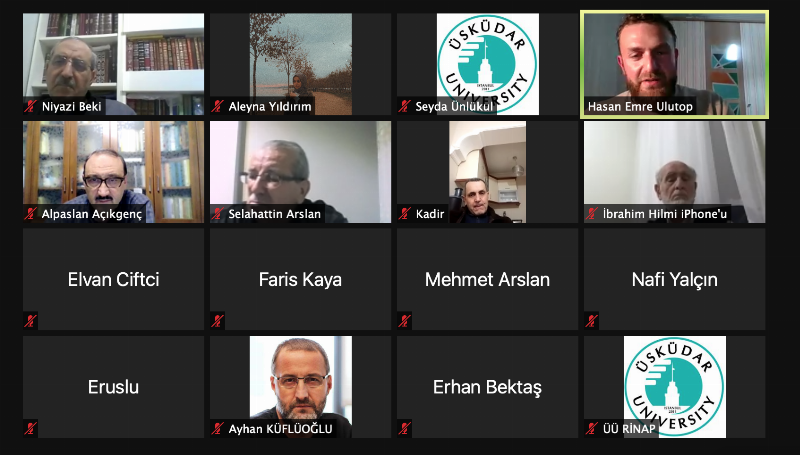
“Methodology of Tafsir is Examined from Three Aspects”
In the online program, Ulutop, referring to the three main headings of tafsir methodology, said: “The methodology of tafsir is examined from three aspects. Today, it is used in many senses. These are Quranic sciences, the method of composition, and the method of understanding verses. The primary ones are, first and foremost, Quranic sciences. It is also used in the sense of authorship sciences. That is, it refers to how the exegete composes their exegesis. And there is the method of understanding verses, used in the sense of how a verse is understood and how commentary related to that verse is made. We also examined Said Nursi’s Muhâkemât from these three perspectives.”
“We Witness the Use of Unconventional Analogies in Tafsir”
Ulutop stated that Quranic literature is a subject many exegetes have focused on and authored works about, saying: “Some have addressed tafsir methodology topics in certain tafsir introductions, while others have dealt with them as independent books. From this, regarding the issue of al-Amsal, we witness the Master’s intellect employing unconventional analogies within the scope of representation in tafsir, after incorporating them into the definition of analogy through metaphor. Here, Said Nursi’s view, which distinguishes him from the literature, is that representation goes far beyond mere expression in terms of its epistemic value; methodological discussions on this have been ongoing since the early periods.”
“Said Nursi’s Definition of the Quran is Quite Original”
Ulutop, speaking about the differences in Quranic definitions, said: “The Master’s definition of the Quran is very original. The most fundamental among the definition theories in the literature are definitions made with one of the proximate genus and proximate differentiae. The definition of a thing, in terms of the science of definition, was made this way until Ghazali. However, according to Ghazali, knowledge is; ‘All these things you do are actually deficient. The true definition of a thing is structured with all its essential qualities.’ That is, it is a definition made by mentioning all the characteristics that possess that essence, and also by mentioning its proximate genus,” he stated.
Share
Update Date: February 28, 2026
Creation Date: February 25, 2022
Request a Call
Other News
- The book that read today's digital threats in 2014: Being a Conscious Family
- Experts warn: 'Instead of memorizing letters, teach pencil grip, scissor use, and coloring'
- School fear and school love both start in the family!
- Family is not merely transforming, it is being battered under a serious assault
- Artificial intelligence opens the door to early diagnosis in autism!