

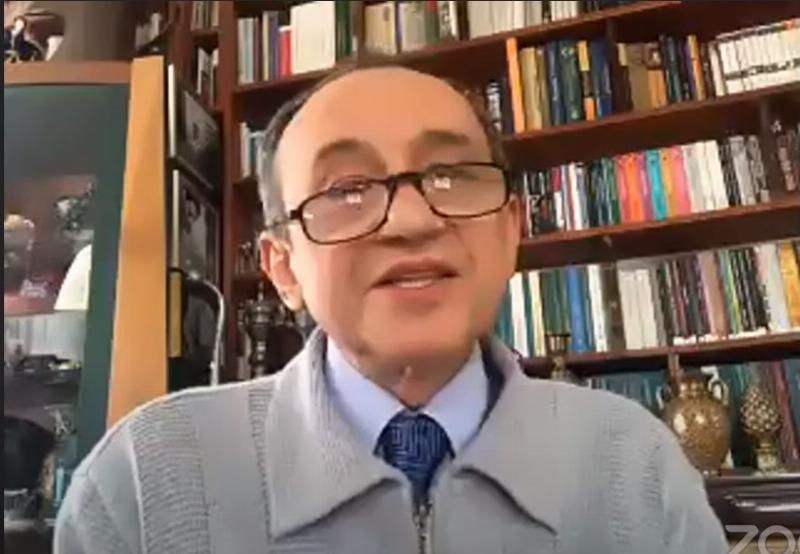
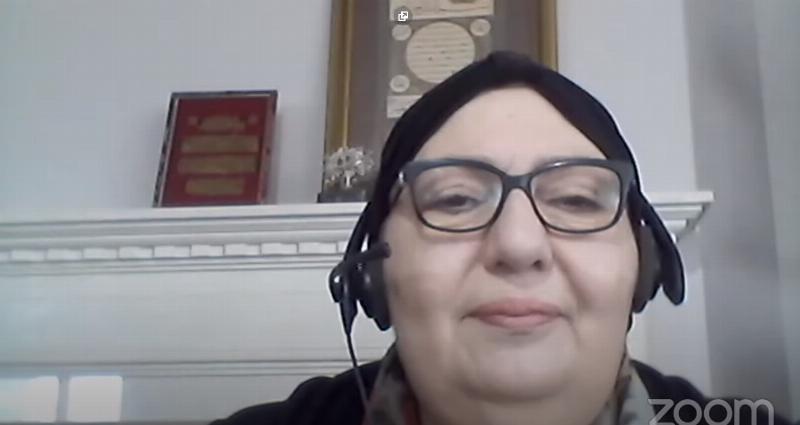
On the occasion of Mawlana Rumi's 747th Anniversary of Union with the Divine, within the scope of Şeb-i Arûs Week, an interview program titled “Heart to Heart” was held in cooperation with Üsküdar University Institute for Sufi Studies and Kerim Foundation. The interview, moderated by Prof. Dr. Emine Yeniterzi, Assistant Director of Üsküdar University Institute for Sufi Studies, featured Üsküdar University Rector's Advisor Cemalnur Sargut and guest speaker Author Sadık Yalsızuçanlar.
Content
Mawlana Rumi Commemorated with 'Heart to Heart' on His 747th Anniversary of Union with the Divine
Prof. Dr. Emine Yeniterzi said, “We are conducting studies to better understand Mawlana Rumi and his works. Mawlana Rumi says in the last couplet of the Mathnawi, ‘There is a window from heart to heart (a path from heart to heart).’ It is extremely interesting that this six-volume work ends with this sentence. In another couplet, he states that the light distinguishing between truth and falsehood shone from the window opened from heart to heart. In these days when face-to-face conversation is difficult, we will converse ‘Heart to Heart’ today. In several of Mawlana Rumi's works, including the Mathnawi, he often dwells upon the Holy Hadith of our Prophet, ‘Allah does not look at your forms or your possessions, but He looks at your hearts and your deeds.’”
Prof. Yeniterzi continued the interview by focusing on the couplets in the Mathnawi that contain the word 'gönül' (heart/soul) and related expressions, and by taking the speakers' opinions.

Cemalnur Sargut: ‘‘It is not possible to approach Allah from an unawakened heart’’
Referring to Sufism through Mawlana Rumi's words about the heart, Sargut said; “Mawlana Rumi states, Sufism means lighting a lamp in the heart with the divine lights. He says, ‘Nothing in the mouth, everything in the heart.’ It is not possible to describe the heart with words. A human being has a soul, ego (nafs), mind, and heart in their body. Unfortunately, our ego is in opposition, our soul is always in acceptance, but Allah desires the heart to awaken and be elevated amidst these. The heart is a barzakh (isthmus/intermediary realm). The heart that perceives, feels, and sees, when illuminated, is called 'gönül' (inner heart/soul). Our hearts must be awake.”
“A heart burning with love is called a broken heart”
Cemalnur Sargut stated, saying that there is a path from the heart to all organs, and if the heart revives, the whole body revives; “One who sees the heart and feels the meaning of Allah in the heart seeks nothing else. Because they seek nothing else, they become ‘strange’ in this world; not everyone can understand them. This is why our Prophet, when asked, ‘Who is the strangest?’ replied, ‘It is I and the Qur’an.’ He says, ‘I and my meaning are the strangest.’ If a heart is illuminated with the light of Allah, for that heart, Allah says, ‘there shall be no fear upon them, nor shall they grieve.’ A heart burning with love is called a broken heart.”
“The heart is what sees the truth”
Emphasizing the similarity between the Holy Qur'an and Insan-i Kamil (The Perfect Human Being), Sargut said: “The explanation of the Holy Qur'an is a healing for hearts. Our Prophet also glorified it by living it. The heart is a grace between the two fingers of the Most Merciful, meaning it is Allah's favor.” She stated that the Mathnawi is Allah's bestowal upon Hz. Pir (Mawlana Rumi) and, through that bestowal, the sole literary book and grace capable of teaching the truth of the Perfect Human Being.

Sadık Yalsızuçanlar: “The Gönül (Heart/Soul) is the Gönül of Insan-i Kamil (The Perfect Human Being)’’
Sadık Yalsızuçanlar, pointing out that the concept of 'gönül' (heart/soul) has many broad meanings in the dictionary, said, “There is no direct equivalent for 'gönül' in world languages, especially in the West. In Old Turkish, it was called ‘köngül,’ and it existed even before Old Anatolian Turkish.” Yalsızuçanlar also gave examples of couplets from Sufi poets and Yunus Emre, stating; “'Gönül' is a quite broad concept in our dictionary. We have many examples like 'gönüldaş' (soulmate), 'gönül açıklığı' (open-heartedness), 'gönül bekleme' (waiting for someone's favor), 'gönlü yatmak' (to be content), 'gönlü razı olmak' (to agree willingly), 'gönlünden geçirmek' (to wish), 'gönlünden kopmak' (to break off from one's heart), 'gönlünü etmek' (to please someone), 'gönül almak' (to appease someone), 'gönlünü avlamak' (to win someone's heart). It is the source of Sufi love. The 'Gönül' is the 'gönül' of Insan-i Kamil (The Perfect Human Being).”
“All people must purify their hearts”
Yalsızuçanlar stated that in Sufism, the nourishment of the spiritual body is inversely proportional to the nourishment of the material body; “For the spiritual body to be well-nourished, one should not give too much importance to the nourishment of the material body.” He said that Mawlana Rumi explains that the Prophet's Holy Hadith, which means “I am a mirror polished by the hand of God's power. Everyone looks there and sees me as they are themselves,” speaks of the mirror of the heart.
Share
Update Date: February 27, 2026
Creation Date: December 18, 2020
Request a Call
Other News
- The book that read today's digital threats in 2014: Being a Conscious Family
- Experts warn: 'Instead of memorizing letters, teach pencil grip, scissor use, and coloring'
- School fear and school love both start in the family!
- Family is not merely transforming, it is being battered under a serious assault
- Artificial intelligence opens the door to early diagnosis in autism!