

A seminar titled “Cognitive Effects of Sensory Deprivation” was organized by the Psychology Department of Üsküdar University Faculty of Humanities and Social Sciences. Prof. Dr. Hıdır İlyas Göz, Head of the Psychology Doctoral Program, attended as a speaker at the event, which was held at Üsküdar University South Campus Socrates Hall and also broadcast online. Prof. Dr. Göz focused on the nature of the interaction between social isolation conditions and mental functions from a psychological perspective. Üsküdar University Founding Rector Prof. Dr. Nevzat Tarhan also attended the seminar and made evaluations.
Content
Loneliness, isolated life disrupts mental functioning!

“For the mind to function efficiently, it needs to receive sufficient levels and variety of stimulation”
Göz stated that the lack and monotony of stimulation under social isolation conditions would disrupt the mind's functioning, supporting this statement by referring to scientific experiments. Göz said; “When a person is alone, isolated, their mental functioning deteriorates. It's like this in the real world too. To reveal the effect of one factor, all other factors are isolated. To find the effect of isolation, one isolates oneself from their immediate environment. After 1 or 2 days, hallucinations begin to appear. Brain function deteriorates, and the person is unaware of it. We see prison conditions, solitary confinement, and studies conducted at the poles that clearly support experimental findings.” Göz associated the reason for more accidents on high-quality highways compared to low-quality and winding roads with lack of stimulation and monotony. He reinforced this association by emphasizing that in a psychological experiment on university students who stayed alone in a cube for 24 hours a day, these students started showing restlessness after three days and did not want to stay in the room despite being paid $170 daily. Göz also added; “There are also differences in dyadic isolation, with variations emerging between men and women in couples.”
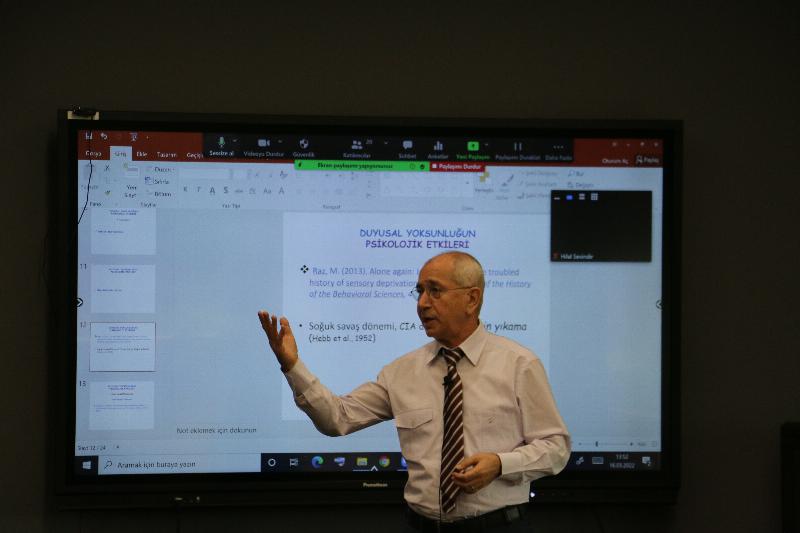
“A person who remains alone struggles to adapt to the isolation regimen”
Referring to experiments conducted by the CIA during the Cold War with court permission, Prof. Dr. Göz said; “When prisoner-subjects are left alone, after a certain period, they tend to adopt thoughts heard from audio recordings instead of thoughts that contradict their own. Based on this information, prisoners held in six-square-meter cells, over 1-6 weeks, successively exhibit behaviors such as anxiety, hyperactivity, adaptation to the isolation regimen, demoralization, adopting a meaningless facial expression, becoming dirty and disheveled, automatism in their movements, soiling themselves, crying, mumbling, having nightmares, and experiencing hallucinations. Individuals subjected to the experiment show symptoms like depression and self-harm after being isolated for a period. Similar symptoms like aggression and depression are also observed in isolated animals.”
Prof. Dr. Nevzat Tarhan: “Sudden stimulus deprivation seriously affects the brain”
Tarhan said; “When stimulation decreases, the brain works with stimulation; when there is no stimulation, it atrophies and the perception of reality is distorted.” He continued; “A distinction is made between imaginary reality, dream reality, and physical reality. A person caught in a fantasy realizes it's a fantasy once they escape its influence. Normal people distinguish physical reality, but schizophrenics cannot. They create their own fantasy and believe in it. Psychotic behaviors occur due to the disruption of networks in the brain. Sudden stimulus deprivation also affects the brain. In Sufism, it is not a complete form of isolation because they are not only occupied with worldly affairs. Besides that, they perform their worship, and because they are not only occupied with worldly affairs, they are not left without stimulation; it's just isolated focus. There is also voluntariness involved. When you leave the brain without stimulation, it affects the person because humans are social beings. If there is constant stimulation, the brain produces energy, and measurements are made through these processes. Many neurological studies on this topic are already available.”
Share
Update Date: February 28, 2026
Creation Date: March 17, 2022
Request a Call
Other News
- Social responsibility courses moved to the field
- Erasmus+ Orientation Week completed at Üsküdar
- Prof. Nevzat Tarhan: “Brain secretes ‘dark glue’ in social media lynchers!”
- Prof. Nevzat Tarhan: “Every segment of society should be able to say, ‘This constitution is my constitution!’”
- OHS releases guide for safe operation of industrial robots