

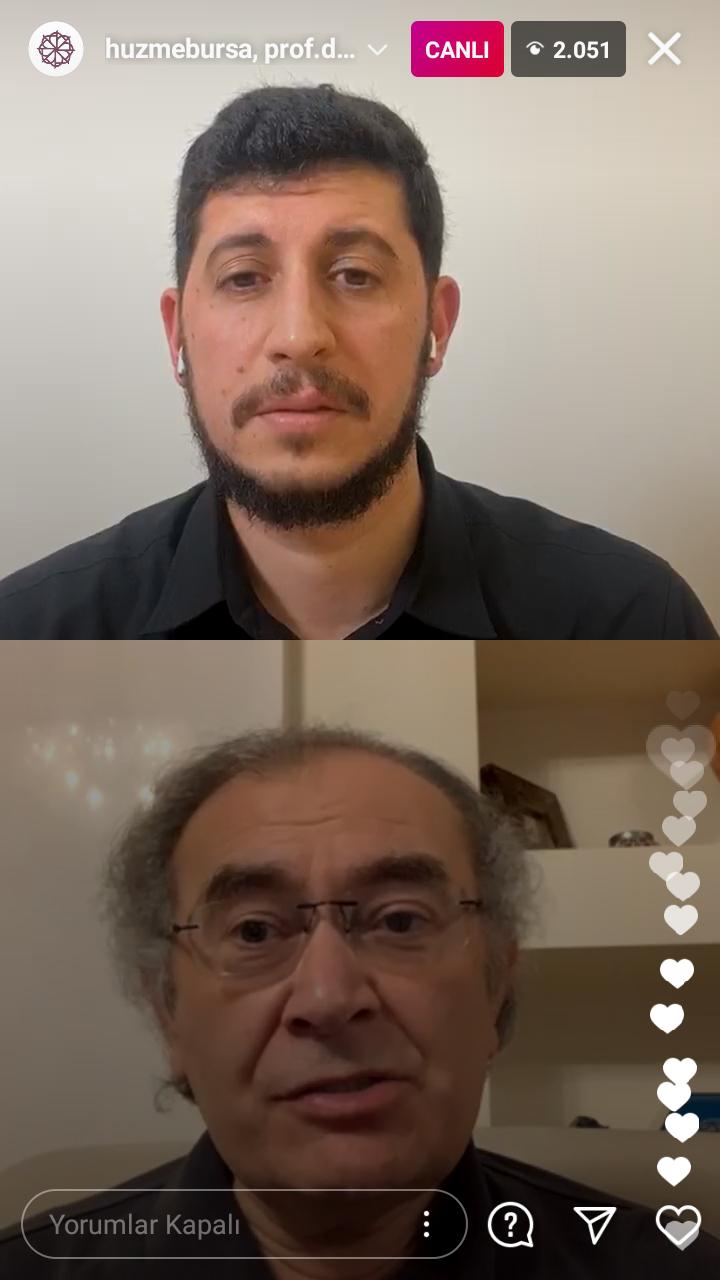
Üsküdar Üniversitesi Founding Rector Prof. Dr. Nevzat Tarhan, was a guest on Huzme Science and Culture Association's Instagram live broadcast. Prof. Dr. Tarhan made evaluations regarding the topic 'Is it possible to get rid of obsessive thoughts?' in the online interview held via Huzme Bursa Instagram page. Tarhan said; "To get rid of obsessive thoughts, the rule 'stop, think, shift your focus' should be applied."
Content
Is it possible to get rid of obsessive thoughts?
“Our brain has to produce thoughts and feelings”
Tarhan, in the live broadcast moderated by Harun Serkan Aktaş, stated that when a feeling is added to a thought that comes to mind, that thought becomes permanent information for the individual; “The words 'vesvese' (obsessive thought) and 'takıntı' (fixation/obsession) have two medical equivalents: rumination and obsession. The exact English equivalent of rumination is mental chewing, meaning a repetition of thought. Ruminations are also called fixations or obsessive thoughts. Another concept is obsession. Compulsion, on the other hand, is a behavior that follows an obsession. If we don't confuse these concepts, the situation will be better understood.
Obsessive thoughts (Vesvese) have two dimensions: abstract and concrete. The abstract dimension is the dimension that has not found a corresponding biological basis in the brain. When we say 'Satan gives obsessive thoughts', we are mostly talking about the dimension that has no biological counterpart in the brain. Here, thought demonstrates a function of the brain. Just as our liver produces bile, our brain has to produce thoughts and feelings. We activate the prefrontal cortex to transform thought into behavior. For example, when a thought comes to mind and we add a feeling to it, or when a feeling comes to our heart and we add a thought to it, and then we approve it, it's like pressing the enter key. That information then becomes permanent for us. There is a file of approved permanent information in the brain. The brain records them there. If we repeat them later, they become a habit; if we continue to repeat them, they become a personality trait. This process takes approximately six months." he stated.
“Excessive fear takes away a person’s freedom”
Tarhan also drew attention to the importance of shifting the focus of attention in individuals with obsessive fixations; “In early-stage obsession cases, we teach individuals to shift their focus of attention. The more you fight obsessive thoughts, the more those thoughts increase. The most important thing to do in this regard is to change your attention and the subject. After a certain time, the thought will fade away. For example, if bees come to a person and you try to swat them away, they won't leave; but if you remain neutral, the bees will buzz and fly away. Patients with OCD (obsessive-compulsive disorder) are in the same situation. Here, the whole job is for the individual to be able to manage their thoughts. If the problem hasn't escalated when the thought begins, it can be resolved, but if the person cannot manage their thoughts, then clinical help is required in such situations. A small amount of fear, controllable anxiety, is beneficial. But when there is excessive fear, a person's freedom is lost." He said.
“To get rid of obsessive thoughts, the rule ‘Stop, think, shift your focus’ should be applied”
Tarhan, in his evaluations on how individuals should manage obsessive thoughts, said; "The first thing to do immediately when an obsessive thought comes is to say 'This thought is not mine, my mind and conscience do not approve, I cannot think like this, therefore this thought is a parasitic thought.' A parasitic thought is a microbial thought. If we wash it immediately, it will be gone, but if we tamper with it or scratch our skin, it won't work. Therefore, it is necessary not to dwell on the subject. Changing the subject and shifting the focus of attention is the best approach. The main rule to be applied here should be stop, think, shift your focus." He said.
News: Hande Erdem
Share
Update Date: February 27, 2026
Creation Date: December 15, 2020
Request a Call
Other News
- The book that read today's digital threats in 2014: Being a Conscious Family
- Experts warn: 'Instead of memorizing letters, teach pencil grip, scissor use, and coloring'
- School fear and school love both start in the family!
- Family is not merely transforming, it is being battered under a serious assault
- Artificial intelligence opens the door to early diagnosis in autism!