

Independence Poet Mehmet Akif Ersoy was commemorated on the 86th anniversary of his passing at a panel titled “From Tradition to Future: Asım’s Generation and Globalization” organized by Üsküdar Üniversitesi. The opening speech of the panel was delivered by Üsküdar Üniversitesi Founding Rector, Psychiatrist Prof. Dr. Nevzat Tarhan, who emphasized that Ersoy was a person of character, dignity, and nobility. Prof. Dr. Nevzat Tarhan said, “The public loved Mehmet Akif very much because of his pure, innocent, and victimized stance. Mehmet Akif is worthy of being an example for Asım’s generation. If he were alive today, he would want the unification of religious sciences and natural sciences. For this reason, Asım’s generation should be a generation that can unite the world and the afterlife, and religious sciences and natural sciences. Today we are talking about the metaverse. This world is the metaverse of the afterlife. We should not only think worldly but also value eternal life.”
Content
Independence Poet Mehmet Akif Ersoy Commemorated on 86th Anniversary of His Passing
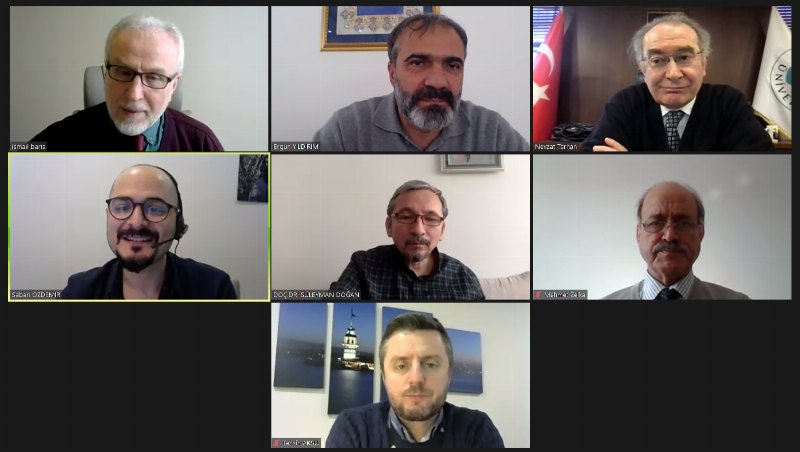
Independence Poet Mehmet Akif Ersoy was commemorated on the 86th anniversary of his passing at a panel organized by Üsküdar Üniversitesi Globalization and Youth Issues Application and Research Center (KÜGEMER).
In the online panel moderated by journalist Şaban Özdemir, Independence poet Mehmet Akif Ersoy was discussed in the context of “From Tradition to Future: Asım’s Generation and Globalization.”
Üsküdar Üniversitesi Founding Rector Prof. Dr. Nevzat Tarhan evaluated the life of poet Mehmet Akif Ersoy in the political-psychological context of three periods: despotism (istibdat), constitutional monarchy (meşrutiyet), and republic.
Prof. Dr. Nevzat Tarhan: “Mehmet Akif adopted an ideal like Asım’s generation”
Stating that Mehmet Akif Ersoy’s life can be examined in three periods, Prof. Dr. Nevzat Tarhan said, “Mehmet Akif set an ideal like Asım’s generation. The first period of his life is the period before the constitutional monarchy, known as despotism (istibdat) with the terms used at that time. We can list these periods as despotism, constitutional monarchy, and republican period. When we evaluate the situation of the Ottoman Empire from the perspective of political psychology, we can say that in the period of despotism, trials were secret, but investigations were open. This situation shows the exact opposite of the current one. According to universal legal orders, trials were conducted secretly in the period before the constitutional monarchy. A system where the realization of justice was hardly possible was implemented.”
Prof. Dr. Nevzat Tarhan: “Abdulhamid Han realized that the world was changing”
Prof. Dr. Nevzat Tarhan stated that Abdulhamid Han realized the world was changing and quoted Bediüzzaman Said Nursi Hazretleri’s words, ‘either a new state or collapse,’ and continued his words as follows:
“Abdulhamid was a person with a vision for the future. He had realized what was to come, seen a wind of freedom blowing in the world, and proclaimed the second constitutional period. The most important characteristic of science is predictability. Politicians plan for the next election. People in a company who only have a mission but no vision only think about the current state of the company, but the senior management of the company has vision, thinks strategically, and tries to foresee the next few years. Universities in democratic countries also determine the vision of politics. Therefore, universities also have responsibilities for predictability. It is very important for universities to be autonomous and to be able to make free decisions in this regard. Thus, they provide information, and the decision to implement rests with the decision-makers. If universities cannot express their views, they have become politicized, suppressed, and alienated from democracy.”
Prof. Dr. Nevzat Tarhan: “Mehmet Akif was a strong advocate of the constitutional monarchy”
Stating that Mehmet Akif also adopted the idea of ‘either a new state or collapse,’ like Abdulhamid, Prof. Dr. Nevzat Tarhan said, “When the constitutional monarchy was declared and freedom came in that period, troubles arose in the east. People questioned whether they would be under the command of an Armenian commander. During the discussions, emphasis was constantly placed on competence and merit. It was highlighted that competence and merit are more important than nationality in such situations. Mehmet Akif also became one of the strong advocates of the constitutional monarchy. The constitutional monarchy did not continue due to the mistakes of the Committee of Union and Progress (İttihat ve Terakki). The nation was not yet ready for a constitutional monarchy. If the constitutional monarchy had continued, Turkey would currently be in a constitutional monarchy system like England, Belgium, and Denmark. It would have been a symbolic monarchy. The sultanate and caliphate would have continued, but because the constitutional monarchy continued, there would have been a slow transition to a system of freedoms.”
Prof. Dr. Nevzat Tarhan: “The 31 March incidents were the most significant problem of the period”
Prof. Dr. Nevzat Tarhan reminded that the most important problem of that period was the outbreak of the 31 March incident and continued his words as follows:
“The 31 March incidents turned everything upside down. It lasted for 13 days, but there was no intervention for 10 days. The army commanded by Mahmut Şevket Pasha suppressed the rebellion in 3 days, but he was also killed. It is known that the deep state was uncomfortable with Mahmut Şevket Pasha. During this process, Mehmet Akif also defended the constitutional monarchy. Abdulhamid acted liberally in the first period. In the constitutional monarchy, he developed a vision that said ‘either a new state or collapse,’ rather than just the sultanate. When he transitioned to the Republican era, Mehmet Akif encountered a despotism even more severe than the despotism of the late Ottoman period. He saw that the fundamental values he cherished most were beginning to disappear. The adhan (call to prayer) was Turkified, and benches were placed in some mosques. Independence Courts were established, and gallows appeared everywhere in a serious manner. People who did not wear hats began to be executed. These are not being discussed in Turkey now, but unfortunately, incidents that did not comply with universal law occurred at that time.”
Prof. Dr. Nevzat Tarhan: “Mehmet Akif is a symbol of nobility, character, and dignity”
Prof. Dr. Nevzat Tarhan stated that Mehmet Akif went to Egypt after these events and, upon returning, saw that people were afraid to go near him, saying, “Those who went to Mehmet Akif began to be monitored. He was not assassinated but passed away hungry and thirsty. His funeral was carried out by İstanbul Üniversitesi students in 1936. Society loves Mehmet Akif immensely. The reason for this love is his pure, innocent, and victimized stance. He was wronged but never rebelled. Even if he opposed, he did not rebel. It is said that Mehmet Akif had the copy of the Holy Quran he translated burned to prevent it from being misused. Mehmet Akif left this world in hardship, but I believe he holds a very important place in the sight of Allah. Because he did not compromise his afterlife for worldly gain. Mehmet Akif Ersoy is a symbol of nobility, character, and dignity. He is worthy of being an example for Asım’s generation.”
Prof. Dr. Nevzat Tarhan: “This world is the metaverse of the afterlife”
Prof. Dr. Nevzat Tarhan concluded his words by recalling Mehmet Akif’s saying, ‘We must make the Quran speak to the comprehension of the age’:
“With these words, Mehmet Akif talks about the necessity of translating the Holy Quran into the understanding of this age. In the understanding of this age, scientific soundness has replaced religious soundness. If Mehmet Akif were alive today, he would want the unification of religious sciences and natural sciences. When the two come together, we find the truth. The purpose of science is to seek and find truth. In Asım’s generation, we need this mental transformation. Modernism offered us happiness as ‘have something and be happy.’ Always externally driven happiness. True happiness is not externally driven happiness; it is internal happiness. Internal happiness is also the happiness of meaning. If a person attributes meaning to a subject and strives for it, they can grasp meaning and be happy. But those who cannot grasp meaning, even if they have everything, cannot be happy and commit suicide. Ephemeral things cannot make a person happy. There must be an eternal meaning in human life. Asım’s generation should be a generation that can unite the world and the afterlife, and religious sciences and natural sciences. Today we are talking about the metaverse. In fact, this world is the metaverse of the afterlife. We are walking around with our avatars. We should not only think worldly but also value eternal life. Mehmet Akif Ersoy left us a very beautiful work like Safahat. We should thank him for leaving us a work like the National Anthem that sends shivers down our spines every time we read it.”
Prof. Dr. İsmail Barış: “The youth idealized by Mehmet Akif Ersoy possess good morals”
Üsküdar Üniversitesi KÜGEMER Director Prof. Dr. İsmail Barış pointed out the importance of telling young people about Independence poet Mehmet Akif Ersoy. Prof. Dr. İsmail Barış said, “One of the most prominent features of the youth idealized by Mehmet Akif Ersoy is possessing good morals. According to Akif, ignorant morality leads to idleness and weakness; immoral knowledge, on the other hand, poisons the souls of nations. In one of his poems, he advises young people on this matter: ‘Come, complete your education quickly, come on! / Because for the future of nations, my child / Knowledge and virtue, two powers are needed.’ That is, complete your education and studies as soon as possible. Because for the future of nations, you need two powers: one is knowledge (marifet), and the other is virtue (fazilet).”
Prof. Dr. İsmail Barış: “Mehmet Akif Ersoy combined these two characteristics in his person”
Noting that these two characteristics are important for young people to regulate themselves and the world, Prof. Dr. İsmail Barış said, “The essence is that knowledge (marifet), that is, science, engineering, and technology, should be under the protection of the fanus (lantern) of wisdom. Virtue (fazilet), on the other hand, means ensuring that national, religious, and moral values dominate the life of individuals, youth, and society. If we can raise young people with these two characteristics, such a nation and its members will uphold human dignity and honor not only for their own nation but for all nations of the world. Mehmet Akif Ersoy is a person who combined these two characteristics in his person. Ersoy, on one hand, became acquainted with natural sciences by studying veterinary medicine, on the other hand, became the most influential and important literary figure of his era, and furthermore, became a good politician and a good family man. In a political sense, he is an intellectual who unified religious will with national will.”
Prof. Dr. Ergün Yıldırım: “Mehmet Akif also criticizes modernism and tradition”
İstanbul Sabahattin Zaim Üniversitesi Sociology Department Faculty Member Prof. Dr. Ergün Yıldırım said, “To commemorate Akif is actually to commemorate this nation. To talk about Akif is to talk about the Turkish intellectual. To reflect on Akif is actually to reflect on the ideal intellectual in Turkey,” thanking Üsküdar Üniversitesi. Prof. Dr. Ergün Yıldırım stated that Mehmet Akif criticized modernism, adding, “He doesn’t just criticize modernity. While establishing a relationship with tradition, he also maintains a distance from it. He also criticizes tradition. For example, his poem 'Neighborhood Coffeehouse' is important in this regard. In 'Neighborhood Coffeehouse,' he portrays with the meticulousness of a sociologist how a Muslim society is closed off to the present, completely bound to tradition, lazy, living far from science, neglecting family values, and living idly in a coffeehouse. Then he criticizes this.”
Assoc. Prof. Dr. Süleyman Doğan: “Mehmet Akif Ersoy is a synthesis personality”
Yıldız Teknik Üniversitesi Humanities and Social Sciences Department Faculty Member Assoc. Prof. Dr. Süleyman Doğan stated that Mehmet Akif Ersoy is a synthesis personality, saying, “Mehmet Akif’s father, Tahir Efendi, was a müderris (Islamic scholar/professor) of Balkan origin. He was sent from Albania to study, but when he came here, the Fatih müderrisleri did not let him go, saying, ‘Tahir Efendi, we need you.’ Mehmet Akif grew up in such an environment. Space, time, and geographies are very influential in the formation of personality and character. He received his religious education to his core. His mother, Şerife Hanım, was originally from Bukhara, Turkestan. She settled in Tokat and appears as a very devout believing woman. One side Turkestan, one side the Balkans. Such a personality in terms of climate and geography. His father enrolled him in a modern school, while his mother wanted him to receive madrasah education. Ersoy, who grew up in such a family, received a modern education. Therefore, he appears as a personality who would combine both the West and the East.” Assoc. Prof. Dr. Süleyman Doğan stated that Mehmet Akif Ersoy was a versatile personality, an intellectual, and a scholar, and said that Mehmet Akif fought against ignorance, bigotry, and despotism. Doğan also noted that Akif revealed the shortcomings in education in his work Asım’ın Nesli.
Share
Request a Call
Other News
- Social responsibility courses moved to the field
- Erasmus+ Orientation Week completed at Üsküdar
- Prof. Nevzat Tarhan: “Brain secretes ‘dark glue’ in social media lynchers!”
- Prof. Nevzat Tarhan: “Every segment of society should be able to say, ‘This constitution is my constitution!’”
- OHS releases guide for safe operation of industrial robots