

Recently, for the first time in Turkey, a 3D copy of a living human brain was made. This brain belonged to Psychiatrist Prof. Dr. Nevzat Tarhan. Prof. Tarhan, one of the few experts who genuinely reflects on human cognitive evolution, happiness, and eternal unhappiness, says, "We have genes for the supermind, genes for the search for meaning."
Content
The Human Brain Will Be An Analyzer
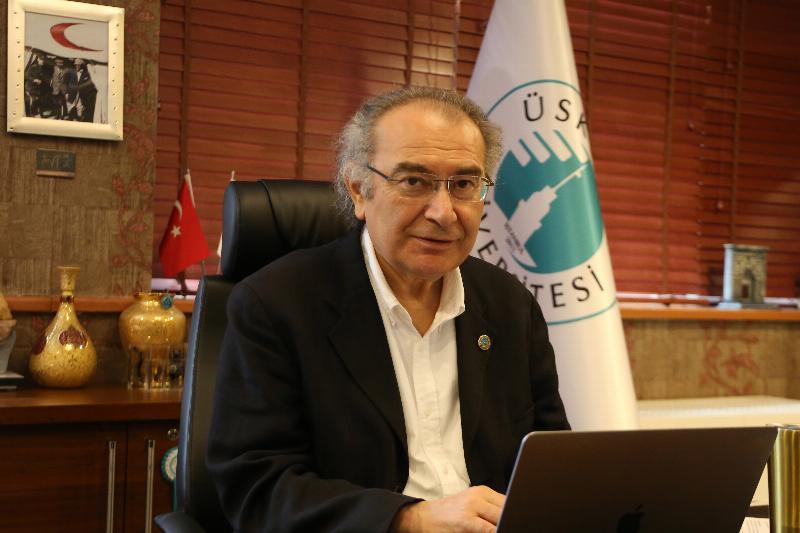
Psychiatrist Prof. Dr. Nevzat Tarhan is the founder of NPİSTANBUL Beyin Hastanesi, Turkey's first neuropsychiatry hospital, and also the Founding Rector of Üsküdar Üniversitesi. He is a pioneering figure who has achieved many firsts in Turkey in both education and treatment. Recently, as part of brain studies within the university, a copy was created using Prof. Tarhan's brain MRI via a 3D printer. Thus, for the first time in Turkey, a living human brain was printed as a replica. In summary, we can also say that a 3D copy of a living human brain was made for the first time in Turkey. Based on this recent news, we went to talk with Prof. Tarhan about the brain and humanity. We discussed human cognitive evolution, happiness, and eternal unhappiness with Professor Nevzat, who is also the author of numerous 'bestselling' books and known for his interest in Sufism. Professor Nevzat, stating that the soul program is linked to a universal database, says, "We have genes for the supermind, genes for the search for meaning." Professor Nevzat deeply analyzed many topics that the curious reader will find interesting, from the brain to the heart, from the mental transformation of modern humans to what Generation Z is seeking, from the causes of unhappiness to the world of the future.
For the first time in Turkey, a 3D copy of Prof. Tarhan's brain was produced. So, what will be this technology's contribution to science? How can this technology benefit us in the near future in healthcare or other fields? Starting his speech by stating that this is a result of Industry 4.0, Prof. Tarhan said the following:
"Dr. Ihab Ellaf, a faculty member from our university's Computer Engineering Department, is working on software that enables a record to be printed in 3D. A person's brain image is taken with an MRI, simulated to be lifelike with artificial intelligence, and an anatomical replica is produced with a 3D printer. When this is applied to cavities, tumors, and masses resulting from disorders in the brain, major abnormalities in a person's brain will become visible, allowing surgeons and neurologists to study them. Furthermore, if we consider a step further; tractography images of the brain's roadmap, i.e., what we call network connections, are being taken. Simulations of tractographies can be performed on the 3D printer. For instance, it will be possible to see which region of the brain becomes active when a person daydreams. By having a person daydream, a simulation regarding how that person's brain works can be created. For example, it will be possible to identify which region of a frightened person's brain is active at that moment. Thus, perhaps the damaged part of the brain could be treated by applying radio frequency waves. Industry 4.0 has now made it possible to intervene with radio frequencies in areas of the brain where function is impaired."
"They will be victims of learned autism"
The way children and young people use their brains is different from the previous generation, and much more different from earlier generations. They have less physical contact, more virtual contact. And in the near future, they will all be adults, managers, party leaders, scientists, artists. So, will they be better or worse? Where is human mental evolution heading? According to Prof. Tarhan, this is a very important question. Tarhan states that mental transformation has begun to be the fastest transformation, sharing the following views: "A new era of data mining, where hundred-meter wells are dug, has now begun. In this data mining era, the human brain will only have an effect as an interpreter. It will collect and interpret data. The one who makes the top interpretation will create the most accurate information, and perhaps artificial intelligences will also make the interpretations. Currently, human minds will be more useful in doing this, being able to use more information. While analyzing the impact of this generation's difference from previous generations on mental evolution, a group will become victims. For instance, a segment of young people will fall victim to learned autism. In learned autism, a group of young people will misuse virtual contact. When virtual contact becomes their sole interest, they will be unable to experience many characteristics when that isn't present. That is, they will be a kind of autistic. Learned autism will increase the number of people with underdeveloped emotional and social skills. Individuals who set the right goals by balancing physical and virtual contact without detaching from life and reality will emerge from this period with gains."
"We have genes for the supermind"
Things like career success, earning good money, having a good marriage seem like they should make a person happy, but people who achieve everything they desire still aren't happy, why? According to Tarhan, it's because people are looking for happiness in the wrong place. Tarhan conveys the following views on the matter: "For example, there is currently a popular culture that attributes happiness to external causes. People say, 'If I have this, I'll be happy; if I have that, I'll be happy; if I possess something, I'll be happy.' Internal reasons should be created. This is called authentic happiness. For a person to achieve authentic happiness, they need to learn. Happiness is not a state, but a process. 'Will you be happy in five years? Do the decisions you've made and the steps you've taken ensure this?' For this, one should not say 'I have achieved everything, my happiness will last.' Life is a dynamic process; in such situations, we are on a journey in life, moving within a time tunnel. We cannot know what will come our way. The human brain is a brain that is interested in both the past and the future. We have genes for the supermind. There are genes for the perception of death, perception of time, perception of the future, and the search for meaning. These are meta-supermind genes. These genes differentiate us from other living beings.
"The human brain will be an analyzer"
So what will the human brain do after this point? Tarhan's answer to this question also sheds light on the professions of the future: "The human brain will be a proper analyzer here. To be an analyzer, one needs to read and possess sufficient knowledge to analyze correctly. In the coming decades, the profession of 'analyzer' will come to the forefront. For instance, analysts who collect data and perform data mining in fields like intelligence analysis, children's literature analysis, or monetary policy analysis already hold the profession of the future. Data analysts will form the profession of the future. Generations who can master data very well will be able to seize the future. For example, the founders of Facebook also do data mining in Silicon Valley. They collect data and create big data. That's why young people will be data analysts in the future. Young people who become data analysts will have seized the profession of the future."
"The brain's connection capacity has developed"
Unfortunately, while medical studies aimed at rejuvenation are increasing, studies on the human brain are not increasing simultaneously. Perhaps in the future, young bodies with Alzheimer's will roam among us. Who knows? Tarhan, lamenting that not enough investment had been made in human brain research until 2018, said: "This topic came to the agenda at the Davos Summit in 2018. Yuval Noah Harari drew attention to artificial intelligence. He said, 'The future is heading towards digital dictatorship, and the era of big data has begun.' Everything will now be turned into data. Another aspect of the universe emerged. As studies related to the human brain advance, quantum mechanics comes into play. The three states of matter—solid, liquid, and gas—were known. Currently, the fourth state of matter has been identified. That is the state of information. Currently, brain capacity has not increased, but it is true that human lifespan has extended. Brain capacity has not increased, but the accumulation of experience and data has. These two enable humans to do better things. The human brain's capacity has not developed, but its connection capacity has developed," he says.
"The mind is a quantum brain"
The extension of human life is always desired, but is this positive for our brains? Indeed, even after 30-40 years, we start to get bored, thinking we know and understand everything. Life isn't as enjoyable as it was in one's 20s. In this situation, one wonders, 'What difference does it make if our life extends or not?' According to Prof. Tarhan's remarks on the subject, there is a p300 wave in the human brain. A person connects to the recording device in the brain. The brain tells the person to press yes when they see red on the computer screen, and no when they see blue. If that information is confirmed, red is pressed. The brain's responses are recorded instantly. Processing speed is measured based on the brain's responses. The p300 wave is used here. A person gets an idea and says, 'Do this.' There is another brain above our brain. There is the mind. Our mind commands our brain. The mind is a quantum brain. Every piece of information is recorded in the form of a signal. It is recorded as wavelength oscillation and vibration but not in our brain. It is recorded in that quantum brain, in the mind part above our brain. This quantum brain is also a brain that can communicate with the universe. A brain that can connect with the universal flow.
"We are not living in the world, we are passing through the world"
According to some views, the human brain genetically has the capacity to live for 120, sometimes 140 years. In developed countries, the average age of death has risen to 78 for women and 72 for men. It used to be between 40-50, now it's 80, perhaps it will reach 120, but until then, it needs to be kept dynamic. Our brain has a characteristic: it operates on the 'use it or lose it' principle. Therefore, the brain is an organ that opens up as it is used, like a water well. The correct use of the brain should be for the purpose of being open to new experiences and self-improvement. If we only see it as eating and drinking, it's correct, but it's not programmed that way. Animal brains are like that. Tolstoy says, 'I am in pursuit of a meaning that explains death.' Therefore, if a person seeks meaning and purpose in their life, and brings openness to death, they will also find the reason for their existence. As Rumi said, 'We are not living in the world, we are passing through the world.' Such a person is never bored. They might even find their existential factory settings and succeed in discovering themselves in life...
"If the universe is a software, it was planned from the very beginning"
To what extent are the concepts of boredom, happiness, and unhappiness related to the brain? Is it truly only about the brain? Prof. Tarhan's answer to these ancient questions is as follows: "This is a question related to the relationship between soul and brain. We said there's a mind above our brain; you can't take the brain from a human identity and put it into someone else. The most important studies undertaken by psychiatry are consciousness studies. 'Why am I me, why am I not someone else but me, why do I remain myself after birth and then die?' If the universe is a software, it was planned from the very beginning. If the universe is a simulation, current information leads to that conclusion. If the universe is a video, quantum information has accumulated. It is necessary to properly understand the soul-body relationship, the body-mind relationship, and the mind-universe relationship. The body-mind relationship is somehow being resolved. When a person is under stress, the brain secretes chemicals with excessive properties. There are five horsemen of darkness: grudge, hatred, jealousy, anger, and hostility. Humans secrete specific chemicals for each emotion. This is pumped into the blood, causing heart palpitations and increased vascular resistance. Vessels in the frontal region of the brain open, and attention increases. The stomach stops eating, enacting a fight-or-flight response. When organs give a fight-or-flight response, and this lasts for an hour or two, the brain says, 'Relax, there's no danger.' In a way, the brain also manages our organs."
"The soul program is related to a universal database"
So what does the heart do in the meantime? According to Prof. Tarhan, the heart is the organ of emotions. After signals from the brain, we feel fear, excitement, coldness, and warmth in the heart. The heart has a central effect. Concepts like boredom and happiness are actually concepts mediated by the brain. If our brain works like a biological computer, we cannot decipher its program. It also has a soul program. That soul program is also related to a universal database. Just as computers are connected to satellites, our brain and the soul program are connected to the universal database. Other living beings come by learning; humans come without knowing, without learning. A person's happiness or boredom is related to their ability to manage the soul program in their brain. The brain needs to be seen as a device. If we configure our soul program incorrectly, we suffer; if we configure it correctly, we are happy. Anyone who knows the science of happiness will not look for it in the wrong place.
"Generation Z is a generation that demands innocence"
People who cannot feel happy, for whom antidepressants are not a remedy, we know, are those who try to find a way out from everything they read. What is actually sought is the answer to the question: 'What can we do to return our brain to child-like awareness?' Prof. Tarhan suggests that the answer we are looking for might be hidden in Generation Z: "There is a generation criticized as Generation Z. Generation Z is insistently trying to protect itself from the negativity of our generations. The point that Generations X and Y cannot understand is this: these generations want to maintain what I call child-like awareness. Its name is innocence. Because it desires innocence, the current generation does not want intrigue. They hate the tricks seen in women's programming on television, the situations where 'whose hand is in whose pocket' is unclear, and these relationships. This generation wants to return to child-like awareness and remain that way. This generation's demand for innocence is greater than other generations', and this demand will lead the world to a better place. I see this not as a threat but as a new reality. I believe Generation Z will lead our future, and the world, to a better place. According to those who write pessimistic scenarios, the future will not be bad; it will be better thanks to this generation."
Source: Para Magazine
Share
Update Date: February 28, 2026
Creation Date: September 27, 2021
Request a Call
Other News
- The book that read today's digital threats in 2014: Being a Conscious Family
- Experts warn: 'Instead of memorizing letters, teach pencil grip, scissor use, and coloring'
- School fear and school love both start in the family!
- Family is not merely transforming, it is being battered under a serious assault
- Artificial intelligence opens the door to early diagnosis in autism!