

The earthquake experienced in Izmir psychologically affected almost everyone, especially children, as well as adults and society in general. Psychiatrist Prof. Dr. Nevzat Tarhan, drawing attention to the fact that constantly thinking about the earthquake can lead to the onset of mental illnesses in individuals, said, “It is essential to take necessary precautions and not to disconnect from routine life. Especially since children observe, parents need to remain calm while watching earthquake-related news and during an earthquake, and explain the reality of an earthquake with appropriate body language.”
Content
How Does an Earthquake Affect Our Mental Health?
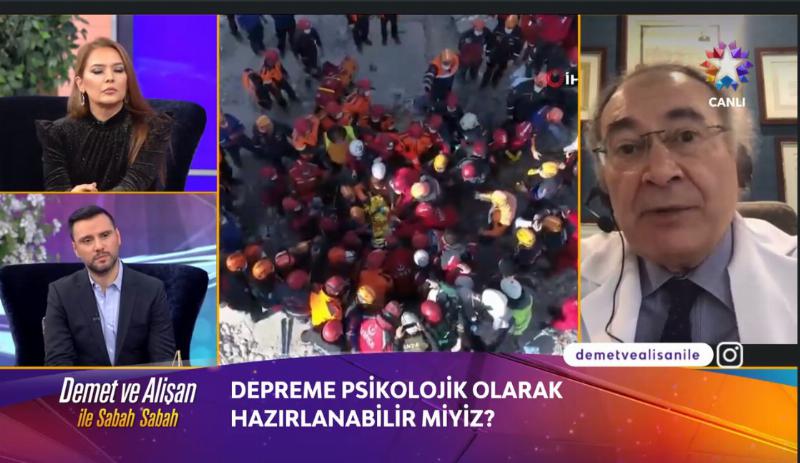
Üsküdar Üniversitesi Founding Rector, Psychiatrist Prof. Dr. Nevzat Tarhan made important evaluations regarding the psychological effects of earthquakes in a program he attended on Star TV.
Some individuals live by thinking about the earthquake
Stating that living with an earthquake is truly a difficult emotion, Prof. Dr. Nevzat Tarhan said, “What should we do in such a situation? Some people constantly think about the earthquake 24 hours a day. They live by thinking about it. Since this is their sole focus of interest, they cannot control their anxieties and fears, and mental illnesses begin. The World Health Organization has a statement, ‘A pandemic of mental health disorders is expected.’ On top of that, an earthquake occurred.”
The reality of earthquakes should be explained to children
Underlining that we need to psychologically prepare for earthquakes because we are an earthquake-prone country, Tarhan said, “Children are especially important because they look to their parents. Children aged 5-6, whose sense of reality has not yet developed, observe their parents when watching earthquake news or when an earthquake occurs. If the parents are calm and relaxed, the child will also be calm. If the parents are not with the child but far away in such situations, the child becomes more frightened. In such cases, there should be reassuring people like grandmothers or grandfathers nearby. The child relaxes or overcomes their fear by imitating adults. If the parents are anxious, the child becomes even more anxious. That's why, instead of keeping the child away from news and such situations, they need to say that such a reality exists.”
Brain exercises should be done for the moment of an earthquake
Prof. Dr. Nevzat Tarhan said, ‘Since Turkey is an earthquake zone, earthquakes occur in different places almost every year. Therefore, brain exercises should be done with children about what can be done during an earthquake,’ and continued: “Doing nothing is uncertainty and increases anxiety. Babies Ayda and Elif were rescued. This means that if it's done safely, one can be rescued even in the worst situation. Just as a child is vaccinated when they have the flu, we need to teach them what to do when an earthquake happens, like a psychological, violence vaccine. Knowing that something can be done reassures the child. We will take our precautions and continue to live as if there is no earthquake.”
Prof. Dr. Nevzat Tarhan: “Disconnecting from routine increases anxiety”
Tarhan, emphasizing that after acquiring an earthquake kit and taking precautions related to earthquakes, daily life and work should continue, said, “The moment we disconnect from routine, anxiety increases. This time, mental health deteriorates, and life becomes unbearable. Seeing the earthquake as an enemy causes great anxiety. If parents proceed with the thought, ‘An earthquake is a reality, let's accept this reality, let's take precautions against the danger it poses, and let's continue on our path in life,’ the child accepts it in the same way. Moreover, they learn stress management at an early age. This is also psychological resilience training. It is beneficial to provide this training to children who experience trauma in earthquake zones or due to illness. Psychological resilience is important, especially for children, and of course, for adults too.”
Those who lose loved ones should be made to feel they are not alone
Prof. Dr. Nevzat Tarhan continued, saying, ‘We all saw Elif holding a finger. It became a symbolic photo.’: “At that moment, a person's greatest need is the need for attachment and to overcome loneliness. Feeling safe is very important. Someone who has lost a loved one should feel that they are not alone. For this, methods such as the 40th day and the 52nd day have been developed in our culture. The underlying message of these is that you are not alone to those who have lost loved ones. Some try to give medication immediately in such situations. However, this is pain; if a person does not experience and covers up that pain, it manifests differently later. This is a trauma. We have a post-traumatic growth scale that we apply. This scale asks whether the trauma was properly addressed. Some completely ignore it, but the brain does not forget that trauma. It emerges differently with the slightest trauma.”
It should be explained to children with body language
Tarhan stated that education given by increasing fear, regret, guilt, or horror in a child is dangerous, and said, “Just as we explain that not crossing at a red light is a rule in traffic, we should explain to the child that this is also a rule in that way. When behaved exaggeratedly, it starts to enter children's dreams. The child cannot bear this; there is no need to exaggerate. We should explain it with body language without instilling fear and panic in the child. Body language is much more important.”
Upper floors are safer during an earthquake
Tarhan said, “When the Yalova earthquake occurred, everyone tried to go outside, while the Japanese tried to go up. In an earthquake, upper floors are safer, not ground floors. The main thing to pay attention to here is whether the buildings are sturdy. An earthquake does not kill, poor construction kills. If the person's place of residence is safe, they will take their precautions and forget about the earthquake. But if they have moved to a new place and an earthquake has recently occurred, especially then, the person needs to be able to think, ‘What can I do if an earthquake happens here?’”
Narcissistic individuals can act as if nothing happened
Prof. Dr. Nevzat Tarhan stated that there are people who continue their lives as if nothing happened after an earthquake, and continued: “This is also a defense mechanism, an escape. In fact, these are the people who are most afraid, lack empathy, are egocentric, and have many narcissistic traits. They behave this way because they are afraid to confront the earthquake. Such people exist in society, but it is important that there are few of them. Turkey is truly exemplary to the world in this regard. We see people working in the rubble areas crying when they save lives. This characteristic is not found in many parts of the world. These characteristics should also be taught to children at an early age. In such situations, more important than taking the child to a room so they don't watch the news is to inform the child, ‘What should we do if such a situation occurs? Look how people are helping there.’ We should talk to our child like an adult using a discussion method for right and wrong. But we should not expect them to understand like an adult. If you do this, rest assured that child will mature at an early age. They will both live their childhood and learn about life.”
Share
Update Date: February 26, 2026
Creation Date: November 03, 2020
Request a Call
Other News
- The book that read today's digital threats in 2014: Being a Conscious Family
- Experts warn: 'Instead of memorizing letters, teach pencil grip, scissor use, and coloring'
- School fear and school love both start in the family!
- Family is not merely transforming, it is being battered under a serious assault
- Artificial intelligence opens the door to early diagnosis in autism!