

We asked Üsküdar Üniversitesi Founding Rector Prof. Dr. Nevzat Tarhan about the steps to be taken to increase sensitivity towards interest within society and the psychological reflections of economics and trade.
Content
Honesty and Humility Unlock the Door to Goodness

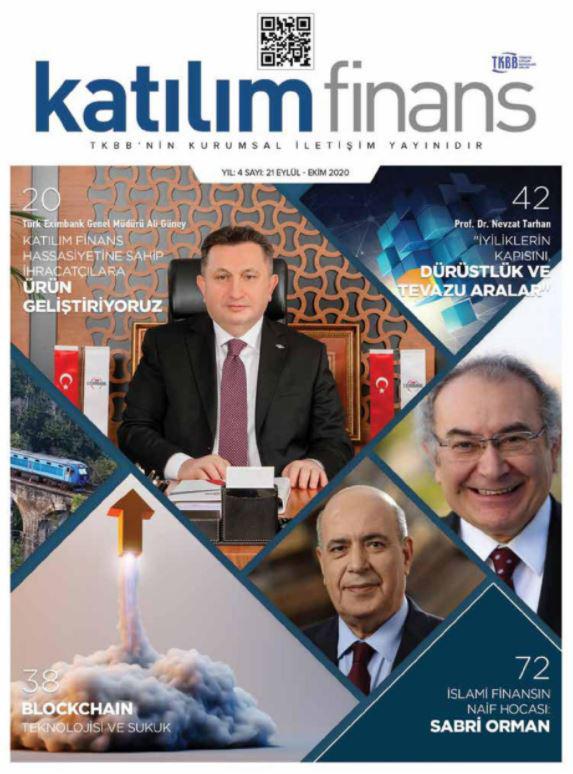
Psychiatry Specialist Prof. Dr. Nevzat Tarhan, who has conducted significant research for many years by blending faith and science, is a scholar who deeply analyzes social life. Prof. Dr. Nevzat Tarhan, who has emphasized the importance of social psychology throughout his life, evaluated many topics for Katılım Finans readers, from the sociological studies needed to increase interest sensitivity in Turkey to the role of psychology in trade and economy. In our interview, Tarhan emphasized that the interest system is not beneficial for humanity; on the contrary, it leads to income inequality.
CONSIDERING THE MAJORITY OF THE TURKISH POPULATION IS MUSLIM, WHY IS SENSITIVITY TOWARDS INTEREST RATES LOW IN THE COUNTRY? AS A PSYCHIATRIST WHO CLOSELY EXAMINES SOCIAL LIFE, WHAT ARE YOUR OBSERVATIONS ON THIS MATTER?
In our country with a Muslim identity, the lack of sensitivity on an important issue like interest is noteworthy. First, we need to investigate its causes and then reveal why interest sensitivity is not accepted in society. When we talk to people, more than 90% respect the sensitivity to interest but cannot put it into practice for many reasons. There is a rule in psychology: if emotion is added to a thought, that emotion becomes a belief. Information that has become a belief becomes a habit if it continues. If it continues for six months or more, it turns into a personality trait. When a person says for any information, "This information is correct for me, I need to learn it," emotion is added to the information. When emotion is added to information, it becomes a value judgment and turns into a belief, and it settles in as it is applied. Based on this approach, individuals know about interest in a theoretical sense but cannot implement it in practice. When participation banks started operating in Turkey, a strong structure emerged, opening the way for those sensitive about interest. Despite this, only a limited segment of society uses these banks. Policy makers in Turkey are not acting sufficiently to increase demand; on the contrary, they are merely evaluating existing demand. Therefore, policies that make interest-free financial institutions attractive need to be implemented. Furthermore, it is essential to clarify the question marks surrounding the participation banking system.
WHAT KIND OF SOCIOLOGICAL STUDIES SHOULD BE CONDUCTED TO INCREASE SENSITIVITY TOWARDS INTEREST WITHIN SOCIETY?
As people of Anatolia, we are a leader-oriented society. We look to the leaders in our lives and try to imitate them or identify with them. If parents at home or elders in the family are sensitive about interest, children continue in that manner. Therefore, those governing Turkey should also show sensitivity in this regard. When executives keep their money in interest-bearing accounts and take 5-10 year interest-free loans without repayments, moving profit-oriented instead of principle-oriented, the modeling effect weakens. If people model their executives and leaders, the participation finance system will gain a larger share than the traditional banking sector.
"YOU WORK, I'LL EAT"
When we look at sociological studies, what does the concept of interest signify? Why has the Holy Quran forbidden interest? First, we need to understand the answers to these kinds of questions. The best sociological equivalent of the word 'interest' is the concept of 'You work, I'll eat.' We must know that the interest system is not beneficial for humanity theoretically and semantically, and that it contaminates capital through the capitalist system. However, money should be earned through hard work, and this knowledge needs to be widespread in society. Currently, the biggest reason for income inequality is that 80% of the world's resources are used by 5% of the population. If people living in Africa and Asia are throwing themselves into the seas to migrate to different countries, the biggest reason is income inequality.
Even if one side works, they cannot feed themselves, while the other side easily accesses all the world's resources. Therefore, we need to explain the wrongness of this system well to people. This is the wisdom behind the prohibition of interest.
WHAT IS THE PLACE OF SHOPPING AND TRADE IN SOCIAL BEHAVIORS? DO HUMAN PSYCHOLOGICAL BEHAVIORS ALSO AFFECT SHOPPING BEHAVIORS?
Today, the capitalist system encourages increased production and consumption. For example, you buy a dress, and capitalism tells you, "Buy another dress, follow fashion." In today's world, the factors influencing shopping behavior are not basic needs but people's desire for appreciation and a sense of security. If an individual shops even when they don't need to, it encourages social mobility. The increase in social mobility, in turn, leads to increased consumption. After the year 2000, two behavioral economists researching psychological factors in purchasing behavior or economic activity received Nobel Prizes. The starting point here is this: Philosophy previously viewed humans as homo economicus. Humans are economic beings; they act rationally; they buy if it suits their economy, and if not, they don't. Especially after the 2000s, it was understood that humans are not homo economicus but homo psychologicus. In other words, when purchasing, people shop not according to their needs but according to psychological factors. The pursuit of happiness also influences shopping behavior in a way. Humans are also psychological beings. Therefore, psychological and emotional factors come into play during the decision-making phase. For this reason, it is necessary to teach financial literacy to young people and those of advanced age.
FOR THE ECONOMY TO BE BUILT ON SOLID FOUNDATIONS, DO SOCIOLOGY AND PSYCHOLOGY ALSO NEED TO BE INVOLVED?
After homo economicus and homo psychologicus, now homo neuro psychologicus has emerged. In line with this, we launched neuromarketing as a master's program at Üsküdar Üniversitesi. There are even many books on "buyology" dealing with the brain-behavior relationship and neuroscience-based economics. In the field of shopping and purchasing behaviors, it is important to know that brand values are very significant psychological factors. How are brand values created? First, quality production, but this alone is not enough. The second stage of quality production is the social network. The social network of a person who produces good goods consists of friends and close acquaintances. As the third part, we can mention promotion. The role of advertising promotion is not, as seen, in the forefront. If promotion is started without the first two points we mentioned, it will not be an effective work. When there is a mental transformation in individuals, social transformation also occurs. And when social transformation occurs, economic transformation happens. Therefore, if individuals' minds and hearts are appealed to first, a stereotype is formed in the person, and that judgment becomes a belief. If mental transformation studies are carried out on individuals, the economy will be built on solid foundations.
HOW SHOULD A MUSLIM MERCHANT BE? WHAT SHOULD BE CONSIDERED IN BUSINESS AND TRADE ETHICS TO BECOME A RESPECTED BUSINESS PERSON IN SOCIETY?
First and foremost, a Muslim merchant must be a believing Muslim. For example, the story of Indonesia, with a population of approximately 200 million, becoming Muslim is quite interesting. A merchant went to the country and started trading. One day, when he was not in the shop, an Indonesian child working for him sold goods to a customer for several times their price. When the merchant returned, he asked the child how much he had sold the goods for. When the child told him the price, the merchant found the man and returned the extra money he had taken. Everyone in the town was surprised by this. Later, the incident reached the governor, who was the ruler of the region. When they asked the merchant for the reason, he said, "This is a requirement of my religion. Islam places great importance on lawful earnings and the rights of others. That's why I did it." Upon hearing this, they researched Islam and subsequently became Muslims. If you fill a room with all evils, two words open the door: lies and arrogance. However, honesty and humility open the door to goodness. A merchant should be a person who lives Islamically, never letting self-interest and capitalist ethics enter their inner world. Rumi says, "The love of the world, worldly possessions, is like a ship. The world is the sea, and you, as a human, are a ship sailing in the sea. If you take the world inside you, the ship will sink. If you don't take it inside, you will sail freely in the sea." One of the greatest tests for a Muslim is whether or not they conduct their relationship with money in an Islamic way.
WHAT KIND OF EFFORTS CAN BE MADE TO INSTILL SENSITIVITY TOWARDS INTEREST IN THE YOUNGER GENERATION?
Before teaching young people about sensitivity towards interest, it is necessary to teach them the concept and management of a budget, the balance between wants and needs, and shopping behavior. Afterwards, it is crucial to instill that interest involves a violation of others' rights ('kul hakkı'). This is because interest offers easy earnings without effort. Not adhering to interest is an act of worship. For an act of worship to be performed, one wants to know its wisdom. The primary wisdom here is to explain that true halal (lawful) earnings come from hard work. Young people need to be taught the understanding of "Earn with your labor, live honorably." Those who prefer interest are respected, and their choice might be in that direction. But those who do not wish to use interest should also be respected. Humans are not beings living only for worldly benefits; there are also benefits beyond death. For example, in the "yawm al-din" section of Surah Al-Fatiha, the meaning is the Day of Judgment. The word 'din' in Arabic means the Day of Reckoning. A mental jury lies within a person's conscience. We need to explain this inner jury well to young people. When we teach this, a sense of responsibility also develops.
Source: Finans Katılım Magazine
Year: 4 Issue: 21 September - October 2020
Share
Update Date: February 26, 2026
Creation Date: September 10, 2020