

Üsküdar University's Globalization and Youth Problems Application and Research Center (KÜGEMER) organized the “GSH Talks” event. Prof. Dr. Abdullah Karatay, Assoc. Prof. Dr. Abdülhakim Beki, Assoc. Prof. Dr. Yüksel Bekaroğlu Doğan, and Assoc. Prof. Dr. Melike Boztilki from the Social Services department participated as speakers. The event, held at the Çarşı Campus Emir Nebi Conference Hall, attracted significant interest from students.
Content
“GSH Talks” event organized by KÜGEMER!
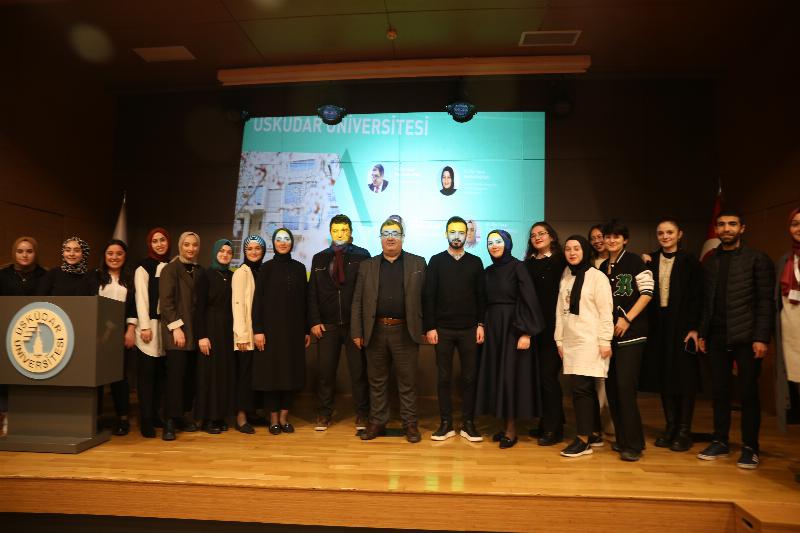
During the event, Assoc. Prof. Dr. Abdülhakim Beki made striking remarks on “Spiritual Social Service”; Prof. Dr. Abdullah Karatay addressed the participants with his presentation titled “Children Working on the Streets.” Subsequently, Assoc. Prof. Dr. Melike Boztilki delivered a speech titled “Introduction to Adulthood: Goal Setting, Focus, and Motivation.” The last speaker, Assoc. Prof. Dr. Yüksel Bekaroğlu Doğan, offered evaluations on the increasing problem of homelessness in recent times with the topic “Homelessness in the Metropolis.”
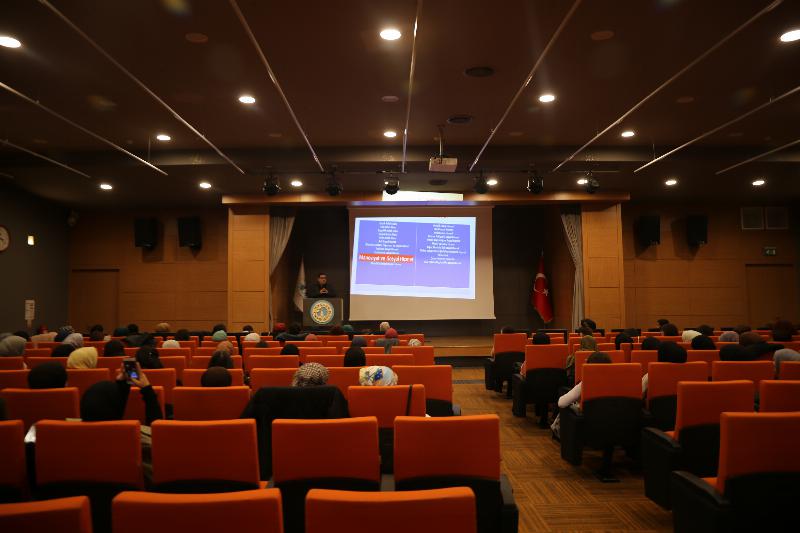
Assoc. Prof. Dr. Yüksel Bekaroğlu Doğan: “Homelessness is something constructed”
Assoc. Prof. Dr. Yüksel Bekaroğlu Doğan from Üsküdar University's Social Services Department, who delivered the opening speech, stated: “Homelessness is not a topic of interest in Turkey and Istanbul. If a homeless person freezes to death in a corner during winter, it becomes sensational news. Following this news, individuals who might be responsible for the issue appear on stage, say a few things, take certain measures, and then you see that the event is merely about preventing a homeless person from freezing to death. Why? Because public reaction is only directed at this situation. When we consider the public as local government, it's an administration that came to power through elections, and there will be another election in four years anyway. Therefore, there's a perspective in local governments that ‘the political response we provide is sufficient to satisfy people.’ Homelessness is something constructed. People experiencing homelessness in Istanbul today experience it within the framework of Istanbul's local structural conditions, the policies Istanbul offers them, Istanbul's sociology, and Istanbul's economy. Therefore, what we call homelessness is not a phenomenon that is frozen and static in a certain period. I am talking about homelessness along with all environmental changes.”
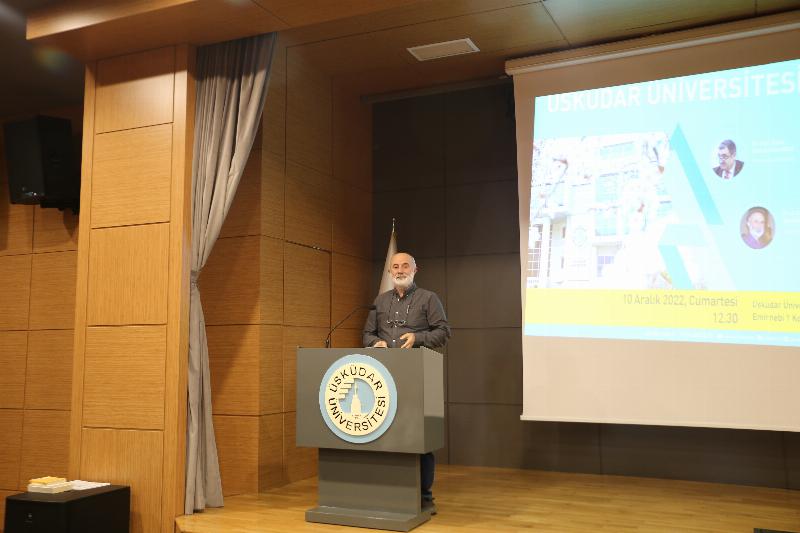
Prof. Dr. Abdullah Karatay: “Some children might enter a harmful role”
Prof. Dr. Abdullah Karatay, a faculty member in the Social Services Department of the Faculty of Health Sciences, who approached the concept of children from a different perspective, stated: “Who is a child working on the street? Some of the individuals accompanying you in your life and experiences are selling something, some are begging, some are just asking for help, wanting to receive a service, or perhaps wanting to talk to you. It's clear that we are not talking about a homogeneous group of people. Perhaps the tendency to homogenize is a very fundamental characteristic of the human mind. We have such a side. We are conformist beings. We want to name, identify, and finish immediately. This is the general tendency. To generalize and homogenize immediately, but when your narratives come together, we encounter an incredibly diverse mass of people. It is an intermediate category between child labor and street children. Why is it this way? Because one of the ways a child exists on the street is similar to an adult earning income by working. In addition, some resort to begging, exploiting our emotions, coercion, or threat. Because childhood is not something to be understood only through the image of innocence. We cannot say that all children are beautiful and pleasant. Some children might enter a harmful role for you; therefore, it is certain that we are facing a complex and heterogeneous structure.”
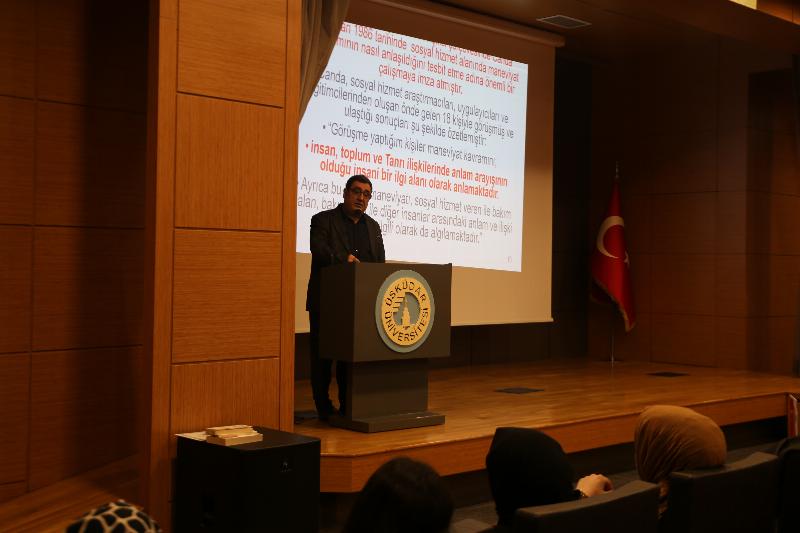
Assoc. Prof. Dr. Abdülhakim Beki: “You cannot achieve sufficient success by ignoring the spiritual dimension of humans”
Assoc. Prof. Dr. Abdülhakim Beki, a faculty member in the Social Services Department of the Faculty of Health Sciences, emphasizing the importance of the spiritual dimension in medical treatments, stated: “What do you understand when ‘spirituality’ and ‘spiritual social service’ are mentioned? There are very widespread studies in positive psychology recently. In fact, another name for positive psychology is spiritual psychology, because if you try to treat a human being, who is a biopsychosocial and spiritual entity, by ignoring their spiritual dimension, you cannot achieve sufficient success. An oncology patient goes to the doctor, is diagnosed, and undergoes surgery. In addition, chemotherapy is administered, radiotherapy is administered, but it is not a sufficient form of behavior. Because the spiritual dimension of the work must exist. This dimension, which exists all over the world, has unfortunately not been created as an employment area in our country. When you think without it, you can do psychological therapy, but psychological therapy with a positivist understanding that does not include spirituality is not a sufficient mechanism. You cannot provide treatment merely by feeding people, providing socio-economic support, and enabling their socialization. If you build these as a whole on four pillars, you will have made a significant contribution to social service.”
At the end of the event, books were presented to three students in a raffle.
Share
Update Date: February 26, 2026
Creation Date: December 13, 2022
Request a Call
Other News
- Prof. Nevzat Tarhan: “Those with a mental filter are not afraid of the digital”
- Artificial intelligence doesn't eliminate the translator, it transforms their expertise!
- Social responsibility courses moved to the field
- Erasmus+ Orientation Week completed at Üsküdar
- Prof. Nevzat Tarhan: “Brain secretes ‘dark glue’ in social media lynchers!”