

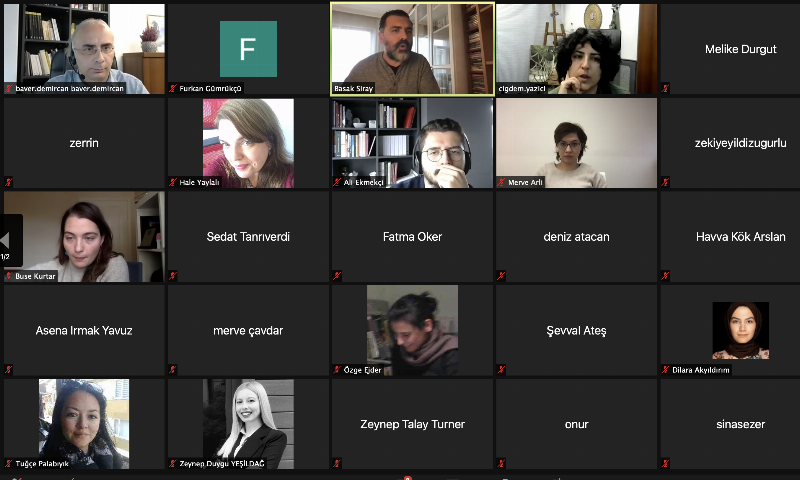
Online, via Zoom, a talk on the topic of “What is philosophy?” was held. In the talk, Dr. Baver Demircan, Assistant Professor from the Department of Philosophy at Üsküdar Üniversitesi, moderated the program. Assoc. Prof. Dr. Mehmet Şiray from Mimar Sinan Üniversitesi Department of Philosophy and Assoc. Prof. Dr. Çiğdem Yazıcı from Üsküdar Üniversitesi Department of Philosophy participated in the talk. Guest Assoc. Prof. Dr. Mehmet Şiray touched upon the definition of philosophy, the relationship between death and philosophy, and the general outlines of Epicurean philosophy.
Content
A 'Gladly Philosophy' Talk on 'What is Philosophy?' Was Held
Assoc. Prof. Dr. Mehmet Şiray: “Love is what overcomes death”
Shiray, stating, “What is philosophy? I am not in a position to give a definitive answer or a definition to this question;” He continued: “But we philosophers engage with this question in one way or another. When asked 'What is philosophy?', some might say it's a critical and free thinking method, some might say it's about questioning, the art of asking questions and giving answers. Of course, all of these might be saying something about what philosophy is. However, I will try to explain the matter a little through Hadot. And actually, his answer to the question 'What is philosophy?' is interesting. He says that in philosophy, there are things that will conquer our fears. Hadot defines it as learning not to be afraid, transcending the time that goes beyond the ordinariness or troubles of daily life, and in a way, deferring time in this sense. Hadot states that for the Stoics and a part of Ancient Greece, the question of how one should live is a very important one. He claims that this issue is directly related to the mortality of humans. Humans are mortal beings, but they are also conscious of this.”
“Death should not be considered merely as the death of the body”
Assoc. Prof. Dr. Shiray, emphasizing that all these reasonings are not enough for philosophy, said; “I have no claim that philosophy will make us smarter. But if philosophy, in a certain way, perhaps as Hadot said, offers us a path to overcome the fear of death and to liberate ourselves, then I must say that being deprived of it is not very meaningful. We can say that all these reasonings are not enough for philosophy, and that philosophy does not stop itself here. Because, at the very least, each of us, not content with these questions, feels the presence of death in every situation, every day, and thus needs philosophy. Of course, here, death should not be considered merely as the death of the body.”
“Epicurus defines philosophy as the medicine of the soul”
Shiray, explaining examples from Epicurus' definition of philosophy, says, “The ultimate goal of medicine is to tell us that death is nothing to be feared.” You might say that religions tell us the same thing here, but we can say that the answers given by Ancient Greece and Christianity to the question of salvation are different. Epicurus says, “There is no need to fear the gods, death is nothing to be feared, it is easy to attain good, it is easy to endure pain.” This is a quote from his student Lucretius. “The fear of death penetrates the deepest parts of our being and poisons human life. It casts a shadow over everything with the darkness of death, denying the right to pure and unadulterated pleasure.” Going a little further, Hadot also tells us that Epictetus again transformed the entirety of philosophy into an inquiry into the fear of death. We don't just find similar ideas in Ancient Greece; Hadot will claim that the Stoa and a large part of Ancient Greece defined philosophy with such a thought, but we also find such expressions in some other philosophers.”
“One of the first seeds sown by philosophy is doubt.”
Shiray, emphasizing the essence of thinking that our fears are an obstacle to living well; “Following Hadot’s thoughts in Ancient Greece, the Stoa philosophy tells us that it is not merely an activity of philosophy teaching philosophy to a person, but also that one must free oneself from oneself, and that this is its practice. What is meant by freeing oneself from oneself is for a person not to remain in the past or to be stuck in things they imagine for the future, therefore, what philosophy needs to offer as a solution here is to reflect on ourselves or to sacrifice ourselves.”
“We can assert that philosophy is learning to lead a humane life, and from this perspective, it is not a luxury at all.”
Shiray, pointing out that philosophy provides an idea about the world we pass through; “If we consider that we are mortal in such a short period, we can essentially think about the question asked by the Ancient Greeks. This is a question about what we will do in human life in such a short period; how will we evaluate this question? Of course, philosophy gives an idea about the world we pass through, and it is at this point that pre-Socratic philosophers began by questioning the essence of the world. This is actually one of the things that led to the emergence of what we call Theoria, because it emerges from the moment we start this questioning. There are some anecdotes here. For example, there is a quote from Hadot about Plato. It is mentioned that Plato, when talking about the academy, said, “Let no one ignorant of geometry enter.” It is not about constantly theorizing. One should think of it as moving to practice, even if only once. To the question, “Isn’t philosophy a luxury?”, we can assert that philosophy is a spiritual exercise or learning to lead a humane life, and from this perspective, it is not a luxury at all.” he stated.
Share
Update Date: February 28, 2026
Creation Date: November 25, 2021
Request a Call
Other News
- The book that read today's digital threats in 2014: Being a Conscious Family
- Experts warn: 'Instead of memorizing letters, teach pencil grip, scissor use, and coloring'
- School fear and school love both start in the family!
- Family is not merely transforming, it is being battered under a serious assault
- Artificial intelligence opens the door to early diagnosis in autism!