

CRISPR is one of the gene editing technologies. It has made a significant impact this century due to being cheap, effective, and easy compared to other technologies. It earned the Nobel Prize in Chemistry for the scientists who pioneered its development. It paves the way for editing the DNA of not only humans but also other living organisms like plants, animals, and viruses. Scientists say they can further utilize CRISPR in agricultural and industrial fields.
Content
Gene editing becomes easier with CRISPR

Is CRISPR, one of the gene editing technologies, a terrifying field or a source of hope? We looked at the CRISPR phenomenon, which remains a hot topic due to its potential, from a laboratory perspective.
CRISPR is a technology learned from the defense mechanisms of bacteria. It is described as 'genetic scissors.' In other words, it allows for cutting and very precisely rejoining DNA strands. This opens the way to modify DNA and add new features. Although the ability to intervene in DNA to such an extent makes CRISPR a controversial technology, it is promising for new treatments and potential applications.
As in most parts of the world, CRISPR technology is being studied in various laboratories and centers in Turkey. One of them is the Üsküdar University Transgenic Cell Technologies Center. Dr. Cihan Taştan is the director of the center. We direct our questions about CRISPR technology to him.
Gene editing becomes easier with CRISPR
What is the root of the fear?
Taştan begins, “CRISPR gene engineering promises a change in something we value most in preserving: our DNA.”
We discuss how the birth of genetically modified babies and the creation of genetically modified viruses and bacteria with CRISPR have caused fear in society.
Despite this fear, however, CRISPR gene engineering is a technology that promises great positive changes and can improve health and quality of life. Taştan gives the following example: “In the coming years, for instance, instead of waiting a year for a vaccine, it could bring us significant advantages such as the emergence of CRISPR vaccines or CRISPR drugs in a very short period.”
Could it be the solution for incurable diseases?
For hundreds of types of cancer or genetic diseases, a cure is not yet possible. Taştan states that with CRISPR gene engineering, treatments that have not been found for hundreds of years could be developed simply, quickly, and cheaply.
What is being done in Turkey?
CRISPR is important for us, just as it is for the whole world. Taştan says, “Since CRISPR gene engineering technology emerged, thousands of patents and articles have been published. At our own center, we have developed platforms in Turkey where we can use CRISPR gene engineering domestically,” and adds:
“So far, we are exploring ways to produce domestic treatments using CRISPR gene engineering within four or five of our different patented products. This enables us to domestically produce medicines that we would otherwise acquire more expensively from abroad, at a lower cost and with greater specificity.”
Studies conducted at the center
We also have the opportunity to witness some of these studies.
One of the studies conducted at the center is the 'CRISPR Valley' platform. With this platform, they have achieved genetic repair and regulation capabilities in algae, bacteria, plants, particularly for cancer and genetic diseases, by using gene engineering.
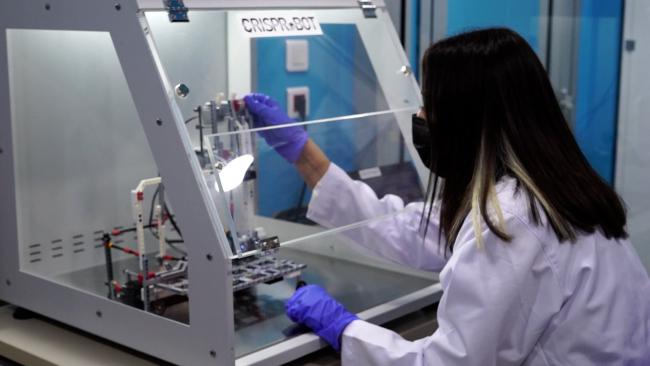
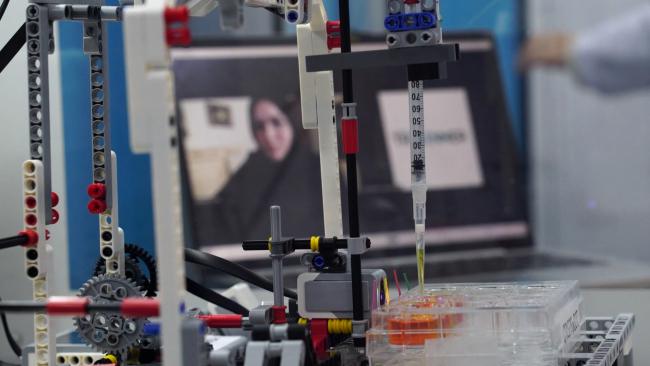
As we listen to the ongoing work, we see a researcher who couldn't come to the laboratory that day initiating an experiment remotely. The autonomous system enabling this was developed by three researchers working at the center: Şölen Doğdu, Çağla Yılmaz, and Fatma Nur Erkek.
We ask Doğdu and Yılmaz about their work. They explain that the device we see performs CRISPR with a robotic system. Doğdu says, “With this project, countless varieties of organisms can be produced untouched, using artificial intelligence.” Yılmaz adds, “We accomplish this remotely, without human intervention. This also saves time.”
A 'breakthrough' is aimed in forensic sciences
Another study mentioned by Taştan is an identification technique called CRISPY. The technique they developed provides an easier and more cost-effective analysis for identifying mixed DNA samples at a crime scene compared to currently used DNA analysis methods.
Taştan states that CRISPR-based forensic sciences “aim to be a groundbreaking technology in the field of forensic sciences.”
A multi-billion dollar field
Taştan explains, “For a technology to achieve an important status in the world and in Turkey, its mere production in a laboratory or whether it wins a Nobel Prize is not truly significant. What matters is whether it can impact people's lives.”
CRISPR, on the other hand, closely affects human lives. Recently, an investment of nearly 1 billion dollars has been made into treating genetic diseases using CRISPR gene engineering. Taştan believes that the development of CRISPR gene engineering systems will also contribute to the national economy.
Share
Update Date: February 28, 2026
Creation Date: December 21, 2021
Request a Call
Other News
- Social responsibility courses moved to the field
- Erasmus+ Orientation Week completed at Üsküdar
- Prof. Nevzat Tarhan: “Brain secretes ‘dark glue’ in social media lynchers!”
- Prof. Nevzat Tarhan: “Every segment of society should be able to say, ‘This constitution is my constitution!’”
- OHS releases guide for safe operation of industrial robots