

Under the moderation of Prof. Dr. Hikmet Koçak, Lecturer at Üsküdar Üniversitesi Faculty of Medicine, Department of Cardiovascular Surgery, and Vice Rector, the program ‘Future of Technologies: Omics Applications Innovation and Bioeconomy’ was held. The guest of the online program was Scientist Prof. Dr. Hasan Türkez.
Content
Future of Technologies: Omics Applications Innovation and Bioeconomy event held

“There is a transformation in health technologies”
Türkez stated that the patient management process during the pandemic and the resources to be allocated for it emerged as a crisis; “To cope with crises and improve virtual services, two concepts came to the forefront. One of these concepts focused on artificial intelligence, and the other on digital technologies. Looking at the advancing processes, we saw that emerging technologies or technology trends such as telehealth, health, virtual conferences, and the Internet of Medical Things began to enter our lives. Especially in health technologies, before our evaluations on an economic axis for today's future, I think it is useful to examine the following processes. There is a transformation in health technologies, and there are dynamics triggering this transformation.” he said.
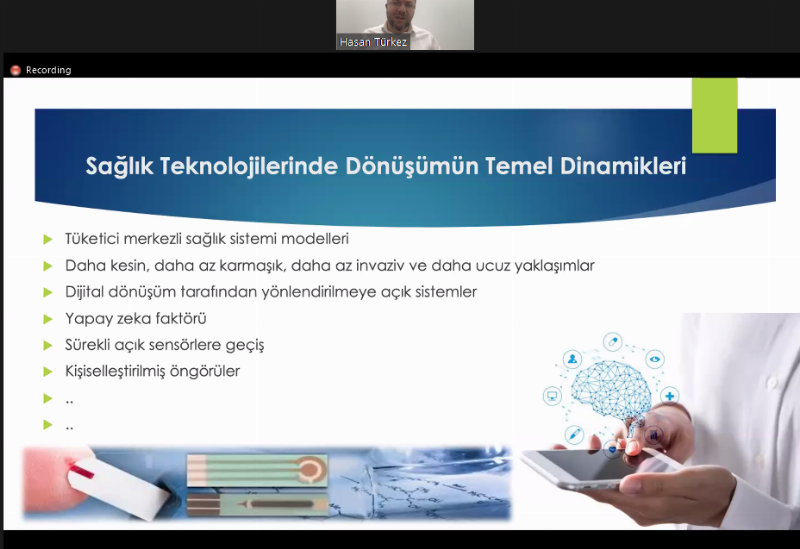
“High-tech producing companies are now being reshaped”
Türkez, emphasizing the importance of discussing the future in healthcare, said; “In the future of health, the focus will no longer be on system management or healthcare providers, but on healthcare recipients. It seems that today, high-tech producing companies like Google, Amazon, and Apple are reshaping themselves and starting to take place in this market. In this process, sectors need to develop themselves and step outside the routine. Before intersecting the concept of omics with these health technologies, it is definitely beneficial to provide some data on why and how these technologies emerged.” he stated.
“The emergence of omics technologies is linked to the human genome project.”
Türkez, talking about the emergence of omics technology, said; “We entirely attribute the emergence of omics technologies to the human genome project. Why? Because from the early 1990s, many institutions and research institutes in the United States came together and planned a study on whether the human genome could be sequenced or the codes of the human genome could be deciphered, and this study was funded by the White House. The goal here was not only to sequence the human genome. It was also to develop technology that would sequence the human genome, to establish a relationship between these genetic structures with many diseases or health conditions and variations, and in addition, to examine the genetic structures of other organisms.” he said.
“The human genome contains 3.2 billion base pairs”
Türkez, discussing why the main outputs of the human genome project affected us so much, said; “In the human genome project, we learned that a human genome is approximately 3.2 billion base pairs long. If you think of human DNA as a thread, each thread is parallel to the other, and each thread has 3.2 billion bases. So, if you print this out, it would be 3,000 kilometers long. That is, we are faced with such a massive output. In other words, it is the will of an output that would cover Turkey from A to Z, approximately 1500 kilometers, twice over. We particularly thought that the coded and non-coded regions in the human genome were very different, which is being surveyed.” he added.
Share
Update Date: February 28, 2026
Creation Date: December 16, 2021
Request a Call
Other News
- The book that read today's digital threats in 2014: Being a Conscious Family
- Experts warn: 'Instead of memorizing letters, teach pencil grip, scissor use, and coloring'
- School fear and school love both start in the family!
- Family is not merely transforming, it is being battered under a serious assault
- Artificial intelligence opens the door to early diagnosis in autism!