

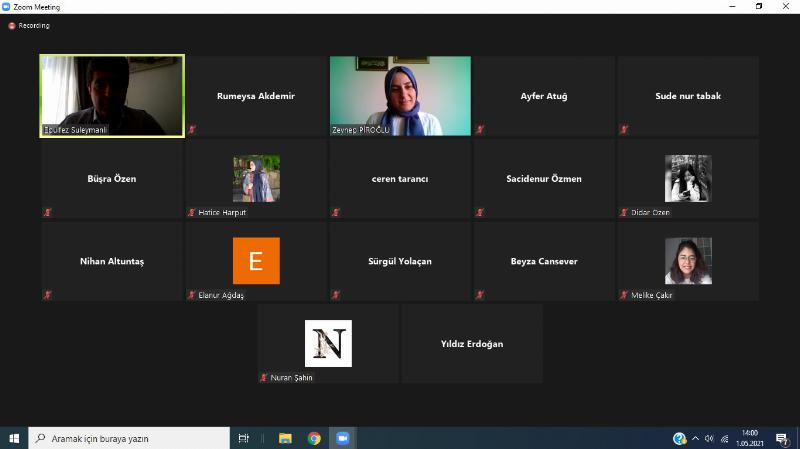
Üsküdar Üniversitesi organized the fifth of its Sociology Internship Seminars under the title “Being a Sociologist in Non-Governmental Organizations.” Sociologist Zeynep Piroğlu from the Turkish Red Crescent Community Center was a speaker at the event.
Content
Fifth Üsküdar Sociology Internship Seminar Held
“My volunteer work increased my chances of being hired”
Piroğlu, stating that she started this job as a volunteer, said: “The one-month volunteer period I started lasted 9 months. At that time, my school was not over, and with my available time, I found myself volunteering for 5 days a week. When I started working full-time this way, they told me about career opportunities at Kızılay. The entry process to Kızılay is a bit arduous and long. After a 6-month period, I was called for an interview. My previous volunteer work put me two steps ahead. Because being someone who knows the corporate culture and is familiar with the job, instead of just applying with a CV, greatly increases your chances of being selected. I started working as a sociologist assistant in the first stage.”
“We opened our first community center in 2015”
Piroğlu stated that a project was created with the unprepared mass migration following the Syrian war in 2011; “Our first community center was opened in Urfa in 2015, and then it became operational in Istanbul. This center offers activities for the integration of migrant groups, workshops, individual interviews to provide psychosocial support, protection programs that provide support for all kinds of problems, and the socio-academic empowerment program for which I am currently responsible. Gaining a more eccentric perspective during my sociology education greatly influences our approach to the groups we work with. In non-governmental organizations, orientation training is provided when starting work, and we inform about the sensitivities of the groups we work with. But at this point, I believe we have a much more fundamental perspective. Especially when organizing training and events for these groups, instead of saying 'let's do this,' it is necessary to include these individuals in advisory councils, ask what they want, and examine their wishes. For example, we have a perception that Syrian refugees are a closed society to outsiders. When we examine this, we see that women do not mix much with society or socialize. When we look at why women are not wanted to go out, we see that men feel uneasy towards a foreign society after migration and therefore do not want women to go out. In this regard, we ask women more probing questions like, 'Would you like to come if we open special Turkish courses for you?' I believe that this provides us with a perspective to uncover the underlying problems.” she said.
“Syrian refugees can be employed in many fields with their language advantages”
Piroğlu stated that there is a general perception of directing migrant groups mostly towards blue-collar jobs; “We approach with a prejudice that the group we work with is unqualified or that they can work in such jobs because they accept them. In fact, when we look at it, there are currently 4 million Syrians living in our country, and this also means that there are 4 million Arabic speakers in our country. Our country is very popular for Arab tourism; we can benefit from this bilingualism in terms of health and cultural tourism. These individuals both speak Arabic and learn Turkish, and some of them also speak English. We opened call center operator courses for these people; e-commerce sites, public institutions, and many organizations provide Arabic language support. So, why don't we benefit from these individuals? Among these people, there are university graduates who cannot practice their own professions. They are already a group we can utilize for translation. When we look at the situation from this perspective, we have also provided different employment opportunities. At this point, I think many people who want to pursue a career in non-governmental organizations already have this perspective. A 4-year education inevitably instills this perspective. We need to contribute to ourselves. Volunteer processes foster this; it is necessary to participate in volunteer processes, even if small. This way, we can also discover areas of interest. You can work in associations for women, organizations related to education, or in immigration-related issues like mine. Kızılay also has many units. Nourishing yourself in these ways would be very beneficial. This process helps you discover yourself and gain work experience through volunteering. During the volunteering process, you get to see the corporate culture, the office processes, and how filing processes are carried out. These experiences contribute to your professional life and make your job easier. Later, in the places where you will start working, you overcome that initial period of inexperience.” she said.
Share
Update Date: February 27, 2026
Creation Date: May 04, 2021
Request a Call
Other News
- Prof. Nevzat Tarhan: “Those with a mental filter are not afraid of the digital”
- Artificial intelligence doesn't eliminate the translator, it transforms their expertise!
- Social responsibility courses moved to the field
- Erasmus+ Orientation Week completed at Üsküdar
- Prof. Nevzat Tarhan: “Brain secretes ‘dark glue’ in social media lynchers!”