

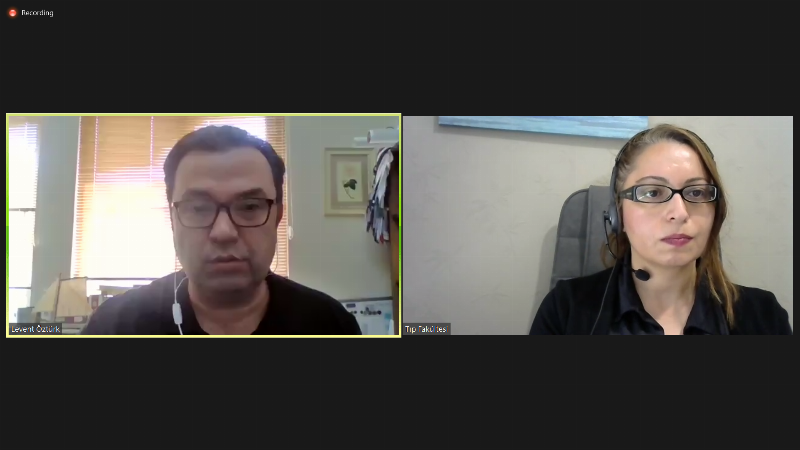
Üsküdar Üniversitesi Faculty of Medicine hosted Prof. Dr. Levent Öztürk from Trakya University Faculty of Medicine, Department of Physiology, as a guest at the “Sleep and Dreams” event.
Content
Everyone Should Determine Their Sleep Duration and Not Compromise On It…
Sleep duration is a genetically determined condition…
Öztürk stated that the ideal sleep duration is genetic; “The cost of being sleepy, of fatigue due to sleeplessness, is very high and it's a societal issue. So, how do we know if such an important condition like sleep is healthy, or what constitutes healthy sleep? One of the most frequently asked questions is 'how long should I sleep?' Of course, there's no standard answer to this. But societal studies show us that a large portion of people sleep 7-8 hours. More precisely, 7-8 hours of sleep is sufficient for them. How do we determine this sufficiency? Waking up spontaneously, waking up feeling rested, and not feeling sleepy during the day. If a person is rested, energetic, wakes up directly, and doesn't feel sleepy during the day, then this is healthy sleep. In society, there are people we call short sleepers. These individuals make up about 8% and can carry on their day perfectly fine with 5 hours of sleep. Then there are long sleepers. These individuals make up about 2%. They cannot function without 10-11 hours of sleep. This means that sleep duration is a genetically determined condition, and sleep duration cannot be changed by one's own intervention. Trying to shorten it by your own will only leads to sleep debt. Therefore, everyone should determine their own sleep duration and try to get that sleep without compromising on it.” he said.
“Asking every patient about their sleep health has become a necessity”
Öztürk; “Sleep is a topic with many dimensions. When I was a medical student, we didn't have subjects related to sleep disorders. These were added over the years. Now, questioning every patient who walks through the door about their sleep health has almost become a necessity.” he said.
“An adult individual needs to sleep in one continuous block”
Öztürk, speaking about sleep stages; “The process we call sleep is not a homogeneous process. That is, there isn't a single type of state from the time we lie down until we wake up. Sleep has sub-stages with very different characteristics within itself. When we lie down, we are first awake, then we enter superficial sleep in the first and second stages. In the third stage, we transition into deep sleep. We sleep deeply for about half an hour. Then, sleep becomes somewhat more superficial, and a period called REM appears. This is the stage where rapid eye movements occur. This stage lasts a few minutes, then sleep deepens again. Another period of deep sleep continues, and a second REM period arrives. Shorter deep sleep and progressively increasing REM periods. Now, when we look at this sleep architecture, we see the following: At the beginning of the night, there is a predominant deep sleep. In the second half of the night, these deep sleeps disappear, and REM sleep predominates. This shows us that six hours of continuous sleep is not equivalent to two separate three-hour sleep blocks. When someone says, 'I'll sleep for a few hours, then finish my work and sleep again,' we disrupt the pattern and fail to get this REM period in the second half of the night. An adult individual needs to sleep in one continuous block.” he stated.
Share
Update Date: February 27, 2026
Creation Date: May 26, 2021
Request a Call
Other News
- The book that read today's digital threats in 2014: Being a Conscious Family
- Experts warn: 'Instead of memorizing letters, teach pencil grip, scissor use, and coloring'
- School fear and school love both start in the family!
- Family is not merely transforming, it is being battered under a serious assault
- Artificial intelligence opens the door to early diagnosis in autism!