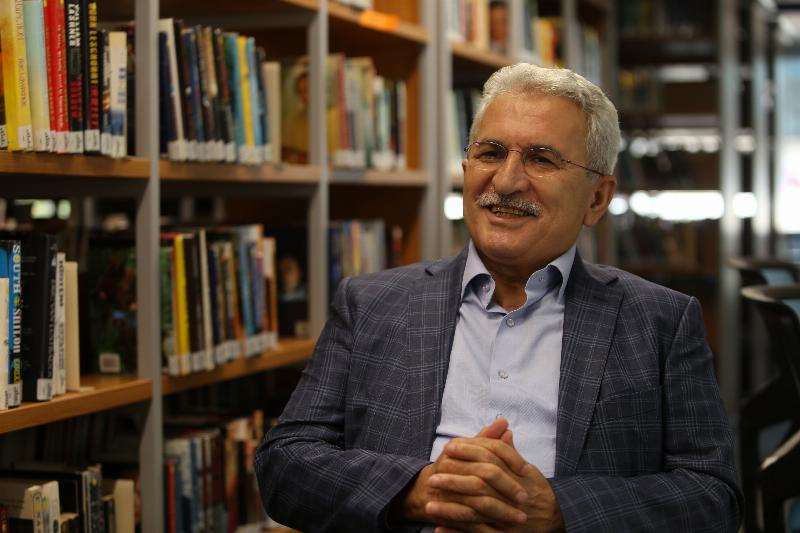
The Intergovernmental Science-Policy Platform on Biodiversity and Ecosystem Services (IPBES) Values Assessment 2022 report has been published. Prof. Dr. İbrahim Özdemir, President of the Environmental Ethics Forum at Üsküdar University, stated that IPBES (Intergovernmental Science-Policy Platform on Biodiversity and Ecosystem Services) published its latest report on July 9, 2022.
Nature should not be seen as a warehouse to be consumed…
Özdemir noted that according to a four-year methodological assessment by 82 high-level scientists and experts from all regions of the world, the way nature is valued in political and economic decisions is both a key driver of the global biodiversity crisis and a vital opportunity to address it, adding, “The latest report prepared by IPBES once again reveals that the global biodiversity crisis is fundamentally rooted in the perception of nature 'based on narrow market values.' In other words, the intensification of climate change and environmental problems is causing us to look at nature differently and, as it were, to rediscover it. According to the report, there are actually more than 50 methods and approaches to understanding nature and establishing different relationships with it. It is up to us to discover and make visible the different values of nature. Not to see nature merely as a warehouse to be consumed.” he said.
IPBES, established by the UN, has 139 member countries
Prof. Dr. İbrahim Özdemir stated that IPBES (Intergovernmental Science-Policy Platform on Biodiversity and Ecosystem Services) is often described as 'the IPCC for biodiversity,' adding, “IPBES is an independent intergovernmental body established by the UN and composed of 139 member Governments. Established in 2012, IPBES provides policymakers with objective scientific assessments on our planet's biodiversity, ecosystems, and their contributions to people, as well as tools and methods for the conservation and sustainable use of these vital natural assets. Thus, it seeks to help decision-makers formulate knowledge-based policies in their development-related goals.” he said.
Focused on short-term decisions and economic growth
Prof. Dr. İbrahim Özdemir made the following evaluations regarding the IPBES 2022 report:
“The Assessment Report on the Diverse Values and Valuation of Nature, approved by representatives from 139 UN member countries, reveals a dominant global focus on short-term decisions and economic growth, and that the multiple values of nature are often not considered in policy decisions. Economic and political decisions predominantly prioritize specific values of nature, particularly its market-based instrumental values, such as those associated with mass-produced foods. Although often privileged in policymaking, these market values do not adequately reflect how changes in nature affect people's quality of life. Furthermore, many non-market values associated with nature's contributions to people, such as climate regulation and cultural identity, are overlooked in the policymaking process.”
Inadequacies in consulting stakeholders regarding valuation results
Prof. Dr. İbrahim Özdemir noted that Prof. Unai Pascual (Spain/Switzerland), who co-chaired the assessment with Prof. Patricia Balvanera (Mexico), Prof. Mike Christie (UK), and Dr. Brigitte Baptiste (Colombia), stated, 'With more than 50 valuation methods and approaches, there is no shortage of ways and tools to make nature's values visible.' He also pointed out that according to Prof. Unai Pascual, only 2% of over a thousand studies examined consulted stakeholders on valuation results, and only 1% of studies involved stakeholders in every step of the nature valuation process, commenting, 'The use of valuation methods is insufficient to overcome power asymmetries among stakeholders and transparently integrate nature's diverse values into the policymaking process.'”
More than 13 thousand references were used
Prof. Dr. İbrahim Özdemir stated that the Values Assessment, which is interdisciplinary and based on an extensive review conducted by experts in social sciences, economics, and human sciences, was prepared using more than 13,000 references, including scientific articles and indigenous and local knowledge sources.
Offers a comprehensive typology to policymakers
Prof. Dr. İbrahim Özdemir said, “It also directly builds upon the 2019 IPBES Global Values Assessment, which identified the role of economic growth as a key driver of nature loss and revealed that currently 1 million plant and animal species are at risk of extinction. To help policymakers better understand the differences in how people conceive and value nature, the report presents a new and comprehensive typology of nature's values. This typology also emphasizes how different worldviews and knowledge systems influence how people interact with and value nature.” he said.
Living from, with, in, and as nature…
Prof. Dr. İbrahim Özdemir noted that to make this typology useful in decision-making processes, the authors presented four general perspectives, listing them as living from nature, living with nature, living in nature, and living as nature. Prof. Dr. İbrahim Özdemir said, “Living from nature emphasizes nature's capacity to provide resources for people's livelihoods and to sustain their needs and wants, such as food and material goods. Living with nature focuses on 'non-human' life, such as the right of fish in a river to thrive independently of human needs. Living in nature expresses nature's importance for people's sense of place and identity. Living as nature views the natural world as a physical, mental, and spiritual part of oneself. It suggests we remember that we are part of nature.” he said.
Studies valuing nature increased in the last 40 years
Prof. Dr. İbrahim Özdemir noted that the report reveals that the number of studies valuing nature has increased by more than ' on average in the last forty years, adding, “While the most prominent focus of recent (2010-2020) valuation studies has been on improving the state of nature (65% of examined valuation studies) and improving people's quality of life (31%), only 4% focused on improving issues related to social justice. 74% of the assessment studies focused on instrumental values, while 20% focused on intrinsic values, and only 6% focused on relational values.” he said.
Four value-centered leverage points
Prof. Dr. İbrahim Özdemir stated that the authors of the report identified four value-centered 'leverage points' that can help create the conditions for transformative change necessary for 'a sustainable and just future,' listing them as follows: “Recognizing the diverse values of nature - Integrating valuation into economic decision-making - Reforming policies and regulations to embody nature's values - Shifting fundamental societal norms and goals to align with global sustainability and justice goals.”

