

Üsküdar University Founding Rector, Psychiatrist Prof. Dr. Nevzat Tarhan, drawing attention to the fact that the earthquake disaster is a serious lesson in delayed gratification skills, especially for children, stated that parents have an important role not only in making their child happy but also in preparing them for life. Tarhan emphasized that children should be made aware of life's difficulties, pains, and realities, noting that this situation acts like a stress vaccine in preparing children for the future.
Content
Earthquake traumas don't disappear but they do decrease!
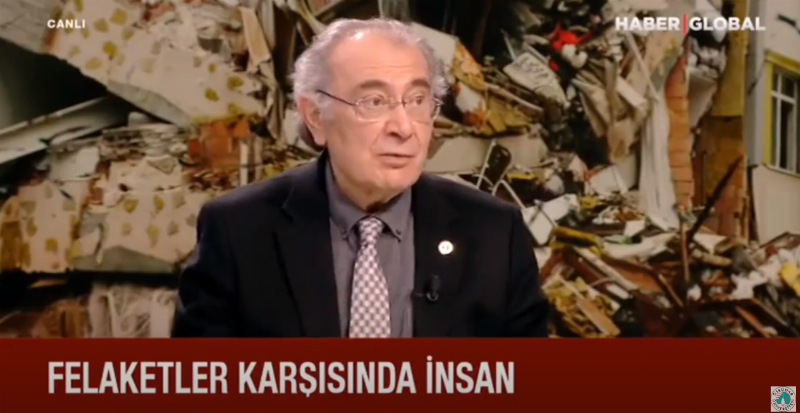
Üsküdar University Founding Rector, Psychiatrist Prof. Dr. Nevzat Tarhan, made evaluations on earthquake traumas and coping methods on Haber Global.

Earthquake traumas don't disappear but they do decrease
Üsküdar University Founding Rector, Psychiatrist Prof. Dr. Nevzat Tarhan, drawing attention to the necessity for individuals to return to their normal lives within 8 weeks, said: “In traumas, there is a threat aspect and an opportunity aspect. In the initial weeks, we inevitably focus on the threat aspect, but now we need to start focusing on the second dimension as well. Every trauma also leads to development. Slowly, we can look at it from this perspective; we do not recommend making sense of it in the first few weeks. If sense-making occurs in the first week, questioning begins; ‘Why? For what reason?’ people ask. As individuals make sense of it this time, they look for someone to blame. They put someone in the defendant's chair, which hurts the wound more, but after a certain normalization begins, sense-making is necessary in such situations. Individuals need to make sense of it with material and spiritual reasons, turning unresolved trauma into resolved trauma and bringing their lives back to normal. Generally, if a person does not return to their normal life within 8 weeks, post-traumatic stress disorder emerges. In fact, there is a study conducted 3 years after the Gölcük Marmara earthquake. The initial acute stress symptoms persisted in 25% of the people living in that region; symptoms are still present in 25%. Japan also experienced a major earthquake in 2011, which killed 11,000 people, if I'm not mistaken, in 2010. They conducted research 2-3 years later, and it was found to persist at a certain rate. It does not disappear. It decreases but continues.”
Children need to be taught a mental sanctuary
Prof. Dr. Nevzat Tarhan underlined that having a mental sanctuary soothes an individual. Tarhan said: “In such situations, instead of denying the reality of death or changing the subject, it is necessary to teach the child a mental sanctuary according to their belief system, such as 'your parents have passed away and will not return, but the soul continues.' Now there are third-wave psychotherapies, in third-generation psychotherapy, it's called Mindfulness therapy. There, this is one of twelve steps. An individual's belief in a guardian angel, having a mental sanctuary, and taking refuge in a higher power creates the feeling of 'there is an all-knowing, controlling power and will; I am not alone' in something they cannot control at that moment, and it relieves them. In such situations, giving children suggestions about a high value, a high power that can be a mental sanctuary for them, relaxes the child. It is not about hiding it from the child, because if you say, 'They will come, they will come,' that is a white lie. When the child learns the truth after a while, they will experience the real trauma then.”

Popular Culture Doctrine: California Syndrome
Prof. Dr. Nevzat Tarhan mentioned that hedonistic individuals eventually become isolated, which leads to unhappiness, and touched upon how popular culture teaches living life as if death will never come. Tarhan said: “This era has a characteristic; egocentrism and worldliness have never risen this much in human history. One lives life as if they will never die, meaning popular culture teaches this. As a result, there is even a popular syndrome in psychiatry, not included in classification books, called 'California Syndrome.' This syndrome has 4 important characteristics. One is hedonism, or pleasure-seeking. The individual chooses pleasure-seeking as an ego ideal. They choose chasing pleasure as their life's purpose. For example, an average American currently works five days and enjoys two days. If they don't have fun that weekend, they feel very bad. For example, if their spouse gets sick, they say, 'I only live once,' and leave. They end the marriage. In this way, these rates are constantly increasing. There's a book I ordered called 'Pandemic of Narcissism,' it's that widespread. The second is selfishness. Hedonistic individuals, those who only see their own pleasure as their life's purpose, eventually become lonely; loneliness begins. When loneliness begins, selfishness comes second, and loneliness comes third in such a situation. Being selfish, one doesn't make a small sacrifice and leaves. They become someone who only thinks of their own interests. The third is loneliness, and the fourth is unhappiness. Currently, antidepressants are being measured in the sewage system of New York Manhattan; they are used so widely. Samples are taken from sewage for illegal substances, for drugs. Antidepressants are used like water.” he stated.
Recommended method: Accept, manage!
Tarhan noted that in situations beyond one's control, one should not deny the event but accept and miniaturize it. He said: “In such situations, individuals will develop coping methods according to their personality structure. Some will try to live by ignoring it, a passive coping method. Some will turn to alcohol to suppress the pain. Some will cope with religious coping methods. Roughly, humankind uses one of these three methods, but the method we, as psychiatry professionals, recommend here is a psychotherapy method: accept, manage. There is a trauma, an event, a life event. There are things a person can change, and things they cannot. There are things within their power and beyond their power, things they can control and cannot. For things beyond one's power and unchangeable, the person will accept it, but rather than denying it, they will miniaturize it. If we mummify the trauma, it continues, but if we miniaturize it, keep its memory alive, and move forward in life with it, we will have a memory of it and not feel guilt. If this can be done, we manage the trauma. If we cannot do this, the person suffers every day, and even after 10 years, they say, 'I still haven't smiled, I still haven't found my old joy,' and it's as if they are constantly waiting for death. It's like they are always living an extension, which is something the deceased person would not have wanted if they were alive. Therefore, such life events are very great traumas. To overcome them, we call this resilience training. A person experiences a shock in life; if they succeed, it becomes resilience training. That is, resilience is a concept referred to as patience in our culture. It is not a passive action, but active patience, patience in motion. In fact, what we call patience is a meditative act. We will not oppose nature, we will not resent nature, but we will act in accordance with its speed and rhythm. We will act in accordance with the laws of nature. When we adhere to this, a person becomes capable of enduring in such situations.”
This incident is a serious training in delayed gratification skills
Prof. Dr. Nevzat Tarhan emphasized that explaining the earthquake disaster as a life lesson to children is currently an opportunity for education. He said: “Children gain delayed gratification skills. A child wants to satisfy all their desires immediately. The child says, 'Now, now, and immediately.' Delayed gratification is a skill; we conduct long sessions for children who easily get everything to teach them delayed gratification skills. Now, this incident is a serious training in delayed gratification skills. For example, even if a child has not experienced an earthquake, explaining this event as a life lesson to our child by saying, 'Life has such realities too, so think about these suffering children whose mothers and fathers have passed away and are left alone,' is currently an an opportunity for education. That is, for those who were not in the earthquake, to help children overcome their childishness, to mature them, to help them acquire delayed gratification skills, you should compare them to these situations and say, 'Look, there is such a situation, we can live in such a situation. There is also such a possibility in Istanbul. Life does not always go in a straight line; life goes in waves.' Preparing them for life means being a parent. It doesn't just mean making the child happy, it means preparing the child for life. We will not make the child too much a part of our comfort and prosperity; we will also share life's difficulties, pains, and realities with them so that the child can be prepared for the future. This is actually a stress vaccine. Just as a child who gets the flu at a young age becomes more resilient when they start school, a child who is constantly raised in an overly sterile environment starts getting the flu as soon as they start school because their immune system is not accustomed to it. Similarly, we call this psychological resilience training.”
The capitalist system first makes you sick, then treats you
Tarhan mentioned that simply making children feel that they are present is enough, instead of giving long advice. He said: “Being there for children is enough. Do not engage in lengthy advice, lectures, or sermons. Simply making them feel 'We are with you, you are safe. If you need anything, we are here,' is sufficient. The child glances sideways and then continues playing. They say, 'That person is here,' and carry on. Play is the most serious business for a child. To love and to work is the summary of an adult's mental health; for a child, it is to love and to play. What is at the top of your love pyramid? If wealth, property, and money are at the top of the love pyramid, you cannot escape the fear of death; love is offered. That is, when a person thinks about it, at the end of their life, what is at the top of their love pyramid; 'What kind of person do I want to be, what do I want to be written on my tombstone, what kind of mark do I want to leave?' They should live thinking about this. If a person lives as if they will be among the good, that is, if a person lives as if they will die tomorrow, why should they fear death? If they can live this way, they won't be afraid. The whole point here is to be able to live accordingly. What is talked about most in a house, for example? If fashion is talked about, for example, that is the most sacred thing in the house. If eating and drinking are talked about, that is the most sacred; if money and position are talked about, that is the most sacred. So, it changes according to the dominant topic in the house. The child also forms their love pyramid in their mind accordingly. At the top of Maslow's hierarchy of needs, which distinguishes humans from other living beings, are abstract things. There are abstract goals like self-actualization. The need to love, be loved, the need for security, the need to overcome loneliness – all these are things that distinguish humans from other living beings. If a person does not set these as goals in life and chooses only to eat, drink, and have fun as their life's purpose, they cannot be happy; when there is a small threat, they panic and feel like they are losing control. This is when the number of people with deteriorating mental health increases. That is why they say, 'The capitalist system first makes you sick, then treats you.' Unfortunately, this is how antidepressants emerged; it first damages, then tries to treat. This is the result of modernism.” he elaborated.
Competing in goodness is not a bad thing right now
Prof. Dr. Nevzat Tarhan underlined that excessively glorifying visuals and visibility while doing good deeds is one of the weaknesses of our time. Tarhan said: “Competing in goodness is not a bad thing right now. For a person to compete in goodness, to try to do good, intention is very important here. That is, exaggeration is a kind of lie. Unfortunately, excessively glorifying visuals and visibility in this regard is one of the weaknesses of our time. In this matter, it would be healthier and more logical for third parties to speak about the help they provided. Boastfully showcasing oneself in this regard, like going to the earthquake zone, taking photos, and sharing them, is just deceiving ourselves without doing anything. Something happens at that moment, but close acquaintances say, 'That person just went and came back to take photos.' For example, some institutions hold meetings, and photos are taken. There's a topic to discuss, but you think there won't be a second or third meeting, that the topic started and continues. Many things now have PR-heavy approaches, always 'as if.' Generally, these people win in the short term but lose in the medium to long term. In the short term, everyone applauds and says, 'How diligently they work!' An outsider sees it and says, 'How much that person works!' and those who know them closely say, 'Yes, they work very well on social media.' They work, but for example, they gave food to someone and go pose there too. Those who know such examples very well say, 'That person's life is a role.' A person with a strong character would not do these things, would not condescend, would not feel the need for it.” he concluded.
Share
Update Date: March 01, 2026
Creation Date: March 02, 2023
Request a Call
Other News
- The book that read today's digital threats in 2014: Being a Conscious Family
- Experts warn: 'Instead of memorizing letters, teach pencil grip, scissor use, and coloring'
- School fear and school love both start in the family!
- Family is not merely transforming, it is being battered under a serious assault
- Artificial intelligence opens the door to early diagnosis in autism!