

The Faculty of Humanities and Social Sciences organized an event titled ‘Biographies and Social Networks: Digital Approaches to the History of Music’ with guest speaker Dr. Onur Öner, a Cultural Historian. Students showed great interest in the event held at the Socrates Hall on the South Campus.
Content
An event titled ‘Biographies and Social Networks: Digital Approaches to the History of Music’ was held with Dr. Onur Öner
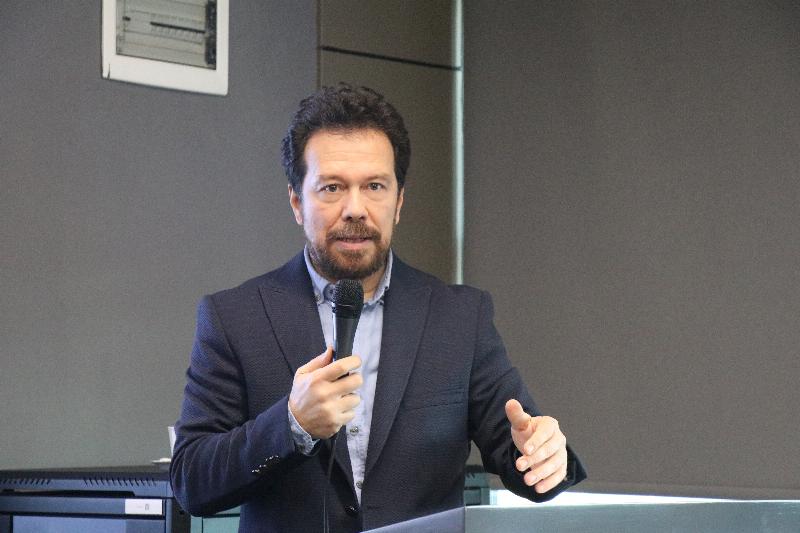
Dr. Onur Öner, who has been involved in the production and presentation of many music history programs on TRT 2 channel, stated in his speech that the fundamental aspect of biographies is to convert fragments of information into data with minimal loss.
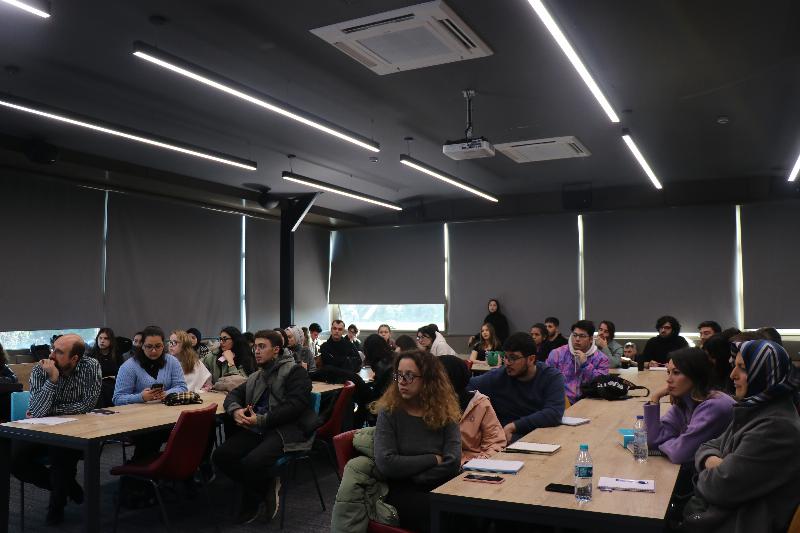
“We are careful not to overlap data”
Emphasizing the importance of data analysis, Öner underlined that they reached conclusions through separate grouping. Öner stated, “Various configurations can be made when analyzing data. We are careful not to overlap each piece of data with another. We need to obtain results from separate groupings by creating separate groupings. If we put everything into one pot, this will lead us to wrong conclusions.”
“Historical sources are not sufficient”
Dr. Onur Öner, drawing attention to the scarcity of historical sources, said: “Not everything is written in historical sources; very little is written in historical sources. That’s why we are already trying to work with very little material. In fact, history writing is, in a way, about how well you can fill these empty spaces, whether you can derive a pure purpose from it or not; that is, what the missing material is or what the abundant material is, emerges through a very careful reading of biographies.”
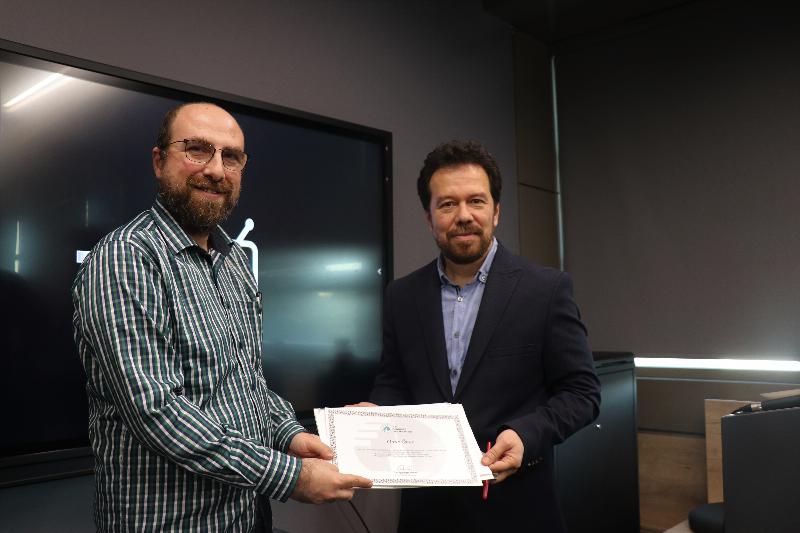
The event concluded after the Q&A session, with the presentation of a plaque of appreciation to Öner and a certificate for a sapling planted in his name.
Share
Update Date: March 01, 2026
Creation Date: December 28, 2022
Request a Call
Other News
- The book that read today's digital threats in 2014: Being a Conscious Family
- Experts warn: 'Instead of memorizing letters, teach pencil grip, scissor use, and coloring'
- School fear and school love both start in the family!
- Family is not merely transforming, it is being battered under a serious assault
- Artificial intelligence opens the door to early diagnosis in autism!