

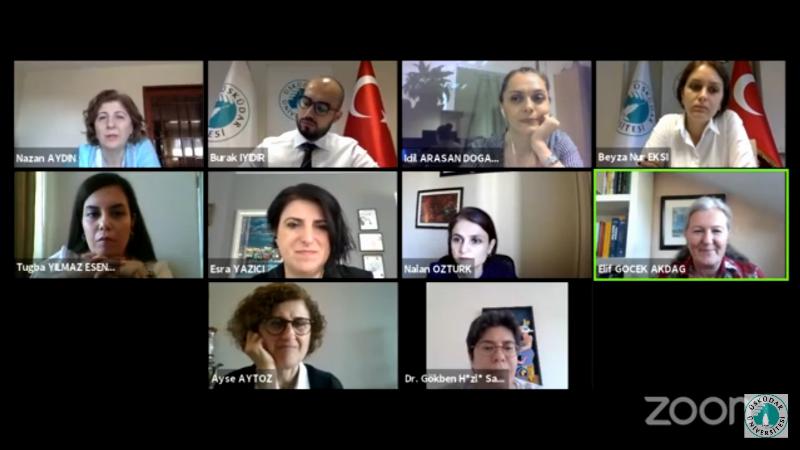
Üsküdar Üniversitesi The second “Maternal and Infant Mental Health” symposium, organized by Üsküdar Üniversitesi Maternal and Infant Mental Health Application and Research Center (ABRSM) and the Institute of Social Sciences, took place. In the program, where presentations were made on the mental health relationship between mother and infant, Dr. Alain Gregoire stated; “Prospective studies show us that in this process, starting from pregnancy, even when children reach their 20s and become adults, the probability of maternal mental disorders being reflected in the child as behavioral or psychological disorders increases twofold.”
Content
Dr. Alain Gregoire: “Maternal mental health disorder doubles the risk in children”
“More investment should be made in maternal mental health”
In her speech, Prof. Dr. Nazan Aydın, Director of ABRSM and faculty member of the Psychology Department, provided information on the importance of maternal mental health and investments made in maternal mental health in the world and in Turkey, saying; “Our motto this year is ‘Let's invest together.’ It is very important to support mothers and babies in accessing maternal mental health care services and to provide an equal level of service definition at the mental health level, similar to improvements made in physical illnesses. We brought this to the agenda in Turkey with the slogan ‘Time to invest in mother's health’ and said, ‘Time to act for maternal mental health services and equality.’ The point I emphasize here by saying equality is to give as much importance to mental health as to physical illnesses and to make improvements in this regard.”

“Mother needs to be well to meet the baby's needs”
Aydın offered advice to mothers and expectant mothers, stating; “As a woman, as a mother, as an expectant mother, or as a spouse, our needs are to rest, sleep, eat healthily, and establish social relationships. Usually, when a baby is involved, the baby takes precedence, and mothers generally do not feel or are not made to feel that these needs are their own priorities. But it should not be forgotten that the most needed person by that vulnerable little being, and the one who will meet its needs the most, is the mother, and that mother needs to be well to meet these needs.”

“Maternal stress also passes to the baby”
In the program, Prof. Dr. Deniz Ülke Arıboğan, Dean of Humanities and Social Sciences and Advisor to the Rector at Üsküdar Üniversitesi, delivered a presentation titled “The importance of motherhood during crisis periods,” stating; “With the pandemic, people were deprived of all social and community support and relationships. Young mothers now have to raise their children on their own. Mothers, aunts, grandmothers, and friends cannot celebrate births or visit hospitals. Pregnancy is experienced during a very difficult period, and babies are born during a very difficult period. We all know that in such crises, maternal stress is somehow transferred to the baby. In February 1921, a study on depression and anxiety was conducted in England. According to this research, mothers were asked, ‘Are you depressed?’ ‘Do you have anxiety?’ Fifteen percent of the answers were ‘I am experiencing depression.’ The rate of those who said ‘I am experiencing anxiety’ was 18 percent. By asking other questions, it was learned whether individuals were experiencing depression and anxiety. Here, it is seen that 43 percent of mothers were depressed and did not realize it. Anxiety was 61 percent. All this fear, stress, and sadness will affect the child as well.”

“Maternal mental health disorder doubles the risk in children”
At the event, Dr. Alain Gregoire, Senior Perinatal Psychiatrist at the University of Southampton and Honorary Doctor of Üsküdar Üniversitesi, delivered a presentation titled “Working together for maternal mental health” and stated that the most frequently researched topic during pregnancy is anxiety disorder. Gregoire continued his words by saying, “Especially among the mental health disorders observed during pregnancy, we see that anxiety and depression are the most researched ones”:
“However, we see that these problems, behavioral and emotional disorders, can increase twofold in infants. Prospective studies show us that in this process, starting from pregnancy, even when children reach their 20s and become adults, the probability of maternal mental disorders being reflected in the child as behavioral or psychological disorders increases twofold. Even if you take into account all factors that can lead to mental and psychological disorders, we must state that the likelihood of maternal mental health disorders appearing in the child and increasing the risk of mental health disorders in the child is twofold. In some studies, it has been observed that these problems are transmitted up to the age of 20. Furthermore, we see that particularly bad memories from childhood multiply the risk of increasing said psychological disorders in early childhood.”

“Prenatal education is very effective”
Dr. Tuğba Yılmaz Esencan, faculty member from Üsküdar Üniversitesi Faculty of Health Sciences, Midwifery Department, stated in her presentation titled ‘Childbirth preparation courses and supporting pregnant women’; “We see that much more effective results are obtained if education is pursued before conception. These trainings have significant effects not only on childbirth but also on the postpartum period. We can observe increased social support, couples bonding with each other, and mother, baby, and father bonding, new parents feeling like a whole where they can support each other, and very few breastfeeding problems during the postpartum period, encountering more successful breastfeeding outcomes.”

“Respond, don't react”
At the event, Prof. Dr. Gökben Hızlı Sayar from Üsküdar Üniversitesi Faculty of Medicine delivered a presentation titled ‘Psychological well-being in mothers during the pandemic’ and offered advice to mothers, saying; “Remember, everyone can be anxious and angry. Ignore hurtful words, take a minute to calm yourself. Postpone the conversation, you can always try talking again when people feel better; respond, don't react. It is very important for you to focus on solutions without playing the victim role, to remain psychologically strong in the face of difficult events.”
Also in the program; Prof. Dr. Arife Polat Düzgün, Spokesperson for the Health, Family, Labor, and Social Affairs Commission and 27th Term Member of Parliament, delivered a presentation titled “Investment efforts in maternal mental health in Turkey”; Op. Dr. Ayşe Aytoz presented on “The needs of mothers during IVF treatments and the infertility process”; Assoc. Prof. Dr. Esra Yazıcı, lecturer at Sakarya Üniversitesi Internal Medicine Department, presented on “Pregnancy losses and psychological support for mothers during the IVF process”; mother Nuray Güngör presented on “My infertility treatment journey on the path to motherhood”; Assoc. Prof. Dr. Elif Göcek Akdağ, faculty member at İstanbul Üniversitesi Psychology Department, presented on “Mother-infant bonding”; and Uz. Dr. Nalan Öztürk from İstanbul Bakırköy Ruh ve Sinir Hastalıkları Eğitim ve Araştırma Hastanesi presented on “Postpartum depression and anxiety disorders.”
Share
Update Date: February 27, 2026
Creation Date: May 05, 2021
Request a Call
Other News
- The book that read today's digital threats in 2014: Being a Conscious Family
- Experts warn: 'Instead of memorizing letters, teach pencil grip, scissor use, and coloring'
- School fear and school love both start in the family!
- Family is not merely transforming, it is being battered under a serious assault
- Artificial intelligence opens the door to early diagnosis in autism!