

An event titled “Particle Accelerators and Applications: Examples from CERN and Turkey” was organized under the leadership of Üsküdar Üniversitesi Nuclear Technology and Radiation Safety Program and Üsküdar Üniversitesi SHMYO Nuclear Technology and Radiation Safety Program Head Dr. Lecturer Feride Kulalı Özdek. In the event, where Ankara University Faculty of Engineering, Physics Engineering Department Lecturer Prof. Dr. Ömer Yavaş was a guest, Ömer Yavaş provided information about the establishment of CERN and particle accelerators.
Content
“CERN and Particle Accelerators” Discussed
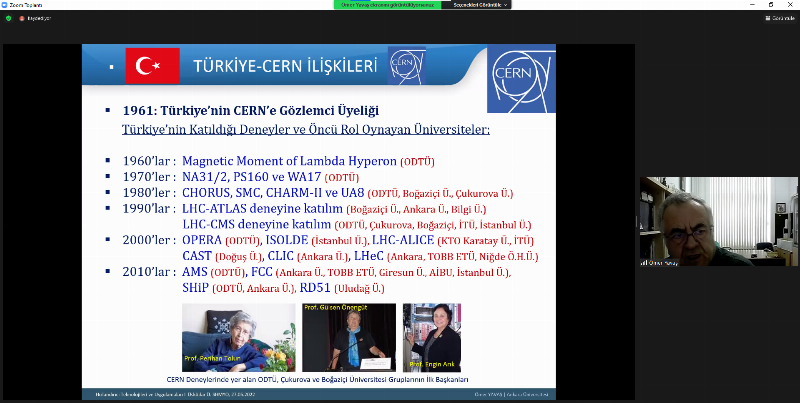
“We have been a joint member in CERN since 2015”
Stating that CERN stands for ‘European Nuclear Research Center’, Prof. Dr. Ömer Yavaş said; “CERN is a research organization located on the border of Switzerland and France, managing the world's largest particle physics laboratory. The decision to establish it was made at the Paris Conference in 1951, after the Second World War. It was founded in 1954 with the cooperation of 12 European countries – Belgium, Germany, France, Denmark, Netherlands, England, Sweden, Switzerland, Italy, Norway, Yugoslavia, and Greece – to enable Europe to catch up with the USA in the field of physics. Our country held observer status at CERN from 1961 until 2015. We have been a joint member in CERN since 2015. It has 40 centers in Turkey.”
“It is the discovery of the Higgs Boson”
Referring to particle accelerators, Yavaş said; “Particle accelerators are devices that enable the acceleration of charged elementary particle (electron, proton etc.) beams to reach target energies. Particle accelerators are divided into two types: linear accelerators and circular accelerators. Accelerators are devices that accelerate particles until they reach very high speeds. As a result of this acceleration, particles can reach very high energy values. These particles, accelerated to possess high energy, can be collided with other accelerated particles or directly with a target point when necessary. Through these collision experiments, it is possible for us to access a wide variety of information regarding the nature of particles. The most famous example of this is the discovery of the Higgs Boson, which gives matter some of its mass, as a result of particle accelerator experiments conducted at CERN.”
Share
Update Date: March 01, 2026
Creation Date: June 02, 2022
Request a Call
Other News
- The book that read today's digital threats in 2014: Being a Conscious Family
- Experts warn: 'Instead of memorizing letters, teach pencil grip, scissor use, and coloring'
- School fear and school love both start in the family!
- Family is not merely transforming, it is being battered under a serious assault
- Artificial intelligence opens the door to early diagnosis in autism!