

Üsküdar Üniversitesi Directorate of Health, Culture and Sports coordinated the 'Big Data and Big Data Analysis' event, organized by the Artificial Intelligence Club. The speaker of the online event was ISISAN Information Technologies Manager Ömer Çolakoğlu.
Content
Big Data and Analysis Discussed
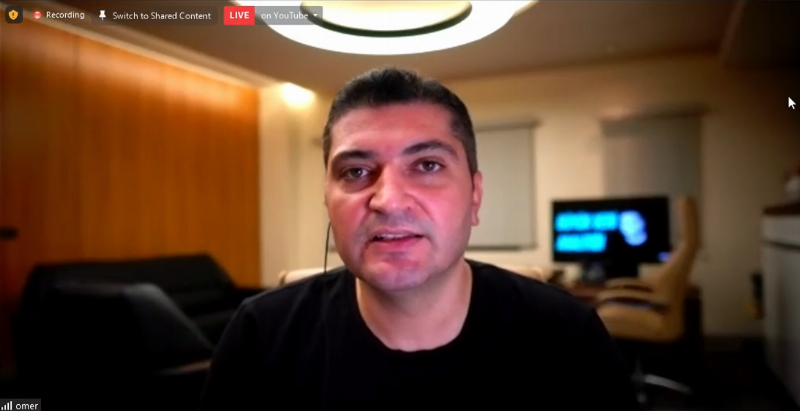
“Data is meaningful when it reaches a format that can guide us and help us make decisions”
Providing information about "big data analytics," Çolakoğlu stated, "Data is meaningful when it reaches a format that can guide us and help us make decisions. To understand this, if we look at the history of data, what was there perhaps 20 years ago? Reports like credit card statements, phone records, or call summaries would pour out to us in sheets. We would check things within these written reports. That is, we would look at the subtotals to see if the system was working correctly. Then data started becoming too large to be reviewed on these papers and lists. To make this data more meaningful, what did we do? We started creating more graphs and charts. We started creating pivot tables, which also gave us an idea.”
“We wanted to use data a bit more interactively”
Çolakoğlu stated that every chocolate bar sold and scanned in a supermarket is transferred as a line to a database, and continued: "When you want to perform an analysis related to the chocolate bar product, you might need to work on millions of lines of data just to access information about that chocolate bar. You need to summarize this somehow. That is, you need to summarize and group things like 'how much of these products have I sold by month,' 'what else have I sold most alongside this product,' or 'in which store did I sell these products.' These emerged in second-generation data analysis; that is, looking at and viewing data collectively, and these were somewhat more static reports. Afterwards, we wanted to use data a bit more interactively. While I could see the answer to the question 'which customer did I sell a product to,' I also started asking to see the answer to 'which product did I sell to a customer' on the same screen. We started wanting to see cross-questions and cross-queries, such as 'how much does a store sell on which days of the week' or 'which store sells on Friday.' Consequently, on one hand, the need for data visualization emerged, and on the other hand, the need for data to be interactively and analytically examined and analyzed. In response to this need, we developed some software, tools evolved, which we generally call business intelligence. These are structures that allow us to strategically analyze and visualize existing data in a way that helps us make decisions.”
Ömer Çolakoğlu then practically demonstrated the information he had presented to the participants. Çolakoğlu, who analyzed the web interface of the tool he created, also answered participants' questions.
Share
Update Date: February 27, 2026
Creation Date: January 13, 2021
Request a Call
Other News
- The book that read today's digital threats in 2014: Being a Conscious Family
- Experts warn: 'Instead of memorizing letters, teach pencil grip, scissor use, and coloring'
- School fear and school love both start in the family!
- Family is not merely transforming, it is being battered under a serious assault
- Artificial intelligence opens the door to early diagnosis in autism!