

Betül Sarı, a 2017 graduate of Uskudar University Faculty of Engineering and Natural Sciences, Department of Molecular Biology and Genetics, gave an interview to Uskudar University about her educational journey and the details of her field of study. Sarı, who has also achieved success in academia, is now continuing her doctoral education at Medizinische Universität Innsbruck in Austria.
Content
Betül Sarı; "Uskudar University was a huge factor in getting me to where I am today"
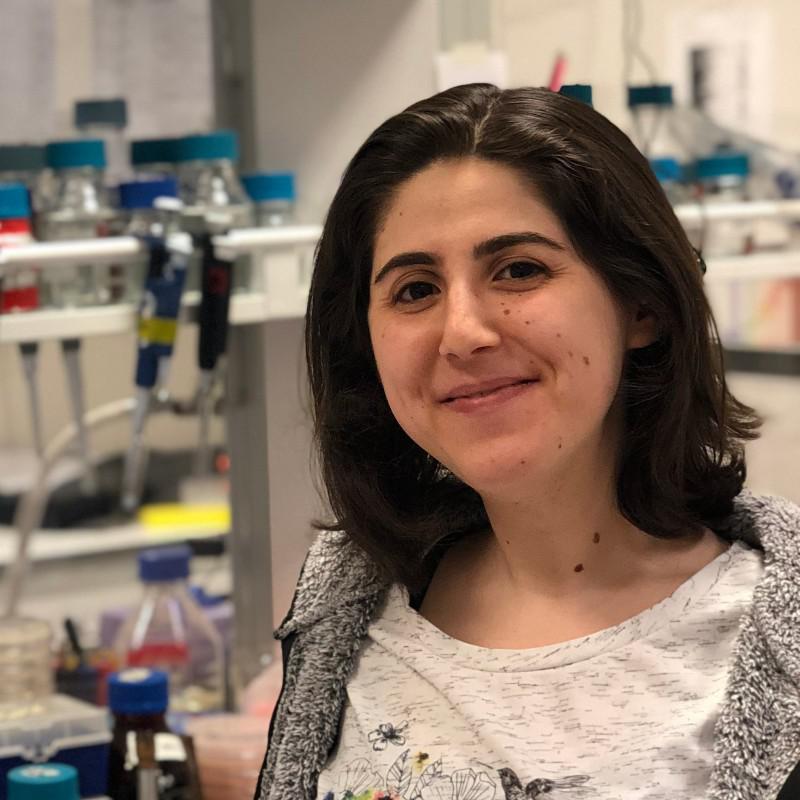
“There is so much to discover, so much to learn”
Betül Sarı stated that her defined goals were one of the biggest reasons for choosing her field; “Since a young age, my goal has been to do important work and be useful to humanity. For this goal, I wanted to choose a field that interested me and excited me. Biology has always been such a field for me. Think about it, you are dealing with living beings, with life. Even the organism you think is the simplest in structure is so complex. There is so much to discover, so much to learn. Molecular Biology, as we call it, is already a vast ocean; we are trying to understand and learn what happens beyond what is visible to the eye. The fact that my field is so open to new discoveries, and that every finding also paves the way for future discoveries, truly makes one feel like they are doing valuable and beneficial work. I can say this was my motivation.”
“Molecular Biology and Genetics is one of the departments with high employment opportunities both domestically and abroad”
Betül Sarı explained the department's working areas from both a sectoral and academic perspective; “Since I work in the research part of the field, I don't have very detailed information about other sectors. However, our department's graduates can work in the pharmaceutical industry, IVF, hospital testing laboratories, or institutions conducting clinical or scientific research. If they consider academia, they can remain as researchers after their doctoral education or join an academic staff by applying for various positions. Molecular Biology and Genetics is one of the departments with high employment opportunities, especially in scientific research, both domestically and abroad. We even have friends who have founded their own biotechnology companies. That's why it was referred to as 'the profession of the future' for years. We can consider that we have reached that future in recent years.”
“The topics being studied are truly very diverse”
Providing information about the university where she pursued her doctorate, Betül Sarı said; “The University of Innsbruck is one of Austria's oldest universities. Its foundation dates back to the 1800s. The Medical University of Innsbruck was one of the first institutions to separate from the main University of Innsbruck and become an independent university. The topics being studied are truly very diverse. Don't just think in terms of the clinical field. Even in our building alone, different disciplines like cell cycle, bioinformatics, biochemistry, and neurobiology are active. It holds great importance because it combines basic sciences and the clinical field. For example, in vaccine science, they can conduct both the necessary research and its clinical application. I can perhaps summarize this situation by saying that multidisciplinary work prevails. Besides my unit, other departments and fields of study are, of course, also available at the University of Innsbruck. Students receive education in many departments such as physics, engineering, and foreign languages.”
“I feel I am just at the beginning of my journey; there is still much to learn”
Betül Sarı shared the process she experienced after her undergraduate graduation; “The idea of continuing as a researcher after undergraduate, master's, and doctoral education was something I had in mind from the very beginning. Honestly, I didn't consider any other career plan. Since I completed my English preparatory period early, my graduation happened in an interim period. I didn't want to deal with applications during my thesis period. After graduating, I made my master's applications for the following year. My thesis period coincided with the pandemic. This situation was both an advantage and a disadvantage for me. Yes, I had time to complete my work. However, since I was focused on going abroad, my future seemed very uncertain under pandemic conditions. We all remember that initial depressive period. As a result, I only applied to 3-4 places. To be honest, I was somewhat hopeless about it. But then I experienced a really big surprise. I received a positive result from a place I saw on Twitter and pushed quite hard to complete the application process. When the interviews at the Medical University of Innsbruck concluded, I learned that I was selected for the project I wanted most, standing out from hundreds of applicants. I tried to develop essential basic techniques for my field and learn new ones. I gave poster presentations in Turkish and English. My thesis period was intense for me. The number of doctoral applications I could make was quite low. While I was thinking that I needed to make more applications for the following year, I was called for an interview by the university where I currently work. Within a few days, they informed me that I was accepted. I am truly happy with where I am and the field I work in, but I feel I am just at the beginning of my journey. There is still much to learn.”
“A good team truly produces good work and publications”
Betül Sarı offered advice for students continuing their education abroad, both in academia and social life; “Completely independent of your department, I think it's very important to identify the institutions you want to work with and gather information about them at least one semester before the application period. Increasing the number of applications is critically important for both job applications and academic applications of this kind. Because you are competing against students from all over the world. When they reach the interview stage, I recommend they observe the team they will be working with carefully. They should also try to ask all the questions on their mind. Questions like 'How many hours a week are worked, is time management in your hands?' may seem very simple, but I think they are very valuable. Everyone has their own version of a biological clock. A good team truly produces good work and publications. However, if they work 12 hours a day, you can imagine that this wouldn't be a pace everyone can endure. Socially, you need to value relationships with people as much as you value your work and education life. One cannot work very productively by constantly concentrating on the same things without clearing their mind. Work and human relations are not entirely independent topics, actually. The friends you talk to, meet up with for coffee, will later become your teammates or help you with matters you never thought of, forming a communication network.”
“You need to work hard, read a lot, and most importantly, be genuinely curious”
Betül Sarı spoke about what needs to be considered when choosing the Molecular Biology and Genetics department; “Molecular Biology and Genetics is indeed a very valuable and promising field. However, people sometimes attribute surreal elements to it. I'm exaggerating a bit. It's talked about as if we're cloning living things every day. But here's the thing, everything in our field really progresses slowly. We try to reach the correct information under those conditions by repeating the same experiment many times, and by trying to eliminate other possibilities for the accuracy of our own hypothesis. For this, you need to work hard, read a lot, and most importantly, be genuinely curious. So, I don't think it's a field that should be chosen just because it sounds cool.”
“Uskudar University was a huge factor in getting me to where I am today”
Expressing her satisfaction with Uskudar University, Betül Sarı said; “Uskudar University was a huge factor in getting me to where I am today. Since we were the first students, our number was small. Therefore, our contact with our instructors was greater. They were a mentor when needed, and like an elder sibling when needed. We never hesitated to knock on their office doors. We completed our internships with their guidance. We worked together to arrange our courses for Erasmus. When we needed references during our master's and doctoral processes, we never experienced not getting a response. They helped us at every stage. During the preparatory period, we took lessons from native English-speaking lecturers. Probably many of us, including myself, achieved fluency in English thanks to them. Our university worked very hard for both internships and the Erasmus opportunity that allowed me to go abroad as an exchange student, thus opening valuable doors in many of our lives. The instructors we met there became our references for our subsequent applications. Our friends also supported us in many ways. In summary, Uskudar University has played a very large role in both my resume and the character that developed during my young adulthood. I am grateful to everyone who contributed.”
Interview: Remziye Çopur
Share
Update Date: February 28, 2026
Creation Date: March 10, 2022
Request a Call
Other News
- Social responsibility courses moved to the field
- Erasmus+ Orientation Week completed at Üsküdar
- Prof. Nevzat Tarhan: “Brain secretes ‘dark glue’ in social media lynchers!”
- Prof. Nevzat Tarhan: “Every segment of society should be able to say, ‘This constitution is my constitution!’”
- OHS releases guide for safe operation of industrial robots