The Faculty of Humanities and Social Sciences (FHS), the Institute of Sufi Studies, and the Kerim Foundation, with their contributions, hosted the panel “Ahmed Avni Konuk’s Metaphysical Views as a Commentator”.
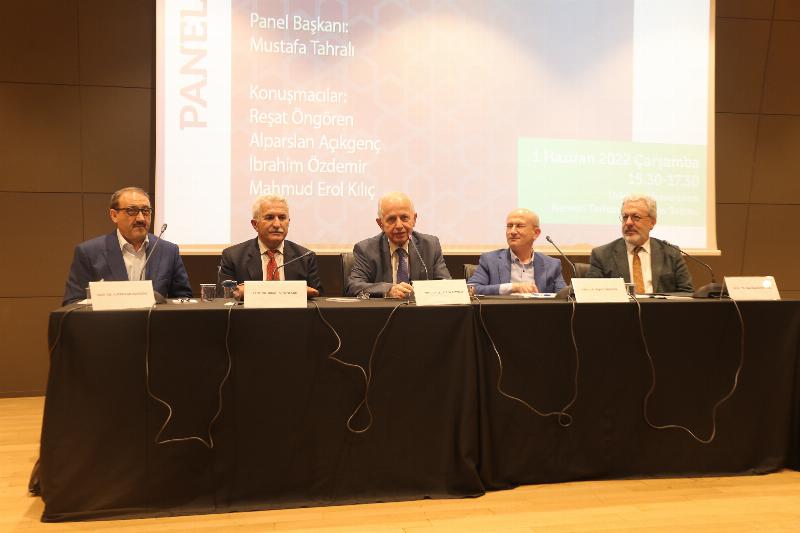
The program, chaired by Marmara University Retired Faculty Member Prof. Dr. Mustafa Tahralı, was attended by Prof. Dr. Reşat Öngören from the Institute of Sufi Studies, Üsküdar Üniversitesi FHS Dean Prof. Dr. İbrahim Özdemir, Philosophy Department Faculty Member Prof. Dr. Alparslan Açıkgenc, and the General Director of the Organization of Islamic Cooperation, Islamic History, Art and Culture Research Center and also Institute of Sufi Studies faculty member Prof. Dr. Mahmud Erol Kılıç, as speakers.
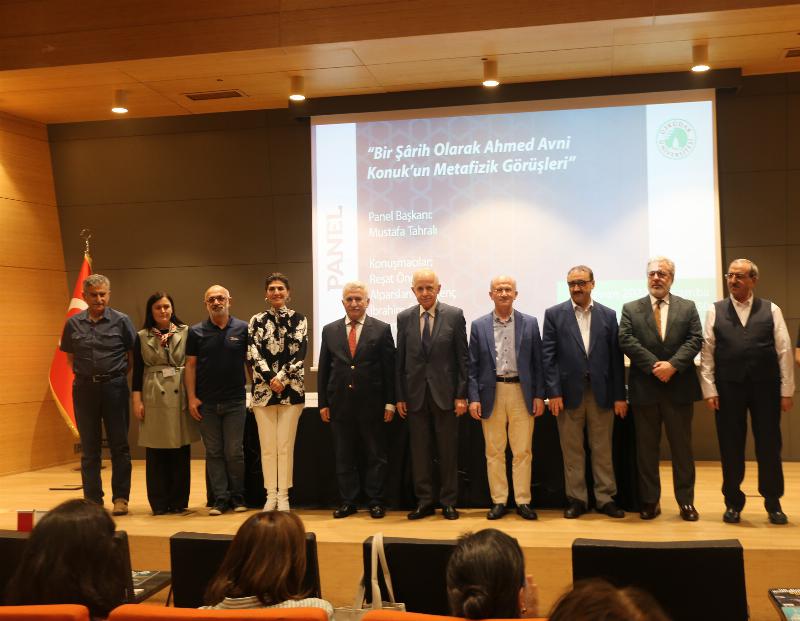
Prof. Dr. Mustafa Tahralı: “If Sufism is discussed, it is because of Ibn al-Arabi and Mevlana”
Tahralı, who views metaphysics as spirituality and high Sufism, said: “If high Sufism is truly discussed in Turkey, it is because of Ibn al-Arabi and Mevlana. If we can do this, it is thanks to great figures like Ahmed Avni Konuk. He is one of the foremost introducers of the Masnavi to the contemporary world. Avni Konuk commented on the Masnavi, which was originally six volumes, in a work comprising 12-13 volumes. This work was translated into contemporary Turkish, prepared for publication, and printed. This endeavor is as valuable as the commentary itself, as it enabled the work to be read and disseminated today. We are very grateful to Ahmed Avni Konuk and the Sufi researchers who brought these great works to our time. It is also Almighty God whom we should thank for creating such servants. Thank God we have reached this day. These meetings are also a product of his work. We organized the first one in 2018, on the occasion of Konuk’s 80th anniversary. Today, it brought us together again. We are not dealing with a science that is understood merely by reading text, or by debate or reasoning. There is more to it. They themselves state this at every opportunity in their commentaries, between the lines, with couplets, and with direct quotes from Ibn al-Arabi and Mevlana.”
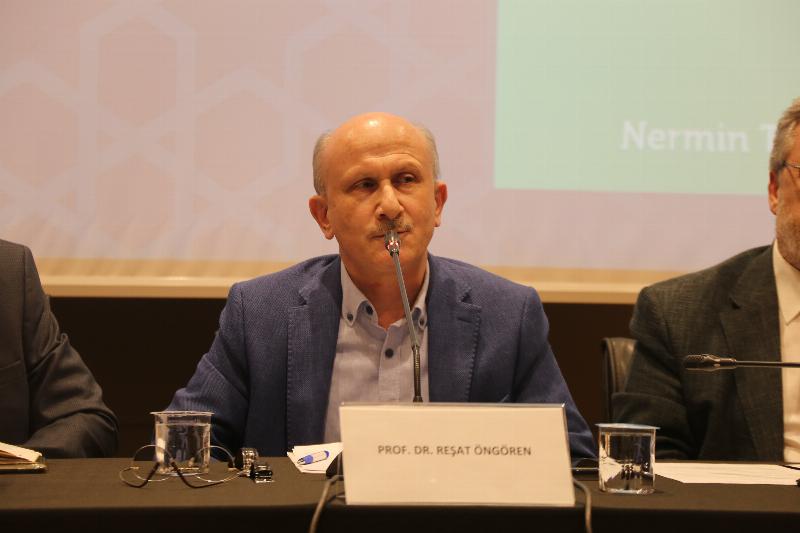
Prof. Dr. Reşat Öngören: “Ahmed Avni Konuk is one of the bridge personalities”
Öngören, touching upon how Ahmed Avni Konuk served as a cultural bridge during the transition from the Ottoman Empire to Republican Turkey, stated: “When transitioning from one era to a new one, if bridge personalities like Ahmed Avni do not transfer the previous accumulation of knowledge to the next generation, then a return to the beginning can occur. Sometimes, a collapse can be experienced. In this sense, Ahmed Avni Konuk, with his commentaries, is one of the bridge personalities who transferred Ottoman Sufi thought and its fundamental elements to new generations. This is because he was born 50 years before the Republican era. He grew up at the center of Ottoman culture and civilization. He also lived for nearly 20 years during the Republican period. He carried out his studies and many of his works before the Republic. These continued after the Republic. Therefore, he reflected his accumulated knowledge in his works by experiencing both eras.”
Prof. Dr. Alparslan Açıkgenc: “Ahmed Avni Konuk is a philosopher on par with Hegel.”
Açıkgenc, comparing Ahmed Avni Konuk with Hegel, said: “Ahmed Avni Konuk is a philosopher on par with Hegel. He developed Sufi philosophy based on Sufism. He is one of the very important thinkers who carried the old Sufi thought as it was into our present during the transition to the Republic. When Ahmed Avni Konuk is compared with Hegel, he needs to be evaluated from the perspective of world philosophy history. In my opinion, we are surpassing Hegel. Creation has neither a beginning nor an end. He says that the concepts of 'beginning' and 'end' apply to created temporal beings. That is, when we say this creation is ancient, it should not be understood as the eternity of beings. There is an excellent expression that needs attention. Therefore, the universe has a beginning. It was created from a beginning. The creation by Almighty God is from the moment it came into existence – if we can even say 'moment', of course, such a thing is not applicable.”
Prof. Dr. İbrahim Özdemir: “All existence is the breath of the Merciful”
Özdemir, stating that “We can no longer ignore this unseen sea,” said: “We need to make his views known to the world. It is narrated that when Mevlana was dictating his 26,000-couplet Masnavi to his student Husamettin Çelebi, and sensed that Husamettin was getting sleepy and thinking to himself, ‘We are writing this, but who will read it?’, Mevlana said, ‘Write, Husamettin. What we are writing is like April rain. When its time comes, it will make the places it falls on green.’ You see, Avni Bey had no children, no one. He abandoned his writings. 40 years later, my esteemed teacher Mustafa Tahralı and the late Selçuk Eraydın discovered them, the handwritten notebooks of the commentaries. Avni Efendi presents a meaning that fundamentally changes the understanding of the universe, based on the works of Mevlana and Ibn al-Arabi, stating, ‘all existence is the breath of the Merciful.’ God has bestowed existence upon the entire universe with His merciful breath. That is, everything we call ‘soul’ or ‘life’ in everything, is that merciful breath.”
Prof. Dr. Mahmud Erol Kılıç: “One of the most important achievements of the Ummah is Muhyiddin Ibn al-Arabi”
Prof. Dr. Mahmud Erol Kılıç, speaking about Ibn al-Arabi through the eyes of Ahmet Avni Bey, said: “In my opinion, one of the most important achievements of the Islamic Ummah, the Ummah of Muhammad, is that God has honored us with the person named Muhyiddin Ibn al-Arabi as a gift and a bounty. Many revered figures have come as representatives of Prophet Muhammad’s legacy. May God be pleased with them; all have tried to convey and indicate his message to us according to their station. However, in the trust given to Muhyiddin Ibn al-Arabi, we see a foundational fatherhood. Although the verse states, ‘We make no distinction between any of His messengers,’ we know that Prophet Muhammad holds the highest rank among the prophets, just as a ruby is a stone among stones, yet superior to other stones. All prophets are respected, and we must honor them, but the verse also contains the expression, ‘We have made some of them to excel others.’ This implies the meaning, ‘We have chosen the elect (Mustafa) from among them.’”
With these words, Prof. Dr. Kılıç made evaluations highlighting the importance of Ibn al-Arabi from Avni Konuk's perspective: “Indeed, Ibn al-Arabi’s position among the esteemed scholars is along these lines.”
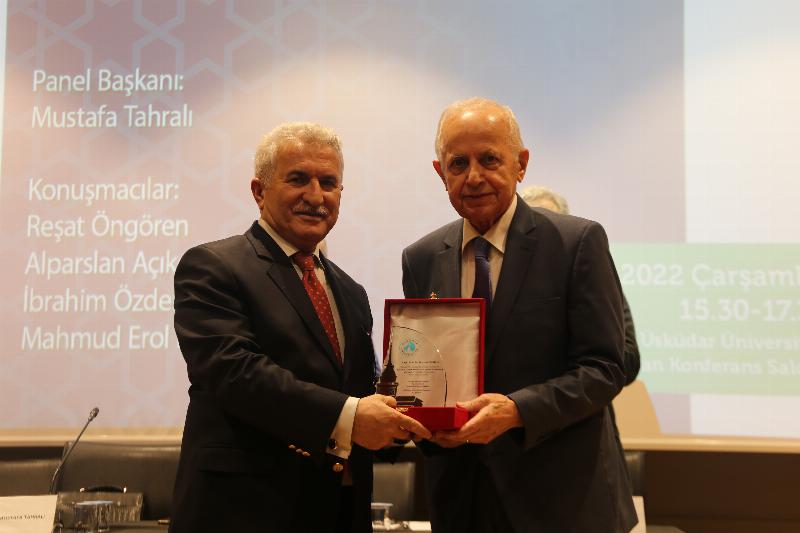
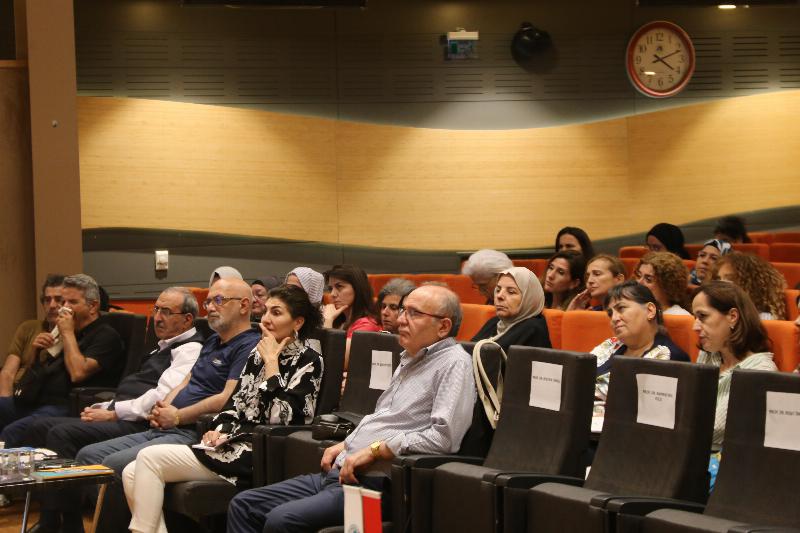
At the end of the panel, questions from the audience were answered by the speakers. At the end of the program, a plaque was presented to Panel Chairman Prof. Dr. Mustafa Tahralı by FHS Dean Prof. Dr. İbrahim Özdemir in commemoration of the day.

