

The panel titled "March 8 Women and Media" was jointly organized by Üsküdar University Human-Centered Communication Application and Research Center (İLİMER) and the Department of Journalism of the Faculty of Communication. Moderated by İLİMER Director Assoc. Prof. Dr. Gül Esra Atalay, the panel hosted Üsküdar University Faculty of Communication Dean Prof. Dr. Nazife Güngör, Prof. Dr. Nilüfer Timisi, Assoc. Prof. Dr. Aysun Aydın, Assoc. Prof. Dr. Bahar Muratoğlu Pehlivan, and Assoc. Prof. Dr. Yıldız Derya Birincioğlu Vural.
Content
Academicians Discuss Women's Representation in Media at the March 8 Women and Media Panel
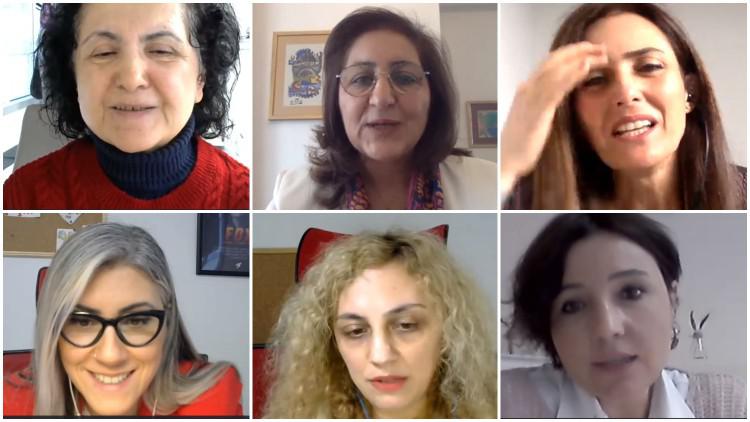
The "March 8 Women and Media Panel," jointly organized by Üsküdar University Human-Centered Communication Application and Research Center İLİMER and Üsküdar University Faculty of Communication Department of Journalism, was held via Zoom, moderated by İLİMER Director Assoc. Prof. Dr. Gül Esra Atalay.
Prof. Dr. Nazife Güngör: “The process of inequality was operated through gender identities”
Prof. Dr. Nazife Güngör, Dean of the Faculty of Communication, delivered the opening speech of the panel, discussing the formation of a societal order structured upon inequalities. “I wish you a happy March 8 International Women's Day. March 8 is a day that makes one reflect. What kind of world do we live in? What kind of social relationships do we exist within? It seems to me that societies were structured upon inequalities as humanity was established. Looking at human history, a small minority establishes dominance over the masses by depriving them of power and disenfranchising them. Those relations of dominance have come down to us by structuring organizational processes. Therefore, it is difficult to reduce this process to the level of individual relationships. A great struggle is necessary. One of these struggles is March 8. We see that it started a century ago in America. We see 120 women, who set out with the sole demand for equal pay, being burned to ashes. A terrible tragedy is occurring. Their only desire was to spend more time with their children and to have livable standards. Even these demands were met with great horror. They tragically lost their lives. The unequal, oppressor-oppressed system established by humans shaped relations at every level of society. Such as men oppressing women, or those with money oppressing those without. The process of inequality was operated through gender identities. Therefore, at the point we have reached, a continuous tragedy prevails. We also see that as the world becomes more civilized, it becomes more barbaric in essence. We call it a civilized world, yet all kinds of barbarity exist. Barbarity is depriving, unequally benefiting from scarce resources, and restricting freedom. We watch femicides every day on the main news. The situation is now beyond deprivation, at the point of annihilation. They annihilate and get rid of it. Moreover, they see annihilation, killing, as their right. We are astonished to see that in societies where laws exist, supposedly functioning, these laws are somewhat ceremonial. There is a mistake made here, not a mistake, but something done knowingly. As social relations began to be organized, men acted aggressively, used some of their biological characteristics to confine women to the home, assigning them a position outside the public sphere and distant from social relations. Since then, women have always been in the home. Being in the home means progressively excluding them from production, preventing them from producing. An individual who does not produce and remains outside of production is doomed to live within the domain of another's dominance. They are rendered passive at every level of life. If the scales had been set equally; if social organizations, family organizations, production organizations, and modes of production could have been in balance, today we would not be discussing gender inequality and violence against women.”
Prof. Dr. Nilüfer Timisi: "Woman is the builder and founder of peace"
Prof. Dr. Nilüfer Timisi from Istanbul University's Radio, Television, and Cinema Department, who has conducted important studies on media and women, touched upon many points regarding women's representation in media and their ability to be subjects. Prof. Dr. Nilüfer Timisi said, “March 8 is an important day for the global women's movement. We need peace today, as always. Peace is the most important issue of our time. Women are the group that voices the concept of peace the most. Beyond voicing peace, women are the builders and founders of peace. Since 1850, women's demands have been conveyed to the present day through the creation of various contents. I hope subsequent generations will also continue. When it comes to the issue of media, the media-women relationship has historically appeared problematic. We know that, since the invention of the printing press, the existing patriarchal power structure in society has also found its place in symbolic production. Therefore, even though women have always existed in creating and building content, it is possible to say that they are not seen or represented, just like in other areas of society. Making women's existence and unequal relationships visible is part of a general social project. Media constitutes the most important pillar in transforming unequal power relations. For this reason, when we look at media and women's relations, we know that the concept of representation is the most important academic tool for academics, and also a social issue.”
“It is possible to say that the content we are exposed to in the media is not in favor of women"
Addressing the position of women in media, Prof. Dr. Nilüfer Timisi stated, “Media is the most important area that shapes society. It is the most important center of symbolic power that unites us, informs us, brings us together within a framework of shared knowledge, and also determines our identities and social belonging. Therefore, what we are exposed to in this field, and to what extent, determines the thought system of broad segments of society. When we look at media historically through the concept of representation, it is possible to say that the content we are exposed to in the media is not in favor of women. In other words, women are less represented in the media. When we look at all kinds of media content, it is possible to speak of a representation difference between women and men. According to a study covering 114 countries, the proportion of women that participants heard, read, or watched over a 20-year period was only 24 percent. Women are certainly present in the media, but they appear more as a symbolic presence rather than existing as subjects. Women appear in fiction, and in TV series. In the interpretation of reality, and on matters related to reality, we see that women are not sufficiently knowledgeable subjects, do not exist as sources, and do not exist as speaking, knowing, thinking subjects. Women constantly become subjects of the agenda by being labeled. If there is victimization, if there is violence, if they are victims of violence, they are on the agenda. The woman who is a victim of violence is also re-victimized through various expressions and images. The second issue is related to labor processes. The number of women working in the media industry is increasing. According to TÜİK reports, 17 out of 100 women are employed. There are no women in senior positions at RTÜK and TRT. Women exist in media as journalists, content producers, and producers, but they cannot advance. There are problems such as unfair wages for equal work, gendered job descriptions, and women being prevented from their profession when they have children. Of course, there are positive examples. By highlighting these positive examples, it is necessary to emphasize that women are free, knowledgeable subjects.”
Assoc. Prof. Dr. Aysun Aydın: "What should be has been determined by the patriarchal system"
Assoc. Prof. Dr. Aysun Aydın, a faculty member at Düzce University, who addressed the topic of women and media from the perspective of philosophy and discourse, stated, “The transmission of gender roles primarily occurs through the instrumentality of media. Media plays a major role at the foundation of gender stereotypes, symbols, and norms. Generally in philosophy, the reduction of social gender roles to sex roles and the reductionist approach, as if there were a causal relationship between the two concepts, is fundamentally a logical fallacy we call the naturalistic fallacy. Because the problem here is to infer what ought to be from the biological reality of women or men. This is not a correct inference from a logical standpoint. What ought to be, determined by the patriarchal system and expressed with 'should' and 'must' moral propositions, forms a system of moral values imposed on women. We very frequently witness this through the media. Moral decisions on how a woman should behave are made on a moral basis, with discourses such as 'a woman's nature' by a male singer. This is a very loaded logical fallacy. Such a norm or system of moral values is not at issue and cannot be explained by biological sex. Therefore, the false causal relationship established between the two feeds patriarchal media. There is a conceptual understanding at the core of this way of thinking. We can see it even in the most primitive societies. Like black representing evil, white representing good, men representing power, women representing the body. If, in today's work life, a woman's ability to bear children or her motherhood becomes a disadvantage for her, then our main difference becomes not bearing children. We are defining women as disadvantaged through a characteristic that men possess. Women are always otherized. If we can reconstruct conceptual transformation, our discourse, language, expression, and action will also change.”
Assoc. Prof. Dr. Bahar Muratoğlu Pehlivan: "Stereotyping is very evident in cartoons"
Assoc. Prof. Dr. Bahar Muratoğlu Pehlivan, a faculty member at Üsküdar University's Faculty of Communication, Department of Journalism, who spoke about the role of women in cartoons, said the following in her speech: “I believe that the role of women in cartoons is very important. Children's minds are very open to learning new schemas. Therefore, we clearly see new schemas in the viewing and storytelling behaviors we observe from childhood onwards. According to research, the stereotyping of gender in content prepared for children is very evident. There are more male characters. Based on this, stereotyping is more prevalent in children who watch many cartoons compared to those who watch fewer. When we look at cartoons in Turkey, it is possible to say that we are in a serious situation. For example, we can observe a situation where the mother is constantly in the kitchen and almost never leaves the house. We can see the formation of gender differences in children who are constantly exposed to such content.”
Assoc. Prof. Dr. Derya Birincioğlu Vural: "Media brings digital violence before us in different forms"
Assoc. Prof. Dr. Derya Birincioğlu Vural, Head of Üsküdar University's Faculty of Communication, Department of New Media and Communication, stated the following in her speech: “In 2021, 339 women and 34 children were killed. 213 female deaths were recorded as suspicious. As years pass, femicides are not decreasing but increasing. Media has a significant impact on this situation. Digital violence emerges with many different concepts. Today, we frequently encounter digital violence practices that are being attempted to be Turkified. Slut shaming is a term used to humiliate women who do not behave traditionally. Gaslighting is deliberately and constantly manipulating someone, replacing their reality with one's own. In a study conducted in 2021, 56 percent of women are exposed to written and verbal harassment in digital environments. 46 percent are subjected to persistent stalking, and 65 percent are exposed to violence on the internet or social media platforms. 21 percent are exposed due to their physical appearance, 52 percent due to their gender, and 76 percent to violence from unknown accounts. Nina Jane Patel, who created her own avatar on the platform called Horizon Venues, was harassed upon entering the metaverse. The metaverse company made a statement, indicating that it would take more decisive steps to prevent such situations. Another important issue is young people using social media as a showcase. They create their self-perceptions in the social media showcase. If we can make the boundaries of our showcase more distinct, we can reduce this phenomenon of violence a little more.
Share
Update Date: February 28, 2026
Creation Date: March 11, 2022
Request a Call
Other News
- Social responsibility courses moved to the field
- Erasmus+ Orientation Week completed at Üsküdar
- Prof. Nevzat Tarhan: “Brain secretes ‘dark glue’ in social media lynchers!”
- Prof. Nevzat Tarhan: “Every segment of society should be able to say, ‘This constitution is my constitution!’”
- OHS releases guide for safe operation of industrial robots