

In the panel organized by the History Department of Üsküdar Üniversitesi Faculty of Humanities and Social Sciences, the atmosphere and conditions of the 31 March Incident, which occurred 113 years ago, were discussed by experts. Üsküdar Üniversitesi Founding Rector Prof. Dr. Nevzat Tarhan stated that historical events have both visible and invisible aspects. Emphasizing that lessons must be learned from history to prevent its repetition, Prof. Dr. Nevzat Tarhan said, “If we correctly analyze these events now, social awareness will be created, and consciousness will be formed. By learning from history, we prevent new mistakes from being made. In fact, it is not history that repeats itself, but events. Mistakes repeat themselves. If mistakes do not repeat, history does not repeat.”
Content
The 31 March Incident Discussed on its 113th Anniversary
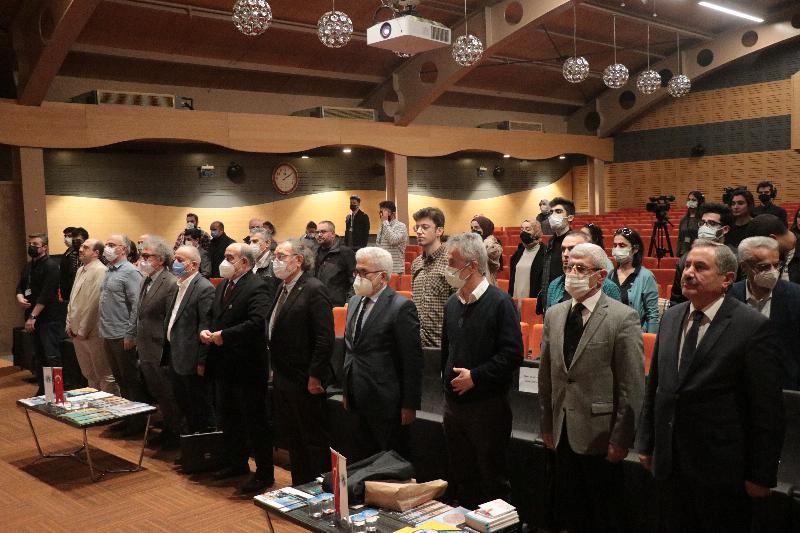
On the 113th anniversary of the 31 March Incident, a panel titled 'Rethinking the 31 March Incident' was organized by the Faculty of Humanities and Social Sciences of Üsküdar Üniversitesi.
Former Istanbul Provincial Director of National Education, Ömer Balıbey, also attended the panel held at the Nermin Tarhan Conference Hall, Üsküdar Üniversitesi Central Campus.
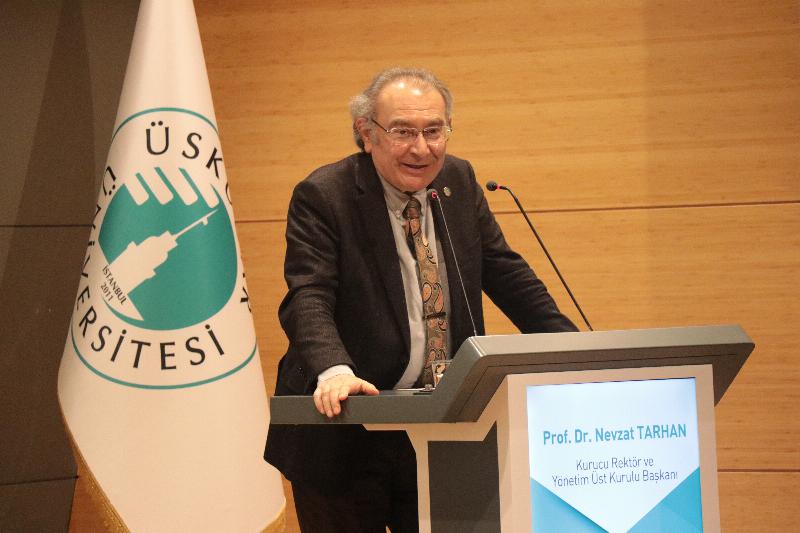
Prof. Dr. Nevzat Tarhan: “There is a need for evidence-based history”
In his opening speech, Üsküdar Üniversitesi Founding Rector and Chairman of the Board of Trustees Prof. Dr. Nevzat Tarhan stated that official history is the history of the victors, and that official history is never truly accurate, often leading to histories with extreme interpretations against it. Prof. Dr. Nevzat Tarhan, stating that history is the science of seeking and finding truth, emphasized the need for evidence-based history, saying, “For evidence-based history, sources must be consulted, literature reviewed, and documents used; there is a need for this. For this, there is a need for historians who conduct such in-depth work.”
What kind of leadership approach was behind historical events?
Prof. Dr. Nevzat Tarhan stated that in the 2000s, Harvard University introduced a field of science called psycho-history, saying, “A psychological perspective on historical events. What kind of leadership behavior was behind social events? What kind of social culture and behavior existed? Why did these events happen? Events have both a visible part and unseen reasons. A field of science emerged related to researching these. In fact, Daniel Kahneman received a Nobel Prize for this in the 2000s. While researching how very intelligent people and great leaders make such foolish decisions in micro-economics, he developed a prospect theory. He understood the importance of expectation management. If a person manages expectations correctly, they make correct decisions. If they do it incorrectly, they make wrong decisions. This is related to leadership psychology. Daniel Kahneman's book has also been translated into Turkish as 'Mental Traps'. Kahneman, a psychologist, made comments in economics and regarding historical events concerning leadership errors.”
Prof. Dr. Nevzat Tarhan: “Was it a game of the Ottoman deep state?”
Prof. Dr. Nevzat Tarhan stated that it is important for us to examine our own recent history within this framework, adding that there are question marks regarding that period:
“I always had a question mark in my mind: the slogans related to the 31 March Incident, which were taught in high school: those who wanted Sharia revolted, and the constitutional parliament seized control and changed it. It is said that this became a turning point in Turkey. However, I could not explain why Abdulhamid, who demonstrated great leadership for nearly 33 years, possessed tremendous political intelligence and genius, and had sound judgment, did not intervene for 13 days. When I asked some people, they said: ‘He had a teacher, and he did not permit it,’ but such political judgment and political intelligence would not have stood aside and waited for 13 days. Later, I confirmed: Just as there was a deep state behind the May 27 coup, September 12, and February 28, and various committees existed, there was also an Ottoman deep state in the final period of the Ottoman Empire. A popular movement takes place for 10 days, and the people who took to the streets demanding 'Sharia' actually meant 'we want the sultanate'. At that time, it appears the Ottoman deep state was planning to revoke the constitution again and return to the sultanate. He does not intervene for 10 days, and just as he is about to intervene, because it was not a decision in line with the spirit of the time, Mahmut Şevket Pasha, who was not involved with Teşkilât-ı Mahsusa, comes to Istanbul with an army he gathered in Thessaloniki out of patriotism. Right there in Yeşilköy, a decision is made in the constitutional assembly. There, the sultanate is given to Abdulhamid. Abdulhamid was a devout sultan. Why did those who took to the streets demanding 'Sharia' cause his downfall? I thought there was a contradiction here. The First Army is in Istanbul. Some hunter battalions had revolted, but the main structure of the army was still intact. In such a situation, did they not have the capacity to intervene? Why was there no action?”
Prof. Dr. Nevzat Tarhan: “It would have been healthier if it were a legitimate constitutional monarchy”
Noting that some religious scholars of that period said, “The old order is impossible; either a new order or annihilation”:
Prof. Dr. Nevzat Tarhan said, “Figures like Abdülhamid, Filibeli Hilmi, and Bediüzzaman Said Nursi said back then that the sultanate was over, and a constitutional monarchy existed. They stated: 'Either a new order or annihilation,' which means destruction. Unfortunately, the second option occurred. If it had been a legitimate constitutional monarchy, with a slow transition, perhaps like the monarchy in England, the Ottoman Empire would have been in a healthier state with a slower transition, without such fragmentation.”
Prof. Dr. Nevzat Tarhan: “The past should be evaluated under the conditions of its time”
Referring to the famous thesis of historians, Prof. Dr. Nevzat Tarhan stated that today's conditions cannot be used to evaluate those days, saying, “It is necessary to evaluate those days with the conditions of that time. One needs to understand the dynamics of that day well, and the leadership characteristics. For example, during that period, trials were not fair, investigations in courts were secret, and the judiciary was closed. There was no justice at all. Can one speak of law in a system where trials are secret? Such a system existed back then. The public was seriously ready to explode.”
Noting that similar situations have occurred in Turkey, Prof. Dr. Nevzat Tarhan said, “There was a memorandum before every presidential election. What does all this show us? There may be secret structures that create an environment for social movements that influence political decisions.”
Prof. Dr. Nevzat Tarhan: “If mistakes do not repeat, history does not repeat either”
Underlining that lessons must be learned from history, Prof. Dr. Nevzat Tarhan said, “If we correctly analyze these events in Turkey now, social awareness will be created. Consciousness will be formed, and by learning from history, we will prevent new mistakes from being made. For this reason, unbiased historians should address these issues, so that the truth emerges, and with the lessons learned, it is actually events, not history, that repeat. Mistakes repeat. If mistakes do not repeat, history does not repeat. What is important is to be able to learn from mistakes. If there were mistakes made during that period, it is to learn from them and to provide information and documents to decision-makers in this period to prevent them from making similar mistakes. As a university, we wanted to address this topic because we believe we can only do this.”
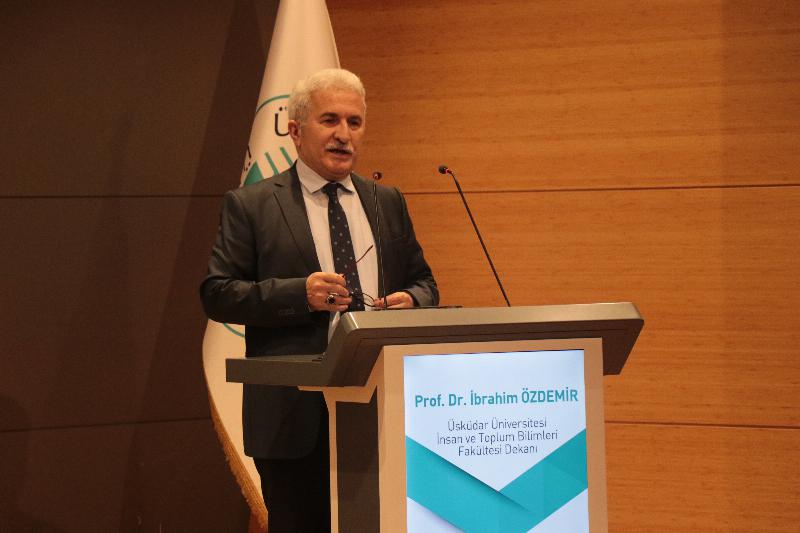
Prof. Dr. İbrahim Özdemir: “We have just begun to understand the impact of climate change on historical events”
In his opening speech, Prof. Dr. İbrahim Özdemir, Dean of the Faculty of Humanities and Social Sciences at Üsküdar Üniversitesi, also pointed to environmental history, a newly emerging field, stating that there is a significant relationship between pivotal historical events and climate change. Prof. Dr. İbrahim Özdemir said, “With the emergence of environmental history, we have just begun to understand the impact of environmental events and climate change on the formation of history and historical events. Yet, we should have understood it before anyone else, because we came to these lands through a long process as a result of major droughts and climate changes in Asia.” Prof. Dr. İbrahim Özdemir emphasized that when trying to understand any event, all factors should be considered with a holistic perspective, stating, “We aim to present the 31 March Incident to you from different angles, 113 years later.”
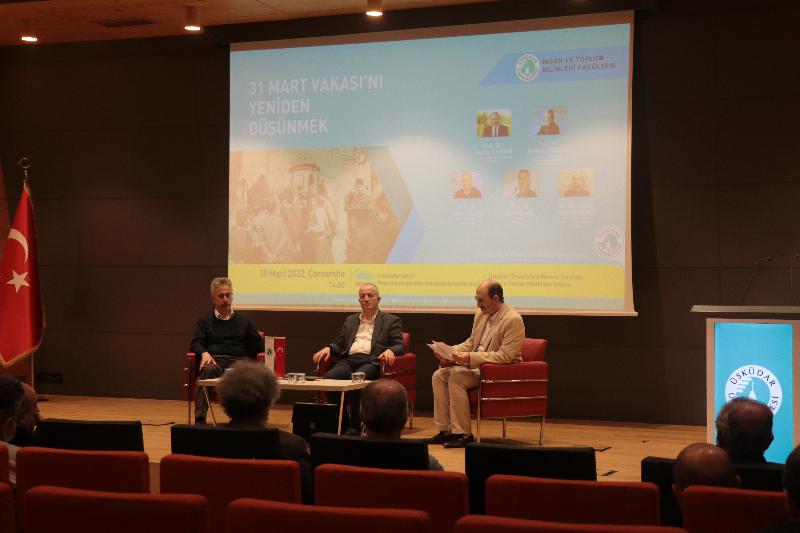
The 31 March Incident discussed from various perspectives
Following the opening speeches, the 'Rethinking the 31 March Incident' Panel was held, moderated by Dr. Uygar Aydemir, Head of the History Department at Üsküdar Üniversitesi.
Prof. Dr. Ali Arslan from Kocaeli University, in his speech evaluating the proclamation of the constitutional monarchy and the 31 March Incident based on internal and external factors, laid out the conditions of the period. Prof. Dr. Adem Ölmez from İstanbul Medeniyet Üniversitesi, in his speech titled “The 31 March Incident in Historiography,” stated that there are many reasons to understand the 31 March Incident, emphasizing that concepts such as reactionary, progressive, and Sharia-advocating are entirely the result of a modernizing historical understanding and that these terms do not define the 31 March Incident.
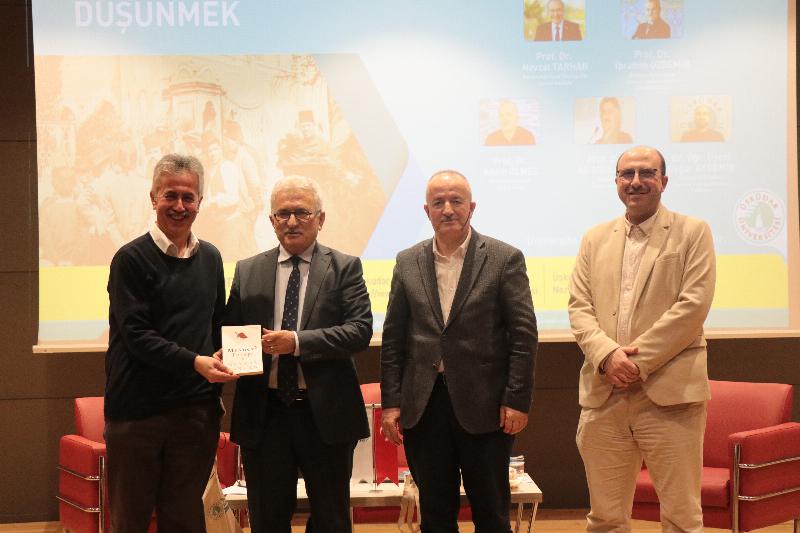
Following the panel, participants took a group photo; a set of books by Prof. Dr. Nevzat Tarhan was presented to the attendees.
The panel was also broadcast live on ÜÜTV and Üsküdar Üniversitesi's official YouTube page.
Share
Request a Call
Other News
- Üsküdar University participated in an international exhibition with a child rights perspective
- Solidarity Bazaar for Palestine from Üsküdar Residents
- In additional placements, don't just choose a department, choose the profession of the future!
- 52 Erasmus students from 15 different countries at Üsküdar University
- Visit to Prof. Nevzat Tarhan from the Global Confederation of Civil Society Organizations