Technical Details
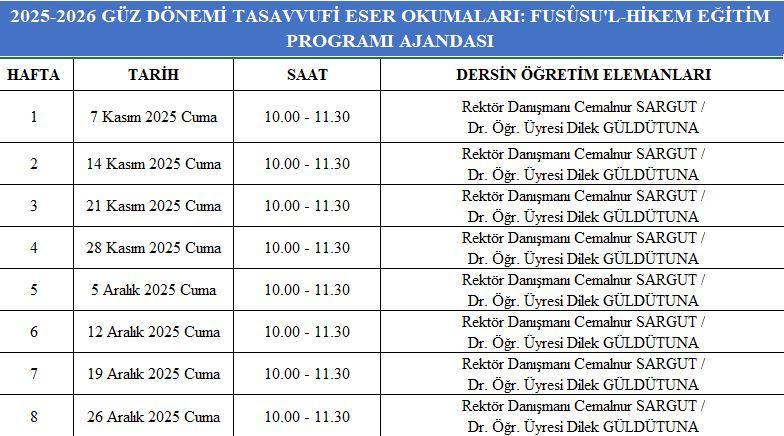
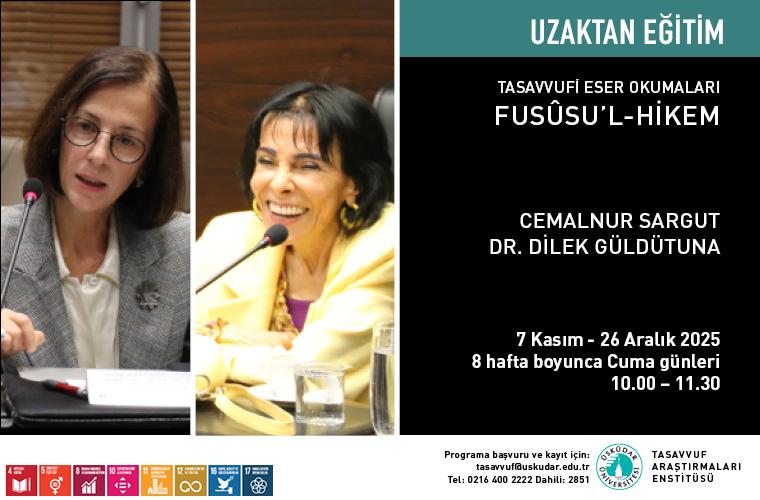
- The program lasts for 8 weeks.
- It will take place between November 7 – December 26, 2025.
- Fridays, 10:00 – 11:30
- Program fee: 12,963 TL
- Fee for International Participants: 270.00 EURO
*** The classes are recorded simultaneously and uploaded to the system. Participants will have access to the course videos for 6 months.
Participants who complete the payment process are kindly requested to send their payment information to tasavvuf@uskudar.edu.tr.
Scope
Ibn Arabi (1165–1240), also known by the titles Muhyiddin (“reviver of religion”) and Shaykh al-Akbar (“the Greatest Master”), united East and West in his works throughout his outward and inward spiritual journey from Andalusia to Damascus. He was a Sufi who interpreted and integrated various disciplines, as well as philosophical and mystical perspectives, without excluding them. In the Islamic world, no scholar has left such profound and widespread influence as he has, and in the West, very few Muslim scholars are as well-known as he is.
Osman Yahya mentions around 550 works authored by Ibn Arabi, ranging from two-page treatises to the 37-volume al-Futūḥāt al-Makkiyya. More than 300 of his works that have survived to this day still exist mostly in manuscript form.
Although he is sometimes unfairly labeled a theoretician because he systematized many Sufi concepts and ideas, Ibn Arabi repeatedly emphasized in his writings that he conveyed only the knowledge he personally experienced and tasted. As his students also expressed, theory and practice are inseparably intertwined in his works.
Among his numerous works, two in particular—al-Futūḥāt al-Makkiyya and Fuṣūṣ al-Ḥikam—have had the greatest impact and best reflect his legacy. While al-Futūḥāt al-Makkiyya covers a wide range of subjects in great detail, Fuṣūṣ al-Ḥikam, written in Damascus in 1229, is regarded as the epitome of his teachings due to its depth and intensity. For this reason, approximately 120 commentaries were written on the work, the first being Ibn Arabi’s own. Initially read within small circles, it gradually became widely known and has remained a center of interest up to the present day.
The title of the work also reflects its content. Comprising 27 chapters, each section is dedicated to a prophet mentioned in the Qur’an and presents a divine wisdom manifested in him. As expressed in the sacred hadith “Hidden Treasure,” the Divine Essence cannot be known or comprehended in itself; yet the cosmos is the place of Divine manifestation, and the Perfect Human—God’s vicegerent—is the locus of complete manifestation and the purpose of creation. By understanding the wisdom manifested in each prophet’s “word,” that is, his spiritual reality, a new door opens for the human being in knowing the Divine. Prophet Muhammad is the Seal of the Prophets (khātam al-anbiyāʾ), for he is the final prophet, confirming, completing, and uniting all previous prophets, and embodying the totality of the “words” (jawāmiʿ al-kalim). As the perfect manifestation of the Muhammadan Reality, he unites the beginning and end of creation. Therefore, understanding the other prophets and their wisdoms leads to understanding and knowing the Muhammadan Reality and Prophet Muhammad himself.
Agenda