

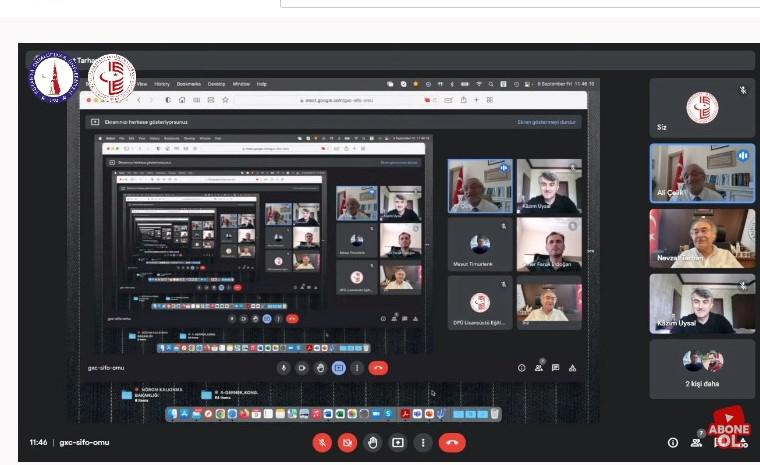
Psychiatrist Prof. Dr. Nevzat Tarhan, Founding Rector of Üsküdar Üniversitesi, attended the “International Symposium on Mental Health and Religion in Theological Disciplines” organized by Kütahya Dumlupınar University as a speaker. Making striking assessments under the title “Psychology Rediscovered Spirituality,” Tarhan spoke about how individuals discover spirituality by using their right brain. Tarhan stated that the right brain processes moral information more than the left brain, adding that those who think with their left brain often say 'I am powerful,' while those who think with their right brain say 'I am the life force, the power of the universe.' Tarhan extensively discussed the topic through cases that have entered the literature.
Content
Prof. Nevzat Tarhan: “We need to develop our right brain more for morality”
“We need to change our mental information sets.”
Prof. Dr. Nevzat Tarhan, Psychiatrist and Founding Rector of Üsküdar Üniversitesi, who was among the opening speakers of the symposium organized by the Faculty of Islamic Studies, stated that we need to transform some of our traditions into new ones based on the Holy Quran. Tarhan said; “Currently, a serious transformation is taking place in the world. There are signs of it, there are precursors. The 20th century was the age of information, and the 21st century will be the age of wisdom. In such a situation, the most beautiful method to tell the truth to people in this era is the reality of tawhid (oneness of God). The reality of tawhid is compatible with reason. There are 4,300 religions. All claim to be true, but within them, the need for religion, currently, there is a reality in the universe that is independent of time and space. Science is now saying this. That is, there is an invisible reality that existed before the Big Bang, existing in the universe. That visible reality is visible to the eye of reason; we can see it. People, science, positive science are currently on the verge of discovering this. If we can synthesize religion and science, we will be able to explain tawhid to humanity. Currently, based on the Holy Quran, we need to transform some of our traditions into new traditions. Just like our ancestors changed cars and vehicles, or changed clothes, now we need to change some of our mental information sets. We need to change our belief sets.”
“In the past, the threat to spiritual life came from ignorance, now it comes from science”
Tarhan stated that humanity has become very worldly, and animalistic desires and impulses have overtaken higher impulses and reason. Tarhan; “With the 20th century, the world has now become a secular society. We became very worldly, globalized. Instinctive feelings overshadowed reason, thought, and higher sentiments. In other words, our animalistic desires and impulses took precedence over our higher impulses and reason. Eating, drinking, sheltering, and reproducing. Humans have a search for abstract meaning. This fell into the background. Secondly, narcissism increased in this era. Egocentricity increased. There is a book talking about the epidemic of narcissism; I, for example, bought that book. Materialism increased. That is, in materialism, previously ignorance came from lack of knowledge. More precisely, the threat to spiritual life came from ignorance. Now it comes from science. The threat to spiritual life, religious life. It comes in the name of science. In such situations, the reason for this is materialism. Materialism has now actually entered a serious questioning process. The capitalist system referred to humans as homo economicus. They are purely rational actors. They possess perfect information, derived from microeconomics. They maximize subjective utility. The actor weighs the benefits and harms of various actions. Then the actor human chooses the option that can provide the greatest benefit relative to the cost. This is called optimal choice, i.e., homo economicus, it was the thesis of capitalism, but then in the 2000s, a researcher who also received the Nobel Prize, Kahneman, received the Nobel Prize in economics for psychological factors in purchasing behavior or investment behavior. After that, they said that humans are homo economicus but also homo psychologicus. The actor is rational to a limited extent; they do not only calculate profit and loss. They do not possess perfect information. Human processing abilities have limits. And now, with the development of neuroscience, humans are called neuro psychologicus, meaning the actor is rational within neurocognitive limits. We are not free outside the boundaries of neurogenetics provided by our genes. Science has now reached this point.”
“Two positive characteristics of science: Productive thinking and sharing”
Prof. Dr. Nevzat Tarhan, stating that a work can be proven if it can be presented to and defended in the literature; “Science has two positive characteristics: productive thinking and sharing. That is, someone engaged in positive science produces productive thought, meaning something new. Secondly, they share this with people. In conferences, congresses, etc. This is the summary of scientific methodology, of positivity. If you can present your work to the literature, if you can defend it, it means you can prove what you have done. That's why being able to publish our work is very important. Imagination is very important. But one of the secrets of discovery is being able to approach something we do every day from a completely different perspective. Currently, what we do every day is referred to as 'thinking outside the box'. When we do this, it becomes the correct use of imagination. In psychology, there are forms of scientific approach. Structuralism, functionalism, behaviorism, cognitivism, Gestalt school, humanistic school, psychoanalytic school, which came until the 2000s, the latter is currently dominant. Now, as I mentioned earlier, Metapolitical, positive psychology, mindfulness – what is fully present in mindfulness? Self-knowledge, empathy. Altruism, sharing, forgiveness, mercy are all there. All these concepts are taught within scientific methodology.”
“Positive psychology is, in a way, also the science of well-being…”
Tarhan provided information on the difference between positive psychology and positivity; “Experimental verifiability is important in positivity. There is positivity in the sense of being well. And there is positivity in the sense of experiencing spiritual significance. In other words, a spiritual orientation emerges that contributes to the well-being of a life that adds meaning in a spiritual sense. Positive Psychology is defined as a branch of science that guides people to make life more fulfilling by focusing on positive character traits, strengths, and virtues, and contributes to their tools for happiness. So, here, the state of well-being is also Seligman's definition. This definition is a complex one. That is, psychology normally brings the negative to zero. Positive psychology raises it above zero. That's why positive psychology brings it to positive. It also refers to the human state of well-being. In our culture, there is the word 'afiyet'. For example, when praying to Allah, it is referred to as 'health and afiyet'. The word 'afiyet' is referred to as 'well-being' in the literature. I researched 'well-being,' which means a state of being well. In Turkish, our ancestors used the word 'afiyet' in exchange for this 'well-being'. The word 'afiyet' is actually beyond health, meaning a person being in a state where they feel good; positive psychology is, in a way, also the science of well-being.”
“Ilm-i Kalam needs to be interpreted in a way suitable for this era”
Prof. Dr. Nevzat Tarhan spoke about the positive and negative aspects of moral theory. Tarhan; “We are in a time when religion and science are not rivals, but rather complementary to each other, as they were in ancient times. Science is ready to take a step in this direction, and if religious scholars are also ready… This will be done by those who know the Islamic religion. Christianity has gone bankrupt; it cannot do this. Within the logical foundation of the belief in Tawhid, we can defend and explain the Quran so beautifully. Ilm-i Kalam needs to be interpreted in a way suitable for this era; it is already written, and our sources are solid. There is no need to change them; they need to be interpreted according to the conditions of this era. Moral identity, moral courage, moral sensitivity, moral reasoning – if these exist in moral theory, then a person's consistency in moral theory emerges. In moral theory, there are positive and negative concepts… Such as wisdom-pride, love-envy, benevolence-anger, justice-deception. According to moral theory, let's strengthen this positive leg and consider the negative leg as a target, this is moral theory, ethics theory. Again, according to this theory, here, that is, according to the universal moral theory, it is called common conceptual.”
“The right brain processes moral information more than the left brain”
Prof. Dr. Nevzat Tarhan, speaking about how individuals discover spirituality by using their right brain; “The right brain, the moral brain, the areas of moral behavior, are larger on the right than on the left. The right brain processes moral information more than the left brain. People who make moral decisions are those who have developed their right brain more. This is a case that has made a tremendous contribution to the literature. In 2008, there's a TED talk titled ‘My stroke of insight’. A neuroanatomist who suffered a stroke, a brain hemorrhage, made this presentation as an insight into my stroke. ‘What my stroke taught me…’ Then, for example, she recounts after the stroke, showing that she experienced spiritual states. But ‘I am still alive, I am still living, there is bleeding, after recovering, I found Nirvana’, meaning I found something spiritual. She found Nirvana after suffering a brain hemorrhage. ‘If I found Nirvana, and I'm still alive, then everyone living can find Nirvana. I revived the world in my mind, a world where peaceful, compassionate, loving, beautiful people know they can come here whenever they want, and they consciously choose to move from the left hemisphere of their brain to the right side and find peace.’ Then I realized how much of a magnificent gift these experiences could actually be, what a striking insight they could offer into how we live our lives, and this motivated me to recover. After the brain hemorrhage, this person had bleeding in her left brain, and then she used her right brain more. When she used her right brain, she discovered spirituality. She presented this as a presentation at TED. Using the right brain means that, in order to educate our morality, we need to develop our right brain more.”
“People who think with their left brain say ‘I am an individual alone’”
Tarhan, referring to the doctrine of capitalist morality in our current era; “Those who think with their left brain say ‘I am powerful,’ but those who think with their right brain say ‘I am the life force, the power of the universe.’ Fifty trillion high and beautiful molecules forming my body, which is one and unique in every aspect, refers to the entire body, ‘I am the life force and power of genius, or I can choose to pass into the consciousness of my left hemisphere, I am an individual alone.’ People who think with their left brain, who think logically, say ‘I am an individual alone.’ Currently, the doctrine of capitalist morality says, ‘The individual is important, you are important, forget others.’ What does someone who thinks with their right brain say? ‘You are not alone, don't just think about yourself, think about society, think about others.’ If you develop this further, a person should say, ‘Think about your country, think about your homeland, think about humanity, think about the universe, think about the Creator.’ This is what our brain, our right brain, tells us. Our right brain says, ‘You did not come to this world by chance, this universe is not aimless, find the Creator,’ it says, ‘There is a power beyond matter, beyond time, a reality, see it, seek it with the eye of reason, find it.’ Do we necessarily need to have bleeding in our left brain, or suffer a stroke, to activate our right brain? An intelligent person does this by using their intellect, but to someone who cannot do this, God gives such an experience, which perhaps, God willing, becomes a means for their guidance.”
“Endorphin evokes a peaceful feeling in humans, as if all problems are solved”
Tarhan, speaking about the effects of some hormones in our brain; “We have attachment hormones in our brain. Ibsos's attachment hormone. Endorphin in our brain is both a painkiller and the brain's internal morphines. It evokes a feeling in people as if all their needs are met, all their desires are satisfied, all their problems are solved, like both a painkiller hormone and an internal morphine. Dopamine is a hormone related to pleasure and focus. All these hormones are secreted abundantly in humans. Historically, this hormone was most secreted in Rumi. He attained divine love, and with the peace it provided, all these hormones flooded the brain. I assure you, I am thinking of believing people who have inner peace. I am thinking of people who have the belief in Tawhid.”
“We should be two-worldly, not single-worldly”
Tarhan, drawing attention to the inadequacy of scales related to humanity's search for meaning and purpose, noted that they developed the ‘Üsküdar life meaning scale’ in this context; “Allah wants from you the beauty of both worlds, not just the beauty of the afterlife, and not just the beauty of this world. We need to be two-worldly. We should not be single-worldly. If we are, then we achieve happiness. It's not difficult at all, I tell you. The person who discovered the concept of emotional intelligence is Goleman. I wrote this book in the 2000s, titled ‘Emotions and Analysis Specific to Our Culture’. Currently, psychologists benefit most from the concept of psychology with emotions: positive emotions, negative emotions, how to manage our emotions. It's a study where I tried to synthesize our culture with our emotions. There are many values such as tolerance, helpfulness, self-confidence, humor, social anxiety, sharing. Here, they have also learned cultural intelligence. A person using the culture they live in like intelligence; there are also dimensions of cultural intelligence. Positive psychology's conceptual content includes cultural factors. Such as the meaning of life, purpose, life dimension, quality of life, psychological needs. For example, there are scales developed in psychiatry regarding the meaning and purpose of life, and believe me, those of the Western world are very inadequate and cannot fully express human beings. We developed an ‘upper life meaning scale’, conducted validity and reliability studies, and published it in the literature. It is referred to as the Üsküdar life meaning scale. In it, we also developed scales related to giving meaning to spiritual values, creating those ideals, and higher meanings. It forms the foundations of positive psychology; that is, when positive psychology emerged, we benefited greatly from the history of scholarship.”
Share
Request a Call
Other News
- Social responsibility courses moved to the field
- Erasmus+ Orientation Week completed at Üsküdar
- Prof. Nevzat Tarhan: “Brain secretes ‘dark glue’ in social media lynchers!”
- Prof. Nevzat Tarhan: “Every segment of society should be able to say, ‘This constitution is my constitution!’”
- OHS releases guide for safe operation of industrial robots