

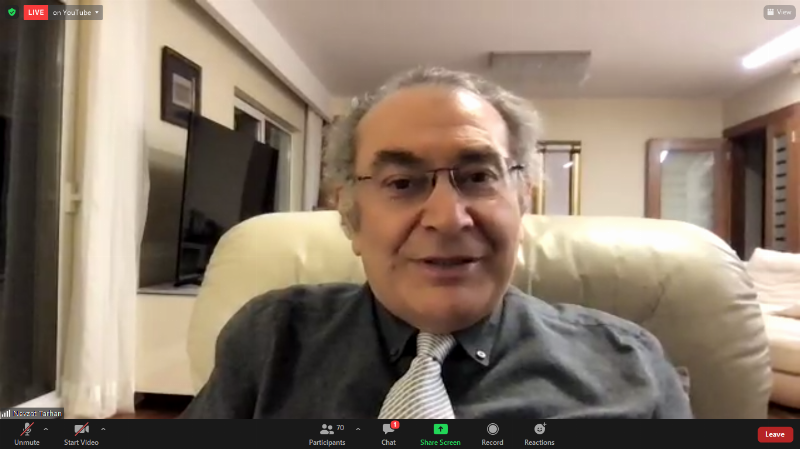
Başakşehir District Directorate of National Education hosted Üsküdar Üniversitesi Founding Rector, Psychiatrist Prof. Dr. Nevzat Tarhan, who made striking evaluations on the topic of “Positive Psychology in Education.” Addressing educators, Tarhan stressed that the need for positive psychology has increased with Covid-19. Tarhan said: “In the coming years, the need for positive psychology courses will sharply increase all over the world. Covid-19 has further accelerated this. We have carried out a book study for ninth graders on this subject. If we can explain the book, which is currently with the editor, to students, millions of students will be able to learn our values and Anatolian wisdom with a scientific methodology.”
Content
Prof. Dr. Tarhan: “With positive psychology, our youth will learn our values”
“Covid-19 saved digitalism from the monopoly of global power”
Evaluating positive psychology in education at the event organized by the Başakşehir District Directorate of National Education, Tarhan stated that the world is heading towards digital dictatorship. Tarhan said: “In the 21st century, Industry 4.0 emerged. Here, autonomous robots, simulation, the internet of things, cyber security, cloud communication, 3D printers, augmented reality, and big data were developed. In 2018 at Davos, global capital had seriously invested in digital platforms, taking over and maturing the entire transaction platform. It had become the sole ruler of the digital world and had reached the point of declaring digital dictatorship. Upon this, the famous historian Harari reflected the current situation very strikingly by saying: ‘The world is heading towards digital dictatorship, we are the last free generation.’ Global capital's main plan until Covid-19 was to keep the digital sphere in its own monopoly. It was to create a digital platform and make it serve itself all over the world. However, Covid-19 emerged, and everyone globally had to digitize. And interestingly, their digital monopolies were broken.”
“Not social media, but virtual media”
Tarhan, stating that Industry 4.0, which emerged in the 21st century, trapped people in the virtual world, touched upon the importance of positive psychology in education. Tarhan said: “Industry 4.0 has advantages and disadvantages. To protect against its disadvantages, positive psychology in education is quite important. According to research conducted in America, while the time spent by young people aged 13-19 on social media is increasing day by day, face-to-face interaction rates are decreasing at the same rate. This digital world has become 'virtual media' not 'social media.' There is no sociality in this world; there is a fake world within a virtual reality. Before, I used to say 'A liar's candle burns until dusk.' Now, a liar's candle burns until the internet. It also has such an advantage. In such a situation, the rates of young people saying they meet face-to-face every day have dropped to 20-30%. What kind of generation this is creating is currently unknown. To remind this generation of the values it has forgotten, positive psychology needs to be taught as a course.”
“Education transformed with 21st-century skills”
Tarhan, stating that new truths have emerged in education according to the world's course, emphasized 21st Century skills. Tarhan said: “21st-century skills emerged in education. For example, emotivism, one of these skills, expresses the importance of emotional and mental skills. Neuroscience-based learning is at play here. A revolution occurred in psychology with the writing of the book 'Descartes' Error.' Before this, only reason was glorified, but paradigms underwent a serious transformation, and the importance of social and emotional skills was understood. One of these skills is connectivism, or interconnectedness. Other skills such as innovation, entrepreneurship, and mental flexibility emerged. Techno-entrepreneurship, objectivism emerged. According to 21st-century skills and chaos theory, active experiential learning is important in this era. That is, it is important for young people to learn not by memorizing at a desk, but by developing their mental flexibility through adding their social and emotional skills and experiencing.”
“Positive Psychology focuses on happiness and well-being”
Tarhan, emphasizing positive psychology which gained importance in the 21st century, touched upon its origin. Tarhan said: “The science of happiness, or positive psychology, emerged after research conducted in the USA. According to this research, it is determined that there is no change in people's happiness rates even though the gross national product has increased. Upon this, the question 'How can we increase happiness?' is asked. After 2013-2016, there is an epidemic of suicide, divorce, and loneliness in the West. I used to define this as a Western civilization crisis, but now I think it's a civilization crisis not just for the West, but for the whole world. The US government granted funding to Seligman and his team from The Pennsylvania State University in 2000 to conduct research in this field. At the end of this study, positive psychology was introduced. The difference between psychology and positive psychology is that while psychology can bring a negative situation back to zero, positive psychology can carry it from zero to positives. It is defined as well-being and focuses on being happy.”
“Üsküdar Üniversitesi among the first universities in the world to introduce positive psychology”
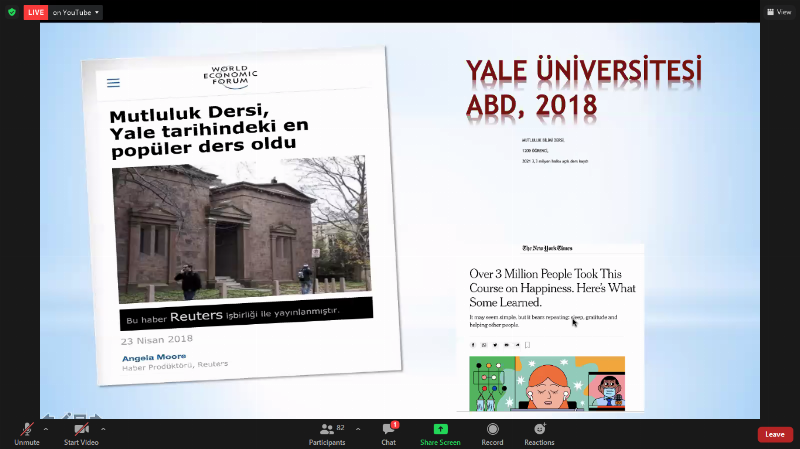
Tarhan stated that the sources of positive psychology are based on Rumi and Anatolian wisdom, and noted that Üsküdar Üniversitesi is one of the pioneering universities to offer this course. Tarhan said: “Harvard introduced positive psychology as a course in 2015. While researching the content and theoretical basis of positive psychology, I observed that it systematized and presented Anatolian wisdom and Eastern philosophy. Moreover, they had not cited Rumi and other sources they quoted on this subject. We live upon a great treasure, but those who systematize it as a methodology are Western scientists; this shows our laziness. Upon this, I tried to pay this debt by writing books like 'Mathnawi Therapy' and 'Yunus Therapy,' saying that Rumi said this centuries ago. As Üsküdar Üniversitesi, after we introduced this course in 2013, Harvard introduced the course after us in 2015. The results of the Oxford happiness scale we conducted after introducing the course as a university were very striking. According to this scale, it was revealed that students' emotional intelligence increased by twenty percent with the emotional intelligence scale. Yale University sees that the course has been highly demanded after introducing it in 2018. Harvard describes this course as 'groundbreaking' and states that it prevents suicide. Due to high demand during the pandemic, Yale University made the course public, enabling three and a half million people to benefit from it. We, as Üsküdar Üniversitesi, also put the course on our website with short videos. So far, more than three million people have accessed the course.”
“If we can explain Positive Psychology, our youth will learn our values”
Tarhan, stating that the need for positive psychology will increase in the future, reported that this science protects people from illness before treating them. Tarhan said: “In the coming years, the need for positive psychology courses will sharply increase all over the world. Covid-19 has further accelerated this. We have carried out a book study for ninth graders on this subject. If we can explain the book, which is currently with the editor, to students at the ninth-grade level, millions of students will be able to learn our values and Anatolian wisdom with a scientific methodology. Positive psychology is a field with a future. Positive psychology is a kind of preventive medicine. It is to work so that people do not get sick and their mental health does not deteriorate. It is to work to prevent the recurrence of illness in people whose mental health has deteriorated. The aim is to increase well-being. We teach psychological resilience and resilience training. We teach delayed gratification skills. These are especially important in the lives of young people. When they learn these, they will win.”

“Family is a small homeland, homeland is a large family”
Tarhan, stating that forming a family and the institution of marriage is the most suitable way of life for human nature, said: “What is suitable for human biological nature is family and married life. Today, as Üsküdar Üniversitesi, we signed an agreement with Kazakhstan. This agreement included seven Turkic states; countries like Kazakhstan, Kyrgyzstan, Turkmenistan, Uzbekistan are in this group. According to research conducted in Central Asia, young people are in a better situation regarding marriage and family formation compared to the West, but of course, we don't know what will happen in 10 years. A famous saying from Kazakhstan came up during the meeting: 'Love of homeland begins with family,' they say there. This perspective is an understanding that equates family with homeland. Indeed, family is a small homeland, and homeland is a large family. If family ties weaken, our nationalism will also diminish, and our homeland will suffer. Currently, global capital wants to weaken family ties to reduce the world population. Out-of-wedlock birth rates have increased worldwide, hovering around 56 percent in England, 59 percent in Sweden, France, and Norway, and around 69 percent in Iceland. According to France's latest decision, since more than half of children are born out of wedlock, the names of 'mother' and 'father' are removed and they are recorded as 'parent 1' and 'parent 2.' In Europe, the family has disappeared. The number of single-person households is increasing every day. Especially in Sweden and Norway, household fragility has greatly increased, and the number of single-parent homes has reached an extreme level.”
Reporter: Esmanur Tuna
Share
Update Date: February 28, 2026
Creation Date: November 04, 2021
Request a Call
Other News
- Social responsibility courses moved to the field
- Erasmus+ Orientation Week completed at Üsküdar
- Prof. Nevzat Tarhan: “Brain secretes ‘dark glue’ in social media lynchers!”
- Prof. Nevzat Tarhan: “Every segment of society should be able to say, ‘This constitution is my constitution!’”
- OHS releases guide for safe operation of industrial robots