

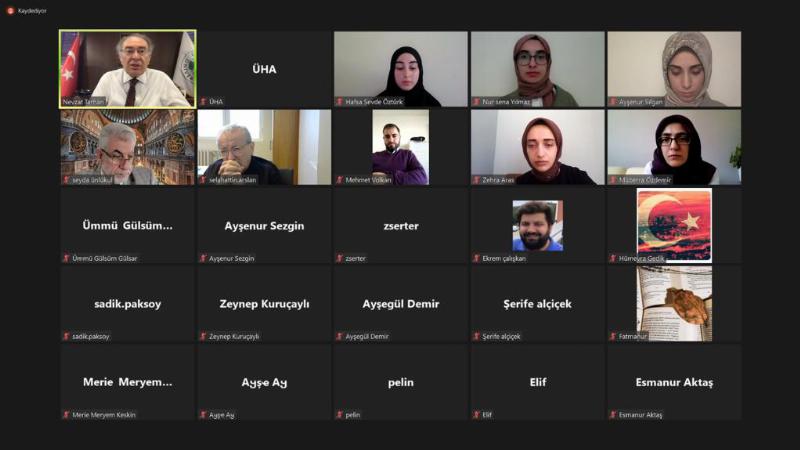
Founding Rector of Üsküdar Üniversitesi, Psychiatrist Prof. Dr. Nevzat Tarhan was the guest of 'Existence Talks' organized by the Conscience of the Age Club. Tarhan, who made evaluations on the control of narcissism and feelings of ego, which are among the diseases of our era, in the context of 'The Cipher of the World of Meaning: The Ego', likened the feeling of ego to a wild horse within us. Tarhan said; 'To tame the ego is to control the self, which is like a wild horse within us. If you tame it, the horse will take you to your goal, but if you cannot, you become a slave to your desires. If we tame and develop the feeling of ego, our self becomes a horse, a mount. If we cannot tame it, we will go towards its - our self's - desires.'
Content
Prof. Dr. Tarhan: “Those who can control their ego are freed from being slaves to their desires”

“New sacreds of the modern age: Humanity and nature”
Tarhan stated that with the acceptance of the Philosophy of Enlightenment, sacredness in the universe was attributed to nature, and in the individual, sacredness was attributed to the ego. Tarhan said; 'As Bediüzzaman Hazretleri said, whatever the ego is in humans, nature turns out to be that under the story. You called the ego, that is, the concept of 'I', a cipher, it has a key role. What does a key do? It opens hidden treasures, hidden secrets. Nature also has a key role in our understanding of this universe. Western philosophy, which wants to separate positive sciences and religious sciences, is currently accepted. Turkey has bought into this philosophy. Our national education system is currently providing its education based on this philosophy. This different treatment of sciences is wrong. Sciences, religious science, natural science are inseparable. Sciences are a whole; with this approach, we wanted to open a holistic science research and application center, but it was not accepted. This kind of thinking is a very dangerous way of thinking. Stating that religious sciences and natural sciences are separate is falling into the Western trap. How did the Age of Enlightenment begin? It started with what we call Spinoza's Error. He sees God as nature and takes the individual as the basis. Sanctifying man and sanctifying nature is actually the key to a perspective on life. When man sanctifies the ego within himself, he sanctifies himself. In other words, in the universe, they give divine sacredness to nature, and in the individual, they give sacredness to the ego. This perspective is the theoretical basis of the philosophy of enlightenment.'
“Western thought presents the concept of ego as an ego ideal”
Tarhan underlined the necessity of bringing a different definition to the concept of ego, noting that it is presented as an ego ideal in the West. Tarhan said; 'We should not define the ego and nature as the West presents them. We need to define them differently from the West. The West presents the ego as 'I'. For example, people come to a couple's therapist. Some psychologists with Western education say that the family is not important, you are important; if it doesn't work out, leave the marriage. They say the family is not sacred, you are sacred. Neither is sacred, why should they be? The West has sanctified the ego. The name for this in psychiatry books is narcissism. The sanctification of the ego is called narcissism. There is a narcissistic personality inventory. You can go online and apply it. It is an inventory of over 20 questions. There are yes/no questions there. If you answer yes to more than half of them, it means you have made yourself a god on earth. A Hadith says that one who has an atom's worth of arrogance will not enter paradise. Arrogance opens the door to all evils. Arrogance is the highest point of the sanctification of ego, the 'I' feeling. So, if it's a narcissistic identity, they say 'I am important, I am a priority.' Narcissists see themselves as special, important, superior. They are very closed to criticism. These are individuals with high ego. In healthy administrations, power resides in laws and rules. But in narcissistic administrations, there is arbitrariness. The most important thing here is that power should be in laws and rules, not in individuals. The third characteristic of narcissism in leadership is that they are closed to criticism; they see criticism as a threat, and the critic as an enemy. They read the critic's intentions and sabotage them, claiming they have a hidden agenda. The fourth characteristic is the absence of the concept of consultation, there is no application of council methods. They do not apply consultation, they do not apply the concept of shura. Adhering to shura, applying council. In individuals related to law and rules, there is no tolerance for criticism, no consultation. In such cases, the person, in a way, sees themselves as sacred. This narcissism is even called a God complex.'
“When the individual is sanctified, it leads to narcissism and egoism”
Tarhan stated that humans must accept themselves as a created being with limitations and emphasized the characteristics of narcissism. Tarhan said; 'There are things that humans have the power to do, and things they don't; things they can control, and things they cannot. Knowing this means knowing the limits of the ego. One should be able to say, 'My power is this much, my control is this much, beyond that belongs to someone else, beyond that belongs to Allah.' Essentially, knowing one's place means not having an ego. When the individual is sanctified, it becomes narcissism; the ego becomes sanctified. In universal narcissism, you sanctify nature, you worship nature. In the past, people used to worship totems; now they worship dollars, nature. Only the sacred objects have changed.
For example, what topic is most discussed at home: money, fame, status, physical appearance, or clothing? That is the sacred thing of that home. Is being a good person discussed, honesty, diligence, being able to establish a heartfelt connection with Allah? What are the important priorities, that is the sacred. What is the sacred of a home for people with high ego? For example, narcissistic individuals are success-oriented. In fact, narcissistic individuals have very significant fears; they fear being ordinary. I see that this illness also exists in religious people. That's why knowledge is not enough; wisdom is needed here. In Risale-i Nur, the master also gave the key to wisdom with the Risale-i Ikhlas for this purpose. If they ask what the distilled form of Sufi culture is, it is the ethics of sincerity (Ikhlas). When you apply the ethics of sincerity, you add wisdom to your knowledge. For this, it is not necessary to follow a Sheikh.'
“Narcissism is ego cancer”
Tarhan emphasized that the struggle with ego will continue until the last breath; 'Narcissism is ego cancer. It is the sanctification of the ego. It is, in a way, the ego putting itself at the center of the world. As a result, what happens is that people of this age become lonely, unhappy, and commit suicide. In old age, they remain alone, paying the price. Ego is the key for us to know and find Allah. The key to grasping the meaning of our existence passes through ego. In schizophrenia, the boundaries of the ego are disturbed, disrupting a person's relationship with themselves and others, their object relations. When this is disrupted, the person becomes schizophrenic. If you have an ego, and you don't use it correctly, you will pay the price. But there is no guarantee for anything or anyone; the test begins here. No one should say 'I am like this now, I am guaranteed,' it is understood at the end of life. Therefore, success here is total success. It is not situational success. Success is a process, not a state. A person can say 'I am successful' now, but may not be successful at the end of life. That's why one of the ways to know one's limits in ego is to be able to say at the end of life, 'I can only see myself as having achieved my goal.' And that becomes clear at the last breath. Our struggle with ego, managing our ego, is a process that we will manage until our last breath. Allah has actually created us with such a test, with such a chance and opportunity.'
“We must blunt narcissism and prioritize teamwork, one of the 21st-century skills”
Tarhan stated that the feeling of ego hinders teamwork and success; 'One of the 21st-century skills is to be able to be a team. Someone with ego says 'I', emphasizes individual intelligence, and tries to make others call them smart. In an ego-resistant marital relationship, there are ego wars: 'my money, your money,' 'what I say, what you say.' The woman tries to dominate the man, and the man tries to dominate the woman. Here, ego is fighting, there is no peace. The ideal is to see the family as a ship and to manage oneself in a way that neither oppresses nor is oppressed for the good of the ship, rather than dominating one's spouse. When a person does this, they are using their ego correctly. If this person approaches based on individual intelligence, saying 'I am intelligent, I am smart,' then they are prioritizing individual intelligence. There is also group intelligence. The most important skill of the 21st Century is team intelligence. When a person acts with group intelligence and adds group intelligence to their own intelligence, a matrix relationship forms within that group, and a matrix relationship brings success. In fact, being a community means forming a matrix relationship. In a matrix relationship, there is no hierarchy, no top-down relationship. Now, old societies were bond societies. Here, you connect with someone, rent out your mind, obey and be at ease. But the 21st Century is a network society, which means team intelligence. When a person acts with team intelligence, because they are a member of the team, when they feel they are a part of the team, tremendous success emerges.'
“Taming the ego is like taming the wild horse within us”
Tarhan, who likened the sense of self to a wild horse within us, emphasized that if this horse is tamed, it will become a beautiful mount. Tarhan said; 'To tame the ego is to control the self, which is like a wild horse within us. If you tame it, the horse will take you to your goal, but if you cannot, you become a slave to your desires. If we have come to this world for a test, it means we are chosen. Being a good person is not a virtue; being a good person is the rent for being human. If we tame and develop the feeling of ego, our self becomes a horse, a mount. If we cannot tame it, we will go towards the desires of our self. A person who cannot tame their ego means a person who cannot tame their self. What happens to this person? They are individuals who succumb to the desires and traps of their self. A sensible person asks, 'How do I establish my connection with Allah?' And they tame their ego, and against it, their self. They will tame the lion within, even if it's difficult, and the lion will be tamed very beautifully,' he concluded.
Share
Update Date: February 28, 2026
Creation Date: May 16, 2022
Request a Call
Other News
- The book that read today's digital threats in 2014: Being a Conscious Family
- Experts warn: 'Instead of memorizing letters, teach pencil grip, scissor use, and coloring'
- School fear and school love both start in the family!
- Family is not merely transforming, it is being battered under a serious assault
- Artificial intelligence opens the door to early diagnosis in autism!