

Üsküdar University Founding Rector, Psychiatrist Prof. Dr. Nevzat Tarhan, took part as a speaker in the event titled “Anxiety, Depression, and Their Impact on Family Relationships During the Covid-19 Process,” organized by Erzincan Binali Yıldırım University Faculty of Health Sciences. Tarhan said; “This process taught us the opportunity for a new philosophy of life in terms of reducing our selfishness, questioning hedonism, and being able to consider the consequences of income injustice and inequality.”
Content
Prof. Dr. Nevzat Tarhan: “The pandemic taught us all a new philosophy of life”
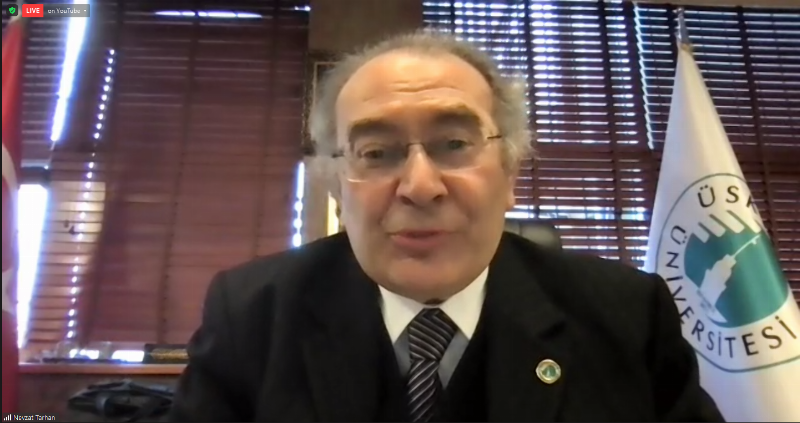
The moderation of the 2020-2021 Spring Semester Scientific, Social, and Community Contribution Events program, held online, was carried out by Lecturer Çiğdem Kaya Bağdaş from Erzincan Binali Yıldırım University Faculty of Health Sciences Child Development Department and Dr. Lecturer Meryem Fırat from the Faculty of Health Sciences Nursing Department.
“Nature makes those who betray it pay the price”
Tarhan, referring to the pandemic process and people's helplessness regarding the virus, said; “This process tests whether we are ready economically, psychologically, socially, and societally. Migrations are happening worldwide. Western culture receives migrations due to the rule of law. I am talking about the inequality and lack of law experienced in Eastern cultures. People are aware of the difficulties experienced during this period. Being aware is very good in one respect. While social crises are being experienced, the virus also teaches something. That is, we must protect nature for ourselves. Nature makes those who betray it pay the price,” he said.
“During the pandemic, we observe an increase in psycho-social maturation”
Tarhan, pointing out that the biggest development in the effects of Covid-19 is in the field of digitalization, said; “We are faced with the reality of social crises worldwide. During the pandemic, we observe an increase in psycho-social maturation. Individuals who exceed 50 percent in these rates are those who have adopted the right position. It is important to evaluate the crisis from the right perspectives. One of the reasons countries like England, Spain, and Italy could not overcome the crisis is that they did not take the right position. It is not possible to make correct decisions with libertarian thinking. In our culture, because a culture of fear is somewhat more dominant, we accept being obedient,” he said.
“There are psychological factors in crisis management”
Tarhan, referring to the psychological factors in individuals after the outbreak, stated; “Changes occurred after the Covid-19 pandemic. We can observe the factors. While social isolations are increasing, we can see that social relationships are decreasing. Diseases like depression and panic attacks are on the rise. This is because less entertainment and happiness prevail among individuals. So, what should we do? In this situation, psychological factors are important. Individuals and institutions need to have crisis plans. Knowing their strengths and weaknesses before a crisis and taking positions that will turn the crisis into an advantage are necessary. There are psychological factors in crisis management,” he stated.
“We need to turn morality into a cultural memory”
Tarhan, stating that society is suffering losses in terms of morality, said; “I advocate for teaching morality to individuals at a young age. Not within the family, but states need to teach it constructively. Otherwise, we will continue to suffer losses in society; investing projects in 'stone and soil' is not the solution. Having social projects would be a great gain for society. Investment should be made in social projects and culture. I observe that the building blocks of the family are fragmented. The concept of family is in a major crisis. If a cultureless society emerges, the next generation can destroy all material and spiritual things that have been built. We need to change our mental codes. We need to turn morality into a cultural memory,” he said.
“The world will embrace the beauty of a new life”
Tarhan emphasized that there is another life the world has not shown humanity and that there is a need for a search for meaning. He used the following expressions; “I want to state the remedy for this time. This is something I particularly advise young people to apply. I believe they should reflect on and focus on natural sciences and religious sciences. Without science, it's impossible; wisdom is essential. The 21st century is the age of wisdom. I want them to develop themselves precisely in that age. I am hopeful about young people. I also say these words in every program and event I attend. Let's not give despair and pessimism a place in our lives. This process taught us the opportunity for a new philosophy of life in terms of reducing our selfishness, questioning hedonism, and being able to consider the consequences of income injustice and inequality. We need science, a search for meaning, and wisdom. If all these come true and we succeed, the world will embrace the beauty of a new life,” he concluded.
Share
Update Date: February 27, 2026
Creation Date: March 31, 2021