

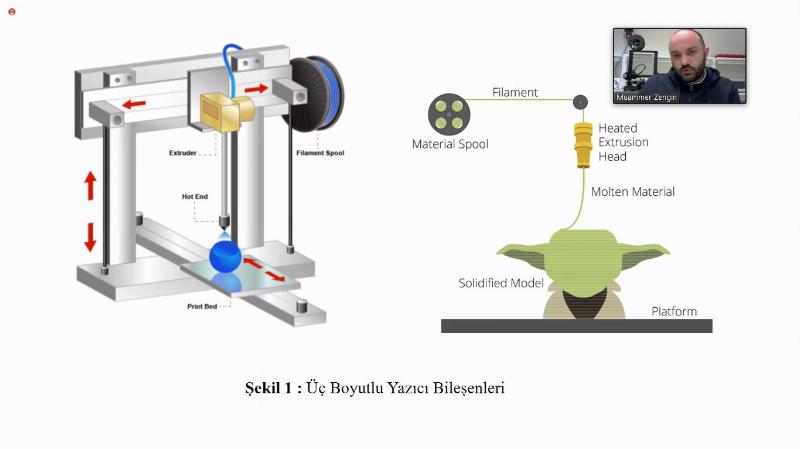
Üsküdar Üniversitesi Muammer Zengin, Lecturer at Üsküdar University Biomedical Device Technology, who spoke at the '3D Printers and Medical Applications' event organized by Üsküdar University; "One of the uses of 3D printers, described as a revolution in the healthcare sector, is the production of personalized pills. Thanks to 3D printers, different materials can be injected into pills according to the severity of the disease. As a result, it contributes to the cost of pill production," he said.
Content
Personalized Pill Production with 3D Printers!
“3D Printers will save lives“
Zengin, stating that 3D printers will save lives and are used in many fields; “With 3D printers, which have made very rapid progress in the health sector, prosthetic arms, feet, and organs can now be produced, and prosthetic teeth can be made. Another use described as a revolution in the healthcare sector is the production of personalized pills with 3D printers. Thanks to 3D printers, different materials are injected into pills according to the severity of the disease. As a result, it contributes to the cost of pill production. Scientists at Oxford University succeeded in producing human stem cells, which will be used to create organs in the future, with a 3D printer. This means that in the near future, organs needed by humans can be produced compatible with the human body using 3D printers,” he said.
“Children will be able to make their own toys”
Zengin stated that the application areas of 3D printers are quite wide; “NASA was also experiencing serious difficulties with some operations it was going to perform in space. Subsequently, a 3D printer capable of operating in a zero-gravity environment in space was developed, which greatly benefited NASA. There are significant developments in printing and design in education, and 3D printers were also used for the design and production of aircraft jet engines. Looking at the future from the perspective of 3D printers; children will have the chance to make their own toys with 3D toy data downloaded from the internet. When any part of a device used at home breaks down, instead of getting that part directly from the factory, it will be sufficient to pay only for the necessary geometry and material information,” he stated.
“The pace of innovation will accelerate”
Zengin emphasized that product innovation will accelerate with 3D printing; “The number of designs will increase in a wide range, from new car designs to household items. Therefore, the pace of innovation will also accelerate. A possible error in a product made with 3D printers will be noticed while the product is still in the design phase. 3D printing will also determine the future of aviation. 3D printers will increase efficiency by reducing the number and weight of parts used for aviation. To give a contemporary example, a company in China built 10 detached houses in 24 hours using giant 3D printers and a fast-drying concrete mixture made from waste materials,” he said.
Share
Update Date: February 27, 2026
Creation Date: April 15, 2021