

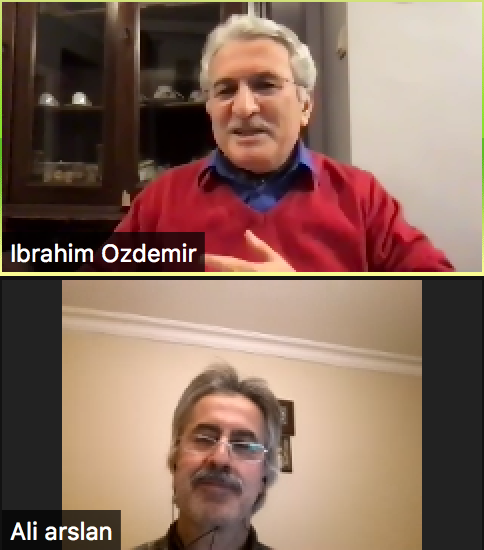
Üsküdar Üniversitesi Risale-i Nur Research Platform (RİNAP) organized the “RİNAP Monthly Conversation” program where “The Unending Agenda in East-West Civilizations Debates: Madrasas and Madrasa Reform during the Constitutional Era” was discussed. Historian Prof. Dr. Ali Arslan was the guest of the program held via Zoom. The program was moderated by Faculty of Humanities and Social Sciences Head of Philosophy Department Prof. Dr. İbrahim Özdemir.
Content
Madrasas and Madrasa Reform during the Constitutional Era discussed
“Education did not burden the state as it was covered by foundations”
Prof. Dr. Ali Arslan stated that there is a Westernization problem in education; “If we divide the education problem into two, from Bediüzzaman’s perspective, we see that the Islamic world has an education problem according to Islam, Islamic principles, and Islamic civilization. There is also the problem of the Westernization period. In Turkey and the Islamic world, the education problem within Westernization needs to be overcome by comparing it with the East, so we are obliged to divide it into two periods. Teachers' salaries fall into the second period. We need to look at the difference. Here, education did not burden the state as it was covered by foundations. With the centralization of the budget during the Tanzimat era, when the state started paying teachers' salaries from the center, there wasn't much revenue in the budget, and schooling and salaries were also its responsibility. After the Ottoman Public Debt Administration (Düyûn-ı Umûmiye) was registered in 1881, paying these became even more difficult. In fact, an official in the Düyûn-ı Umûmiye earned more than a regular official. There was such a standard there,” he said.
“History that records true events is the most accurate witness to the truth”
Arslan, addressing why history is so much on the agenda; “History that records true events was the most accurate witness to the truth. This is our fundamental statement. We rely not on clear facts, but on assumptions. That is, we attribute everything to those we love, and the opposite to those we dislike. Because we couldn't achieve something in our time, we live our own models not here, but in history. When we live in history, it becomes easier to create superheroes. After a while, we ourselves believe in it. Because we believe, we never see defeat. For example, we imagine ourselves in the era of Yavuz and live in the era of Yavuz,” he said.
“We call the entire structure built upon the neighborhood school a madrasa”
Prof. Dr. Arslan stated that madrasas are seen as higher education institutions, and this is incorrect. Arslan said; “Even if we completely bypass Western civilization in the title you put as East-West Civilizations, we cannot avoid dividing the education problem into two. Because we completely provide education according to Islamic standards. The society is Muslim, the people are Muslim. Every place is built according to their own belief, their own values. Then, the success and failure of an educational institution and education in the West occurs by adapting it to Islam. We do it according to Islamic civilization, according to madrasas. We have such a mistake; they call the madrasa a higher education institution. When we say madrasa, this is not just higher education. We just look at Süleymaniye and say, 'This is a higher education institution'. We call the entire structure built upon the neighborhood school a madrasa. This madrasa, and the next level of qualification (mahreç), is also the invention of the model itself. That is, a student entering one level is included, and one exiting from here moves up to the next. In this way, progressing step by step, they eventually graduate from places like Süleymaniye, which we call higher education institutions. However, this progression is not always available everywhere. For example, a single institution may not have primary school, middle school, high school, and university levels. As the student moves upwards, they come here. Their revenues are guaranteed not by the state, but at the time of their establishment. Because even if the state collapses, the expenses will be provided by themselves,” he said.
Share
Update Date: February 27, 2026
Creation Date: January 29, 2021
Request a Call
Other News
- Social responsibility courses moved to the field
- Erasmus+ Orientation Week completed at Üsküdar
- Prof. Nevzat Tarhan: “Brain secretes ‘dark glue’ in social media lynchers!”
- Prof. Nevzat Tarhan: “Every segment of society should be able to say, ‘This constitution is my constitution!’”
- OHS releases guide for safe operation of industrial robots