

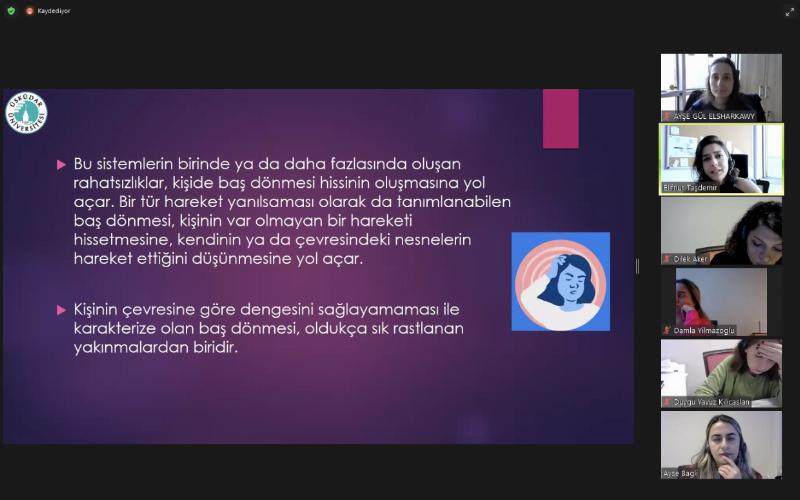
In the event organized by Üsküdar University Vocational School of Health Services (SHMYO) within the scope of the University Culture course, the topic of “Vertigo” was discussed. The moderation of the event, which was held via the Zoom platform, was carried out by Lecturer Elifnur Taşdemir from the Audiometry Department of Üsküdar University Vocational School of Health Services.
Content
Is Vertigo a Disease?

In the event organized by SHMYO within the scope of the University Culture course, the topic of “Vertigo” attracted the interest of students.
Lecturer Elifnur Taşdemir from the Audiometry Department of Üsküdar University Vocational School of Health Services, who participated in the online event, stated; “Vertigo can be described as dizziness, the environment spinning, the ground sliding from under one's feet, blurred vision, a feeling of being in a void, or being pulled to one side. Dizziness, which can arise from many different causes, leads to a decrease in one's quality of life. For recurrent, prolonged, sudden-onset, and severe cases of dizziness, a healthcare institution must be consulted.”
Is Vertigo a Disease?
Taşdemir, pointing out that Vertigo, known as a disease among the public, is actually a symptom, said, “Vertigo is a condition described by the patient as the environment spinning or themselves spinning, and this condition is an illusion of movement. Therefore, after listening to the history of a patient presenting with dizziness, necessary examinations are performed and the findings are evaluated. In this process, a multidisciplinary approach is generally adopted. ENT specialists, neurologists, psychiatrists, internal medicine specialists, and specialist physicians in other fields, as well as healthcare personnel such as audiologists, and physical therapy and rehabilitation specialists, are involved.”
“Some types of dizziness may resolve without intervention”
Lecturer Elifnur Taşdemir; “Mostly, treatment is applied towards healing the underlying disease causing the dizziness. She stated that the complaint of dizziness can be relieved by bringing blood values to normal levels, treating infections, or, if BPPV is present, with the necessary maneuvers.”
The event concluded after participants' questions were answered.
Share
Update Date: February 26, 2026
Creation Date: November 17, 2022