

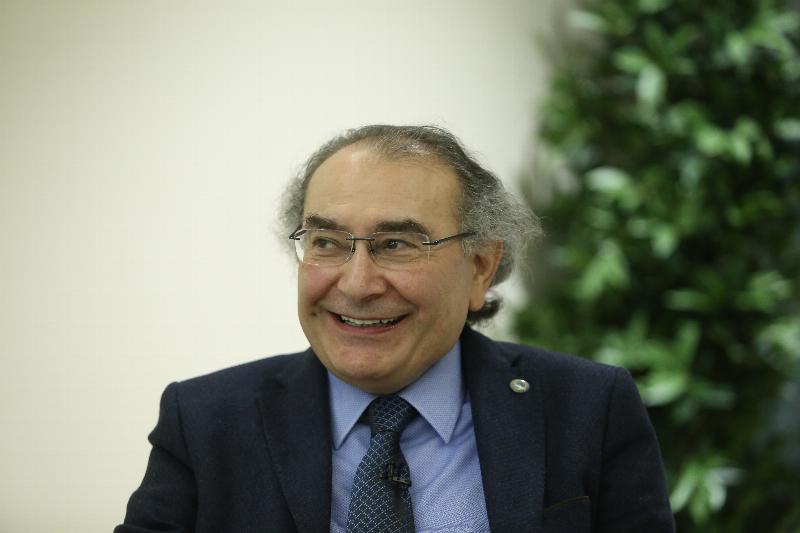
Psychiatrist Prof. Dr. Nevzat Tarhan, Founding Rector of Üsküdar Üniversitesi, addressed the topic of “Mind and Memory” in an article this week in his Hürriyet Aile column.
Content
Is a brilliant mind and memory possible at 100 years old?
While the improvement of living conditions and the development of disease treatment methods extend human life, the incidence of diseases such as Alzheimer's that emerge in old age has also increased. Our brain, just like our other organs, ages, but with proper care, it may be possible to slow down brain aging. A person who uses their brain correctly will have a brilliant memory and mind even at 100 years old. Early precautions regarding forgetfulness are important. Only 5-10 percent of forgetfulness in Alzheimer's is genetic. The rest is entirely related to misusing the brain.
In daily life, we often encounter people, especially those living in cities, complaining about forgetfulness. Forgetfulness is common. However, it is necessary to examine whether these types of forgetfulness are benign or malignant.
When we talk about benign forgetfulness, we mean simple forgetfulness, which we also call innocent forgetfulness. You open the refrigerator. You think, 'What was I going to get?' You pick up your phone and say, 'Who was I going to call?' and then you remember. Such forgetfulness can occur. These are simple forgetfulness.
Care should be taken with forgetfulness over the age of 60
The other type is malignant forgetfulness, which we refer to as malevolent forgetfulness. These two types of forgetfulness are often confused. It is especially important to be careful and make good observations regarding forgetfulness in individuals over the age of 60. When forgetfulness begins over 60, people often say, 'This much forgetfulness is normal,' and the risk of Alzheimer's is overlooked. Since the first symptoms of Alzheimer's and dementia are forgetfulness, it is necessary to pay attention to this. We should not dismiss it as just simple forgetfulness in our brain.
Alzheimer risk rises to 50% over the age of 85
The average human lifespan has extended in the world and in our country. Globally and in Turkey, there is an average age of 78 for women and 74-76 for men. This average has even increased to 80-90. For instance, if a person reaches 60-65 years of age and starts experiencing forgetfulness, and dismisses it as 'this much forgetfulness is normal' without taking precautions, it can later be understood that the cause of this forgetfulness is Alzheimer's. A person can spend the last 10 years of their life with Alzheimer's because the probability of Alzheimer's in individuals over 85 years old increases to 35-50 percent.
In Alzheimer's, the brain cannot form new memories
In Alzheimer's disease, the brain cannot form new memories. Alzheimer's patients remember and recount old events very well but cannot recall new things; they forget them. This is a typical characteristic of Alzheimer's. We call this retrograde amnesia. When Alzheimer's is very advanced, a person may forget their spouse but not their parents. This is because things related to childhood remain in the brain. For this reason, in Alzheimer's disease, the brain is unable to make new learnings.
Precautions should be taken regarding forgetfulness
Our brain, just like our skin, ages. A person who uses their brain correctly will have a brilliant memory and mind even at 100 years old. Early precautions regarding forgetfulness are important. Only 5-10 percent of forgetfulness in Alzheimer's is genetic. The rest is entirely related to misusing the brain.
New learnings are needed to keep memory strong
There's a case that emerged in the USA. This is an interesting case that has also entered the literature. A math professor in San Francisco noticed that while he could see 8 moves ahead in chess, this ability had dropped to 5. He then went to a neurologist. The neurologist performed tests. Everything came back normal on all scales. His intelligence test results were within the normal database for his age group. Later, he had a brain check-up. The definitive diagnosis was made based on plaques in the brain. It was determined that he had numerous plaques in his brain, but he had no memory loss. Subsequent research revealed this: He used his brain so well that, despite having amyloid plaques in his brain, the brain found a way, and with new learnings, the person's memory never weakened.
A brain open to new experiences works
At one time, it was believed that the number of brain cells was constant and that these cells died as one aged. This was discovered in 1998. Brain cells do not die. There is a hippocampus region in the brain. This area, located in the center of the brain and responsible for memory formation, produces stem cells. If a person uses their brain actively, meaning they are open to new experiences, the brain operates on a 'use it or lose it' principle. As it is used, the brain opens up, and as it opens up, it produces new cells from stem cells. Those cells migrate, going wherever the brain area being used is. They form networks there. They create a network there. The person's brain functions brilliantly. Memory does not weaken despite plaque formation in the brain.
Our brain resembles a well
If a person is open to new learnings, their brain works continuously. Because the brain constantly learns new things, it always uses its layers actively. The brain operates on a 'use it or lose it' principle. For this reason, it resembles a well. Just as a well opens up as water is drawn from it, our brain is an organ that opens up as it is used.
It is necessary to live brain-friendly
The importance of lifestyle for a healthy mind and memory is immense. Nutrition is important, lifestyle is important, and having a guide on how to use our brain is important. If we are using our brain correctly, we should not confuse simple forgetfulness with illness and panic. A brain-friendly life is important for brain health. Brain-friendly nutrition and brain-friendly habits are important.
Our brain has an automatic learning feature
Our brain has an automatic learning feature. This is often encountered in daily life. A person driving a car will follow a familiar route by rote. They have been there many times before; the brain performs automatic learning. When thought and emotion are added, it becomes a belief. When repeated, it becomes a habit. When repeated for 6 months, it becomes a part of one's personality. That's why repetitions are very important. When you repeat something wrong, it also becomes a habit. Therefore, in old age, the biggest mistakes people make are habit traps; habits are mental traps.
Being able to use the brain is the most important step in preventing forgetfulness
The brain needs to be kept constantly dynamic. The brains of people who are open to new experiences are always functioning brilliantly. We put them in an MRI machine. Every part of their brain is active in every respect. It's even likened to this: Imagine a valley; in summer, if there's an unsprinkled area in the valley, it's completely yellow, but if an area is cared for and watered, it's a lush green area with trees, flowers, and birds. It's the same in the human brain. Well-maintained areas in the brain are active, vibrant, and dynamic. This is related to usage. Unused areas dry up like a parched valley. Therefore, what is important here is to see the big picture and use the brain skillfully and wisely. Being able to use the brain is the most important step in preventing forgetfulness; it is the greatest solution against brain aging.
It is important to use our brain intensively in daily life activities. More important than solving puzzles and Sudoku, for example, is to suggest taking different routes instead of the same one every day. In other words, instead of always continuing the same habits, it can be advisable to frequently change habits and positions.
Share
Update Date: February 28, 2026
Creation Date: March 15, 2022
Request a Call
Other News
- Prof. Nevzat Tarhan: “Those with a mental filter are not afraid of the digital”
- Artificial intelligence doesn't eliminate the translator, it transforms their expertise!
- Social responsibility courses moved to the field
- Erasmus+ Orientation Week completed at Üsküdar
- Prof. Nevzat Tarhan: “Brain secretes ‘dark glue’ in social media lynchers!”