


The Department of Software Engineering at the Faculty of Engineering and Natural Sciences of Üsküdar University offers graduates a strong foundation for a successful career.The Department of Software Engineering at the Faculty of Engineering and Natural Sciences of Üsküdar University offers graduates a strong foundation for a successful career.
The Department of Software Engineering at the Faculty of Engineering and Natural Sciences adopts a contemporary educational approach that integrates the fundamental principles of software engineering with artificial intelligence technologies. The undergraduate program, delivered entirely in English, prepares students for the future of software technologies through its distinguished academic staff, practice-oriented curriculum, and interdisciplinary perspective.
Our program approaches software development not only from the perspective of programming but also through the lenses of artificial intelligence, data science, and intelligent systems. It aims to equip students with the knowledge and skills required to adapt to today's rapidly evolving technology ecosystem.
What Is Software Engineering?
Software Engineering is an engineering discipline that encompasses all processes related to the design, planning, development, production, operation, and maintenance of software systems. Today, AI-based systems play a vital role in every aspect of modern life, from mobile applications and healthcare technologies to e-commerce platforms and smart devices. Consequently, software engineering has become one of the most strategic professions, particularly in the development of AI-powered solutions.
The Software Engineering Program at Üsküdar University is designed to provide students with a strong foundation in mathematics, basic sciences, and engineering principles. Throughout the program, students develop the ability to analyze, model, and solve software-related problems while gaining expertise in analytical thinking, algorithm design, and system development.
The primary objective of the program is to educate software engineers who possess the technical knowledge required for modern software engineering practices, understand and develop AI-powered systems, and collaborate effectively across interdisciplinary teams.
Opportunities Offered to Software Engineering Students
Throughout their education, Software Engineering students benefit from numerous opportunities that support both their academic and personal development, including:
- Scholarships at various funding levels
- Erasmus+ student exchange and internship programs
- Double Major and Minor programs
- Project-based learning model
- Opportunities to participate in academic research projects
- Entrepreneurship support through the BrainPark Incubation Center
- Active participation in technology and software-oriented student clubs
- Industry collaborations and internship opportunities through the Career Center
These opportunities enable students to gain professional experience before graduation and begin shaping their career paths at an early stage.
Laboratory Facilities of the Department of Software Engineering
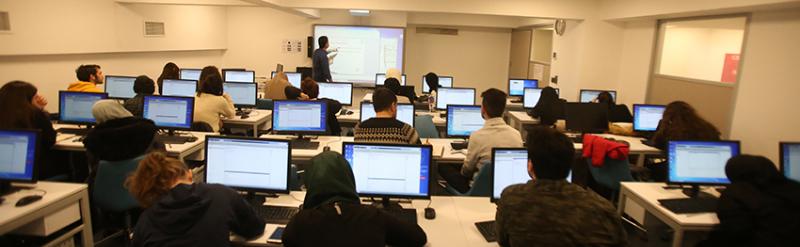
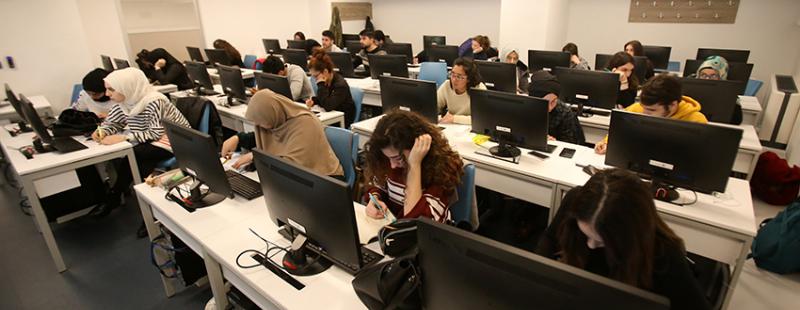
Students of the Department of Software Engineering actively benefit from modern computer laboratories to reinforce the theoretical knowledge they acquire in their courses through practical applications. The approximately 70 m² computer laboratory located on the Main Campus is equipped with high-performance computers, a smart board system, up-to-date network infrastructure, and high-speed Internet access. The laboratories are also available to students outside class hours, providing an appropriate environment for individual study, project development, and research activities. Through laboratory applications, students receive hands-on training in software development, algorithm design, data structures, object-oriented programming, database management, web and mobile application development, artificial intelligence, data mining, computer networks, and modeling and simulation.
Throughout their education, students utilize up-to-date software development and analysis tools that are widely used in industry. Laboratory computers are equipped with software including Visual Studio 2022, Visual Studio Code, PyCharm Professional, Eclipse IDE, Apache NetBeans, Dev-C++, CodeBlocks, MATLAB, Anaconda Navigator, Cisco Packet Tracer, Unity, Unity Hub, IBM SPSS Statistics, WampServer, Apache JMeter, SOLIDWORKS, SOLIDWORKS Visualize, and eDrawings. These software packages enable students to gain practical experience with various programming languages, software development environments, data analysis tools, network simulation platforms, game development platforms, and engineering applications.
The laboratory infrastructure is continuously updated in line with course content and technological advancements. New software and applications deemed necessary for educational, instructional, and research purposes are regularly installed on laboratory computers and made available to students.
Under the supervision of faculty members, students make effective use of the laboratory infrastructure for capstone projects, TÜBİTAK-funded projects, research activities, and graduate-level studies, gaining practical experience in teamwork, software development processes, and project management. In addition, nearly 20 laboratories across the University dedicated to data analytics, artificial intelligence, health informatics, and other interdisciplinary research areas are available to our students. By participating in the research and development projects conducted in these laboratories, students gain valuable experience working collaboratively across different disciplines.
Practical Experience and Applied Learning Opportunities for Software Engineering Students
The educational approach adopted by the Department of Software Engineering is based on a project-oriented model that integrates theoretical knowledge with practical application. Through individual and team-based projects, students gain hands-on experience in every stage of the software development life cycle, including analysis, design, development, testing, and maintenance. In addition, they develop essential professional competencies such as problem-solving, analytical thinking, communication, and teamwork.
As part of the program, students complete compulsory summer internships at the end of their second and third years, providing them with the opportunity to gain professional work experience in organizations and companies operating across various sectors. During these internships, students participate in real-world software development projects, apply their theoretical knowledge in practical settings, become familiar with industry practices and workflows, and strengthen their professional experience. As a result, our graduates enter the workforce with not only a strong academic foundation but also the practical experience necessary to adapt successfully to professional life.
Courses Offered in the Department of Software Engineering
The language of instruction in the program is 100% English. Following the completion of the English Preparatory Program, students undertake a four-year undergraduate curriculum. The curriculum is designed to integrate the fundamental principles of software engineering with emerging and contemporary technologies.
Throughout their studies, students take core courses in programming, object-oriented programming, data structures and algorithms, software requirements analysis, database management systems, operating systems, software project management, computer networks, web and mobile application development, and software testing. In addition to these fundamental subjects, the curriculum includes courses on cutting-edge technologies such as artificial intelligence, machine learning, data science, Large Language Models (LLMs), Prompt Engineering, and digital game development.
By combining theoretical instruction with practical applications, the program enables students to develop a comprehensive understanding of modern software development processes while equipping them with the technical competencies required by today’s software industry.
Career Opportunities for Software Engineering Graduates
Graduates of the Department of Software Engineering have a wide range of career opportunities in public institutions, private sector organizations, technology companies, research and development (R&D) centers, and the entrepreneurial ecosystem. They may pursue careers in various roles, including Software Engineer, Artificial Intelligence Engineer, Data Scientist, Machine Learning Engineer, Data Engineer, Mobile or Web Application Developer, Full-Stack Developer, Systems Analyst, Software Test Engineer, and Information Technology (IT) Specialist.
Our graduates contribute to the development of AI-driven and data-centric software solutions across a wide range of industries, including healthcare, finance, defense, telecommunications, e-commerce, and manufacturing. They also have the opportunity to establish their own technology startups within the entrepreneurial ecosystem or pursue graduate studies and build academic careers.
The strong theoretical foundation, practical experience, and AI-focused competencies gained throughout the program enable our graduates to build competitive careers at both the national and international levels.


